
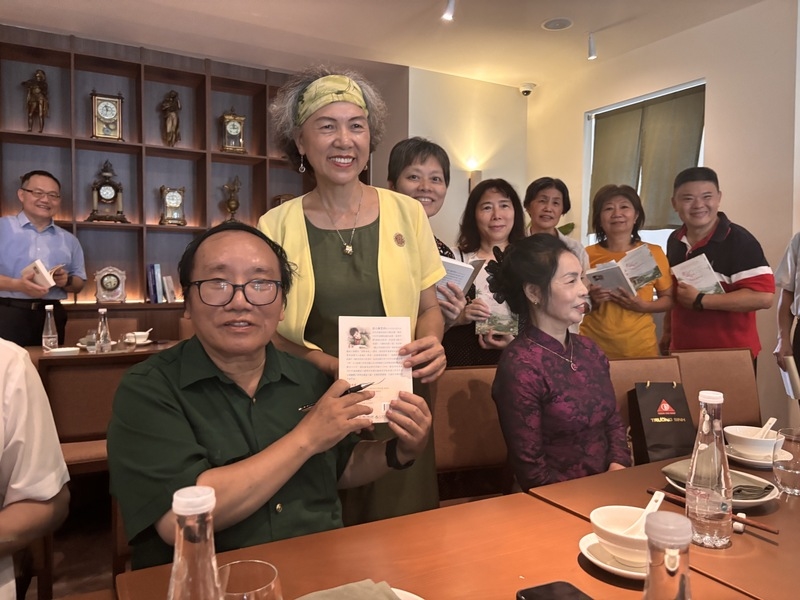
Renowned Vietnamese poet Tran Dang Khoa attended the poetry collection translation presentation at the Vietnam Research Center of Cheng Kung University. He told the Central News Agency that during his third visit to Taiwan, he felt the spirit of love and kindness among the Taiwanese people, and he also saw the souls of his homeland and motherland. He admired the philosophy of life in Taiwan and hoped to continue promoting mutual translation and literary exchanges between Taiwan and Vietnam.
Cheng Kung University’s Vietnam Research Center held the Taiwan-Vietnam collaborative new poetry collection “Spring Breeze Poetically Brushing Mother’s Room” presentation and exchange meeting in Hanoi, the capital of Vietnam, on the 18th. Over forty people from both Taiwan and Vietnam attended the event.
Representatives from organizations such as the Taiwan Pen Club, Taiwan-Vietnam Cultural Association, Taiwan Romanization Association, and Fah Ji Foundation for Taiwanese Language were present. On the Vietnamese side, twenty Vietnamese literary figures, including Vice President of the Writers’ Association Tran Dang Khoa, Nguyen Phong Phu, former director of the Institute of History at the Vietnamese Academy of Social Sciences, Dinh Quang Hai, former director of the Literary Institute at the Academy of Social Sciences, and Nguyen Phuong Chiem, director of the Cultural Institute, also participated in the event.
The original author of “Spring Breeze Poetically Brushing Mother’s Room” is the renowned Vietnamese writer Tran Dang Khoa. The new book was translated into Taiwanese and Mandarin by a team led by Professor Chiang Wei-wen from Cheng Kung University, and published in Vietnamese, Taiwanese, and Mandarin.
Tran Dang Khoa, born in 1958, is a national treasure-level poet and journalist in Vietnam, currently serving as the Vice Chairman of the Vietnam Writers’ Association. He published poetry in newspapers at the age of 8 and released his second poetry collection at the age of 10. His works were translated into European languages through French media and were praised as a “child prodigy of poetry.”
Director Jiang Wei-wen of Cheng Kung University’s Vietnam Research Center analyzed that Tran Dang Khoa’s creative phases can be categorized into three stages. In his childhood phase, he focused on daily life and environmental observations with an innocent and naive tone. After joining the military, he shifted toward social realism, reflecting the voices of oppressed people in Vietnam and other countries. In his later years, he delved into contemplating the meaning of life. His works are characterized by rich imagination, romanticism, sincerity, and a concern for societal welfare.
Tran Dang Khoa’s brother, Tran Run Ming, is also a well-known Vietnamese realistic poet, often offering strong criticisms and profound insights on contemporary social and historical events.
As recipients of Vietnam’s National Literature and Art Awards, the two brothers have been key figures in promoting literary and cultural exchanges between Taiwan and Vietnam in recent years. They led Vietnamese writer delegations to Taiwan to participate in events such as the 314 Taiwan Poetry Festival and Taiwan-Vietnam literary exchange activities.
In an exclusive interview with the Central News Agency, Tran Dang Khoa expressed his feelings toward Taiwan, stating his joy at visiting Taiwan for the third time. He mentioned how his impressions of Taiwan were completely overturned, realizing the beauty of the country and, more importantly, the Taiwanese people’s affection and philosophy of life which deeply impressed him. He specifically admired the Taiwanese people’s kindness and care for others.
He shared that his brother had written a poem about Taiwan, where he described how if there was a rough road, a sign would be placed nearby to alert others. Tran Dang Khoa and his brother both felt moved by the spirit of love and kindness prevalent in Taiwan. Tran Dang Khoa’s works often depict love for his homeland and land, resonating deeply with Taiwanese poets. He expressed his hope for more translations of Vietnamese works into Taiwanese and vice versa, enabling people from both countries to appreciate each other’s creations and love for their nations.
This Taiwan-Vietnam collaborative new poetry collection not only introduces Vietnamese readers to the works of Tran Dang Khoa, a national treasure poet of Vietnam but also serves as a bilingual teaching material for Taiwanese to learn Vietnamese and for Vietnamese to learn Taiwanese and Mandarin.
Regarding this book, Tran Dang Khoa expressed, “My poetry has been translated into over forty languages, which makes me very grateful. However, the version just published in Taiwan touched me the most because it is beautifully done and translated excellently, bringing me closer to Taiwan, which is what I appreciate the most. I hope to host Taiwanese poets in Vietnam in the future, playing a significant role in fostering cultural exchange.”
He hoped that both governments would actively reduce barriers between their peoples, including simplifying administrative procedures for cross-border artist exchanges. He looked forward to both countries organizing creative or writing camps, allowing poets and writers from both nations to freely create and communicate, embracing each other’s cultural values.
Jiang Wei-wen pointed out that there are numerous similarities and differences between the literature of Taiwan and Vietnam, worth comparing, discussing, and promoting. Historically, both Taiwan and Vietnam have experienced colonial rule, especially under the oppression of the Chinese (Communist) empire, which would deeply resonate with modern Taiwanese readers.
He informed the Central News Agency that the Vietnam Research Center generally publishes a book related to Vietnam every year, covering areas such as literature, historical culture, or language teaching. This year’s focus is on Tran Dang Khoa’s poetry collection. They are also planning to translate a Taiwanese poetry collection into Vietnamese for publication in Vietnam, aiming to let readers from both sides see the “real-life experiences of contemporary locals.”
Specializing in Vietnamese studies and comparative studies between Taiwan and Vietnam, Jiang Wei-wen is dedicated to promoting Taiwan-Vietnam exchanges. He believed that this cultural and citizen diplomacy was an area where grassroots efforts could make a difference, and his expertise aligned perfectly with these efforts. Citizen diplomacy is currently something Taiwan can actively engage in without much hindrance.
来源: 中央社