
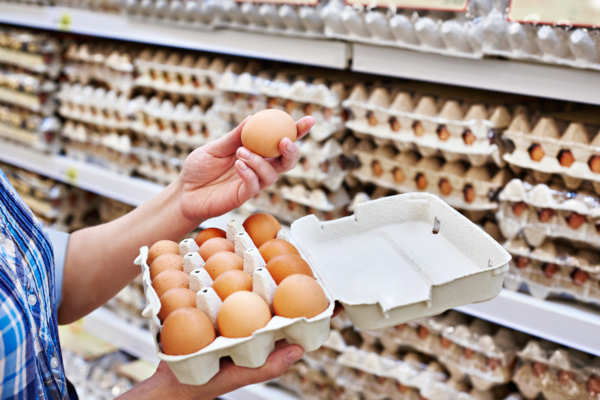
On the eve of the Dragon Boat Festival, egg prices in mainland China suddenly surged by nearly 80%. As of early June, retail prices of eggs across the country soared to a record high, reaching 5 yuan (RMB) per catty, with some areas hitting 6 yuan per catty. Although there have been slight decreases in some regions in the past two to three days, prices are still fluctuating at a high level. Chinese farmers have revealed the reasons behind the increase in egg prices.
According to reports by Chinese media, since early May, the average price of eggs in major production areas has been steadily increasing, rising for five consecutive weeks to around 3.80 yuan per catty. By the afternoon of June 5th, the wholesale market price for eggs nationwide was 10.56 yuan per kilogram. Currently, egg prices have risen nearly 80% compared to the same period last year. Despite minor fluctuations in the past two days, prices remain high, with some regions experiencing further increases.
Many farmers have stated that the recent surge in egg prices, just before the Dragon Boat Festival, is due to various reasons. While the stockpiling by major retailers plays a role, the primary reason is the substantial losses suffered by farmers last year, leading to a significant decrease in the number of egg-laying hens and egg production, resulting in a market situation of “low supply, high prices”.
Farmer Xu Yan told a reporter that the current rise in egg prices has been rapid but may not fall as quickly, explaining that “there is low production capacity, high demand, and a shortage of eggs in the market, which is why prices have increased”.
Farmer Li Cheng also commented, “The high egg prices now are because there are fewer chicken farmers.”
According to Li Cheng, in the fourth quarter of 2025 alone, approximately 30% of free-range chicken farmers left the industry. “Those who could sell chickens did so, and many farms were completely cleared out. Every day of extra farming meant more losses; the whole of 2025 was a year of losses.”
“Because farmers lost so much in 2025, they are now afraid and more cautious when restocking. The selling of chickens has reduced and the egg-laying hen inventory has naturally decreased,” Li Cheng explained. Farmers also worry that if they restock on a large scale now, will they still lose money by 2027?
In addition to the aforementioned reasons, the increase in feed costs is also a contributing factor to the rise in egg prices.
Li Cheng pointed out that recently, the prices of corn and soybean meal have remained high. In addition to feed, other costs such as land, water and electricity, labor management, and disease prevention also add up, making the cost of producing a catty of eggs around 3.5 to 3.7 yuan. However, farmers have been operating at a loss in 2025 and the first quarter of 2026.
Farmer Qi Xin analyzed that following the current surge in egg prices, it may accelerate capital inflows. Some farmers may face even greater challenges as they lack any competitive advantage compared to large-scale enterprises.
Regarding the future trends of egg prices, many farmers believe that prices will continue to fluctuate at high levels for some time, with a likelihood of further increases and without significant drops.