
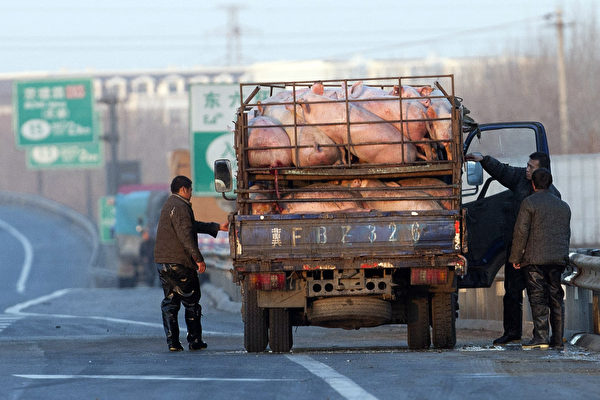
China’s three major listed pig enterprises, Muyuan Group, New Hope Group, and Wens Foodstuff Group, saw a significant year-on-year decrease in revenue in May, attributing it to weak market demand. Some analysts believe that in the current environment of supply-demand imbalance, there is insufficient driving force for pig price increases.
In recent days, the three major pig companies—Muyuan Group (Muyuan Food Group Co., Ltd.), New Hope (New Hope Liuhe Co., Ltd.), and Wens Foodstuff Group (Wens Foodstuff Group Co., Ltd.) have released their sales briefings for May this year.
Muyuan Group’s “May 2026 Sales Briefing” released on June 6 showed that “In May 2026, the company sold 6.883 million pigs, a 7.43% change compared to the same period last year; the average selling price of pigs was 9.80 yuan/kg, a -32.51% change year-on-year; and the sales revenue of pigs was 8.565 billion yuan, a -30.13% change year-on-year.”
New Hope’s “May 2026 Sales Situation Briefing” on June 9 reported, “In May 2026, the company sold 1.2334 million pigs, a 1.94% change month-on-month and a 23.98% change year-on-year. The sales revenue of pigs was 1.386 billion yuan, a 5.68% change month-on-month and a -20.10% change year-on-year. The average selling price of pigs was 9.48 yuan/kg, a 3.61% change month-on-month and a -35.02% change year-on-year.”
Wens Foodstuff Group’s “May 2026 Main Product Sales Briefing” indicated, “In May 2026, the company sold 2.6527 million pigs (including live pigs and fresh products), generating revenue of 3.24 billion yuan. The average selling price of live pigs was 9.70 yuan/kg, with month-on-month changes of -18.15%, -16.06%, and 4.64%, and year-on-year changes of -15.93%, -39.13%, and -33.92%.”
Data shows that among the three major pig companies, Muyuan Group and New Hope Group experienced a month-on-month increase in pig sales revenue, while Wens Foodstuff Group saw a decrease. Year-on-year, all three companies experienced a decline in pig product sales revenue.
Regarding average selling prices, all three listed pig companies saw an increase in average selling prices month-on-month but a decrease year-on-year, with declines exceeding 30%. For instance, in May, Muyuan Group’s average selling price for pigs was 9.80 yuan/kg, a 32.51% drop year-on-year; Wens Foodstuff Group’s average selling price for live pigs was 9.70 yuan/kg, a 33.92% decline year-on-year; and New Hope’s average selling price for pigs was 9.48 yuan/kg, a 35.02% decrease year-on-year.
Despite the downturn in sales revenue, Muyuan Group and New Hope Group saw a year-on-year increase in sales volume, while Wens Foodstuff Group experienced a year-on-year decline.
In response to the revenue decline in May, Muyuan Group stated, “It is primarily affected by the fluctuation of the live pig market.” New Hope Group believed, “The significant year-on-year change is due to market oversupply.” Wens Foodstuff Group pointed out that, “In May 2026, the company’s pork revenue declined year-on-year primarily due to decreases in live pig sales volume and average selling price.” They also mentioned, “The year-on-year decline in the average selling price of live pigs is mainly affected by changes in the domestic live pig market.”
China’s live pig market has been hovering at low levels for the past two years, with one of the main reasons being inadequate market demand, and this market downturn is expected to persist. According to analysts at Vision Futures, it is still too early for pig prices to reverse, as terminal demand is mediocre, and the driving force for pig price increases is currently insufficient, with the need for further digestion of existing inventory before any positive rebound.
China International Securities believes that oversupply combined with a decline in medium- to long-term demand has contributed to a larger-than-expected drop in pig prices during this period. Based on the number of pigs in inventory, pork supply is expected to remain ample in the second quarter, with an effective marginal decline in supply possible from the third quarter onwards. However, given the improvements in breeding efficiency and higher pig weights, price flexibility may be limited.
According to data from the National Bureau of Statistics of China, in early April, the price of live pigs (lean pork) was 9.1 yuan/kg, marking at least a 12-year low in prices.
In economic data, year-on-year figures are generally preferred and widely used due to their ability to eliminate seasonal fluctuations and more accurately reflect the long-term trends in the economy.