
At the beginning of 2025, just after the abduction and silencing of Li Yixue in Jiangxi by the authorities, while public attention was still escalating, a mysterious student falling from a building incident occurred in Pucheng County, Shaanxi, triggering large-scale protests and clashes between the public and the police. Pucheng County, where the incident took place, borders Fuping County, the hometown of Xi Jinping, and both are under the jurisdiction of Weinan City. This further attracted attention to the development of the situation and how the Shaanxi authorities would respond to this crisis.
On January 2, a senior high school student from the Vocational Education Center in Pucheng County fell to their death in a mysterious incident. Three days later on January 5, the Joint Investigation Team of Pucheng County reported that a student at the new campus of the Vocational Education Center fell to their death. The deceased student, identified as Dang, a student from Class 7 of Grade 3, was found outside the window in the early hours of January 2. The official report stated that after an altercation with other students who had disturbed his sleep on the night of January 1, Dang went back to his dormitory to sleep following intervention by a teacher. In the early morning, his roommates found that the balcony window was open and the metal screen was removed, leading to Dang’s fall from the window. The official investigation concluded that it was a case of falling from a height, ruling out criminal involvement.
However, multiple posts shared by the deceased student’s mother on social media revealed a different narrative. On the afternoon of December 29, 2024, her son, Dang, went to school in high spirits. In the early hours of January 2, she received a phone call from the homeroom teacher, informing her of an emergency at school and asking her to come. Upon arriving at the school, she couldn’t find her son, and when she asked his classmates about his whereabouts, they panicked and ran away. The mother was later detained by the school until 7 a.m., at which point a deputy from the local police station informed her that her son had jumped off the building. She was then controlled again until 4 p.m. when she was taken to the funeral home and saw her son’s body with no visible injuries on his face or head but numerous bruises around his neck. The mother requested to check for injuries on her son’s body, but over ten teachers prevented her and did not allow photos to be taken. She stated that all students with information had their phones and smartwatches confiscated and all photos on the phones were deleted.
Furthermore, despite the family’s demands to view surveillance footage, the school claimed that the surveillance system was damaged. The conflicting accounts between the official report and the school’s statement raised suspicions of a deliberate cover-up by the school and authorities.
The incident surrounding Dang raised several doubts, with the handling of the case drawing public scrutiny. The mother’s restriction and information lock, the lack of evidence linking the student conflict to the fall, the dismantling of the security window, and the hasty dismissal of criminal involvement were all subjects of concern.
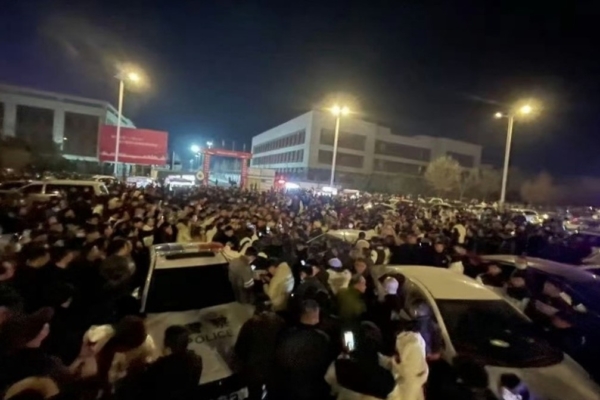
The family’s plea for answers and transparency led to a public outcry, with thousands gathering at the school gates. However, live broadcasting channels were promptly shut down, restricting the dissemination of information. Subsequent clashes between law enforcement and demonstrators escalated the situation, leading to a large-scale group event.
According to information provided by a local student, Fang Ming (alias), the night of January 5 saw around 30,000 people gathering at the school gate, with over a hundred police officers present. Despite an initially peaceful gathering, tensions rose on the following morning with clashes intensifying. Protesters broke open the school gate on the morning of January 6, leading to altercations where two deputy principals were hospitalized after being assaulted. The crowd then stormed the school premises, damaging the cafeteria and various facilities. Law enforcement officers were targeted, with one officer hospitalized after being taken away by emergency services.
Fang Ming mentioned the escalating conflict between protesters and police officers, with a series of violent confrontations unfolding, depicting a chaotic scene with injuries sustained by both students and law enforcement officers.
The incident in Pucheng mirrors past cases of abnormal deaths involving school students and has prompted nationwide attention due to government attempts to suppress the truth. The societal unrest indicates a shift towards a period of heightened civic discontent, with events like the Pucheng incident likely setting the stage for future similar incidents and escalating tensions between authorities and the public.
The latter half of 2024 marked the emergence of an era in China where violent responses to injustices became increasingly prevalent, with a surge in collective violent events throughout the country.
In December, a series of incidents unfolded across various regions, with escalating conflicts between authorities and citizens demanding accountability. These events indicate growing social and economic challenges leading to widespread dissatisfaction and protest.
Addressing worker payment issues, public health concerns, and government transparency will likely be key focal points driving future social conflicts and public unrest in China. Authorities will face mounting pressure as bottom-up anger reaches a boiling point, underscoring a precarious period of uncertainty and instability in Chinese society.
As 2025 unfolds, the Chinese society finds itself at a critical juncture, with high levels of distrust towards institutions and growing resentment towards perceived injustices. The protests and clashes witnessed in Pucheng represent the first major instance of conflict between the government and the public, hinting at broader implications for the stability of the region and potentially signaling a turbulent year ahead.