
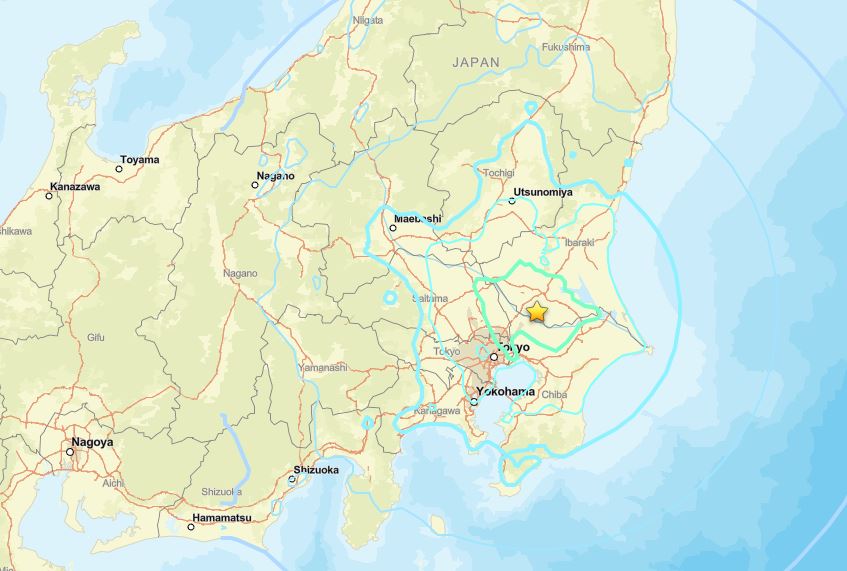
Recent frequent earthquakes have been occurring around the world. In the early morning of Sunday (August 23), an earthquake struck eastern Japan, including the Tokyo area, injuring more than 30 people. Fortunately, this earthquake did not pose a risk of triggering a tsunami.
According to the Japan Meteorological Agency, the preliminary magnitude of this earthquake was recorded as 5.9, with its epicenter located in the southern part of Ibaraki Prefecture and a depth of 70 kilometers (approximately 43.5 miles). The United States Geological Survey measured the magnitude at 5.8.
Officials and fire and disaster management agencies across Japan reported that at least 37 people were injured in the region: 15 in Tokyo, 9 in Saitama Prefecture, 8 in Kanagawa Prefecture, 4 in Chiba Prefecture, and 1 in Ibaraki Prefecture.
Local officials stated that most of the injuries occurred as people were caught by surprise while sleeping during the earthquake, causing them to fall or bump into furniture and doors, resulting in injuries. One report from the Yomiuri Shimbun mentioned an elderly woman in her 80s from Yokohama City in Kanagawa Prefecture who suffered severe hip injuries after falling from her bed.
A 23-year-old man told the Asahi Shimbun that he was shopping in the Taito Ward of eastern Tokyo when his mobile phone earthquake alert went off, and a few seconds later, he felt the vertical shaking. He expressed concern about being hit by falling items from shelves as the building swayed.
The earthquake led to delays in express trains travelling between Tokyo and Narita Airport, as well as other regional trains serving the Tohoku region. However, East Japan Railway Company (JR East) stated that the Shinkansen bullet train services were running as usual.
Prime Minister Sanae Takaichi announced on the social platform X that the government had set up a special task force to assess the potential extent of damage.
The Japan Meteorological Agency cautioned local residents to remain vigilant for another moderate earthquake that could occur within the next week.
This earthquake triggered mobile phone emergency earthquake alerts, and the Tokyo area felt the tremors strongly. Television footage from the Japan Broadcasting Corporation (NHK) showed that surrounding cities including Mito and Saitama appeared to have normal traffic flow. NHK footage also showed that a water pipe in the Koto Ward of eastern Tokyo had burst, causing water to flow onto the road. The pipe has since been repaired, and the leakage has stopped.
The Japan Nuclear Regulation Authority stated that various nuclear facilities, including more than a dozen nuclear power plants, reported no abnormal situations.
Last month, a magnitude 7.1 earthquake struck the Kumamoto region, the southernmost part of Japan’s Kyushu Island, resulting in 38 fatalities and 364 injuries.
On Thursday (August 20), Peru experienced a strong 6.7-magnitude earthquake. Due to its deeper focus, this earthquake did not cause significant casualties or property damage. However, residents in multiple areas felt noticeable shaking.