
Recently, a case has sparked outrage among many British people. 18-year-old university freshman Henry Nowak was stabbed to death by a Sikh man named Vickrum Digwa in Southampton. When the police arrived at the scene, they believed Digwa’s lies and instead arrested the critically injured Henry. That night, Henry passed away at the hospital.
This incident occurred on December 3, 2025, initially not garnering much attention, with mainstream media treating it as a routine local nighttime stabbing incident and providing minimal coverage.
However, the sentencing of the murderer Digwa to life in prison, with a minimum term of 21 years, on May 28 this year, sparked nationwide attention in the UK. Especially after the court released the footage from the police body-worn cameras, depicting a highly impactful scene, it triggered widespread controversy and public outrage.
The footage from the body-worn cameras showed that upon the arrival of a male and a female police officer at the scene, Henry was already sitting on the ground due to exhaustion, telling the police, “I can’t breathe.”
The male officer asked for Henry’s name, but his voice was very weak, possibly mistaken for being drunk. He then asked if anyone else was injured besides Henry.
At this moment, the villain Digwa falsely claimed that he was injured and accused Henry of grabbing his brother, pulling off his turban, and pulling his hair. When asked if he was injured, he said, “My eyes are swollen and slightly bruised.”
Henry pleaded again, “I’ve been stabbed, I can’t breathe.” It seemed like the police didn’t hear him, as Henry pleaded multiple times but was ignored by the police, who proceeded to handcuff him.
The female officer asked Henry where he was stabbed. Henry was barely able to speak anymore. The female officer briefly opened Henry’s shirt and found no visible wounds.
At this point, Henry, who was gradually losing consciousness, was informed by the police that he was being arrested for “assaulting others,” along with his rights – possibly the last words he heard in his life.
About a minute after being handcuffed, Henry lost consciousness completely, his condition deteriorating rapidly into an unresponsive state. It was only then that the police realized something was wrong, removed the handcuffs to examine his injuries, performed CPR at the scene, and urgently called for an ambulance.
The police promptly arrested Digwa, his brother, and father after confirming they had lied and misled the police.
Unfortunately, by the time the police arrived at the crime scene, Henry had already lost substantial blood in his chest cavity. Pathologists later confirmed in court that due to the severity of his injuries, even if the ambulance had arrived immediately when called by the police, there was no medical intervention that could have saved his life. Henry was pronounced dead at 12:37 AM the next day, approximately an hour after the police arrived at the crime scene.
The autopsy results revealed that Henry’s cause of death was catastrophic internal bleeding.
The assailant Digwa was carrying two knives, one of which was a 21-centimeter-long dagger. The forensic examination confirmed that Henry was stabbed five times in total, with a fatal wound in his chest penetrating 8 centimeters deep, puncturing his lung, and severing a major vein behind the clavicle.
Additionally, he was stabbed twice in the thigh, once in the lower abdomen, and had a laceration on his face.
The forensic report indicated that Henry was wearing a dark-colored shirt, and it was late at night. Moreover, due to the deep internal severing of the vein behind the clavicle, blood did not splatter outward but flowed back into the chest cavity, explaining why the wounds were not immediately visible to the police.
More than 1,200 milliliters of accumulated blood were found in Henry’s chest cavity during the autopsy.
As the case was a serious criminal homicide in December 2025, all primary evidence at the police scene, especially the body-worn camera footage, was sealed as core judicial evidence directly.
At the time, the family only knew that Henry was stabbed in an inter-ethnic conflict, ultimately leading to his unfortunate death.
During the court hearing of the case, when the on-site video footage was publicly played as prosecution evidence, Henry’s parents witnessed for the first time, firsthand, the last few minutes of their son’s life, where he was spitting blood, pleading nine times, “I can’t breathe,” yet was treated as a criminal by the police, being handcuffed.
Henry’s father, Mark Nowak, condemned the inhuman and insulting treatment of Henry by the police, stating, “Henry should not have died on the streets of Southampton under police custody.”
Outside the court, he told the media, “Henry told the police he couldn’t breathe, said it nine times… He was dragged on the stony ground, forcibly handcuffed… My son died with no dignity. He did not receive the treatment and care he deserved. Before anyone chose to believe him, he had already lost consciousness.”
In contrast, the perpetrator Digwa “received dignified treatment” and “as far as we know, Digwa was never handcuffed throughout.”
From the police-released footage of the scene, Digwa’s family appeared at the scene, providing false testimonies, deceiving the police.
Although the location of the incident was not at Digwa’s doorstep, it was very close to his home. After stabbing Henry, Digwa immediately called his family to plan their next steps.
Subsequently, Digwa’s brother made a 999 call to report the incident, claiming that he and his brother were subjected to racial discrimination and violent attack by Henry. During the call, he denied using any weapons at the scene and omitted the fact that Henry had already suffered fatal injuries, severely misleading the emergency call center and the first responders.
Following the murder, Digwa’s 52-year-old mother, Kiran Kaur, concealed the bloodied murder weapon in their house. Kaur was charged with aiding and abetting a crime on May 28 and is currently detained in custody, awaiting sentencing by the authorities.
Digwa’s grandmother, Bimla Kaur, described Digwa as a “problematic young man” in an interview with the Daily Mail, attributing it to the UK. She said, “Vickrum (Digwa’s name) has always been a troubled child, but this is not uncommon for children born in the UK.”
Despite intentionally misleading the police like Digwa, his brother and father were not prosecuted.
Facing public anger, Deputy Chief Constable Robert France of Hampshire Police defended that within three minutes of contact with Henry, the police had already started CPR.
He said, “It’s a complete tragedy. I am sorry that they couldn’t save Henry that night, and I’m also sorry that Henry was handcuffed and declared arrested while losing consciousness. But the forensic pathologists in court made it clear that the police couldn’t have saved Henry that day, no matter what they did. His injuries were too deep and internal, with massive internal bleeding.”
The Independent Office for Police Conduct (IOPC) has initiated an investigation, and a coroner’s inquest involving a jury has been scheduled to officially review whether the police’s use of force during the dragging process led to or accelerated Henry’s internal bleeding, indirectly causing his death.
In fact, there is an explicit policy of “double standards enforcement” within the UK police force. The National Police Chiefs’ Council (NPCC) stated in guidance called the “Anti-Racism Commitment” that “racial fairness” does not mean “equality” or “color blindness”, and that “white people should be treated differently from other ethnic groups.”
This commitment is central to the Police Ethnic Action Plan, bringing considerable political pressure to frontline officers. Many police officers are afraid of being labeled as “systemic racists.”
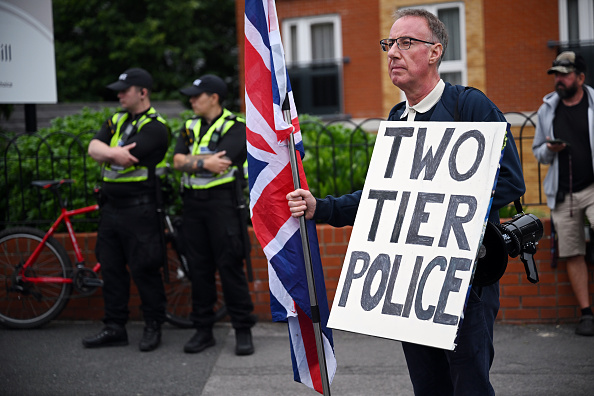
On June 2, protests and riots erupted on the streets of Southampton. Hundreds of protesters gathered outside the local police station, denouncing the way the police handled Henry. People shouted, “Racist police get out of our streets” and “Shame on you.” They carried British flags and homemade signs with messages like “You have Henry’s blood on your hands,” “Save our children,” and “Lock up the cops at the scene.”
The protesters attempted to enter the street where Digwa’s family resided but were prevented by the police. Some protesters threw bottles, beer cans, and trash bins at the police.
Under public pressure, on June 3, government ministers and the Prime Minister’s office stated that the comment about “white people should be treated differently from other ethnic groups” was wrong.
Deputy Commissioner Sarah Jones told GB News, “This is definitely a misstatement. I think that’s wrong and gives a wrong impression.” She emphasized that “everyone is equal before the law” and added, “We must ensure that this is always the case, and I believe that in the vast majority of cases, the response by the police is correct.”
The Prime Minister’s spokesperson said, “The National Police Chiefs’ Council is reviewing the document to ensure there is no ambiguity in its guidance.”
Currently, the Attorney General is reviewing Digwa’s sentencing.
Another contentious issue arising from this case is about carrying knives.
Although possessing knives is illegal in the UK, under Section 139 of the Criminal Justice Act 1988, carrying a knife for reasons related to ethnic dress or religious practices can be considered a legal defense. The Offensive Weapons Act 2019 further protects the rights of Sikhs to possess and supply the “Kirpan” (one of the five articles of faith in Sikhism, a ceremonial dagger).
The legally permitted Kirpan is relatively small and dull. On the tragic night, Digwa not only carried a smaller traditional Kirpan in his clothes but also had the deadly 21-centimeter dagger hanging from a scabbard around his neck.
Digwa often participated in various weapon combat training. He had a collection of ceremonial swords. However, the police later discovered that many of the weapons he owned were actually illegal.
Henry’s father called for urgent law reforms, emphasizing that the law should follow “common sense” and must not allow anyone to carry knives like the one that killed his son openly on the streets of the UK.
Henry’s death has triggered a tsunami of public anger in the UK. Reform Party leader Nigel Farage drew parallels between this case and the death of George Floyd, the black man whose death in the US in 2020 sparked global outrage.
Both men’s dying words were “I can’t breathe,” and they were also handcuffed by the police, losing dignity and facing death, but the political reactions were significantly different.
Farage mentioned that following Floyd’s death due to police violence in the US, the then leader of the UK opposition, Stamer, “took a knee in Parliament, the ‘Black Lives Matter’ movement swept through the UK, vandalizing even Winston Churchill’s statue with graffiti, extensively covered by all media.”
He believed that the reason the UK police chose not to trust the victim Henry after hearing the minority perpetrator’s allegations of “racism,” ignoring his plea of “I can’t breathe,” was due to the influence of the prevalent “anti-racism training” following the Floyd incident in 2020. He indicated that the police “out of fear of being labeled as racists preferred to believe the perpetrator’s lies and ignore the reality in front of them.”
He said, “Now, thousands of Britons see clearly that we are living under ‘double standards enforcement.'”
Farage directly linked this case to “prejudice against white people.” He urged the UK to promote the idea that “white lives matter, and they are just as important as black lives.”
He also expressed concerns that the perpetrator’s sentencing was too light, calling for the Attorney General to review it.
Henry’s case has also attracted attention from across the Atlantic in the United States. The world’s richest man, Musk, posted and reshared several posts related to the case on X and offered to financially support Henry’s family to sue the police privately.
In a post, he stated, “Did you know? Official police policies in the UK require racial discrimination against white people. This is horrendously wrong and must change immediately!”
In response to Musk’s criticism, UK Prime Minister Stamer stated, “Musk is rudely interfering in our country’s politics, attempting to incite division and hatred in our country. In the UK, we are rational and inclusive people… Using a young man’s tragedy to foment rioting is absolutely unforgivable.”
Henry’s family has not publicly indicated a willingness to accept Musk’s assistance. They stated in a press release, “We absolutely do not want Henry’s death to be used to further divide, sow hatred, or create opposition in society. We hope that his story can make everyone walking on the streets safer.”
This tragic incident has left a deep impact in the UK, stirring public outcry and calls for justice and reforms in law enforcement and handling of similar cases.