
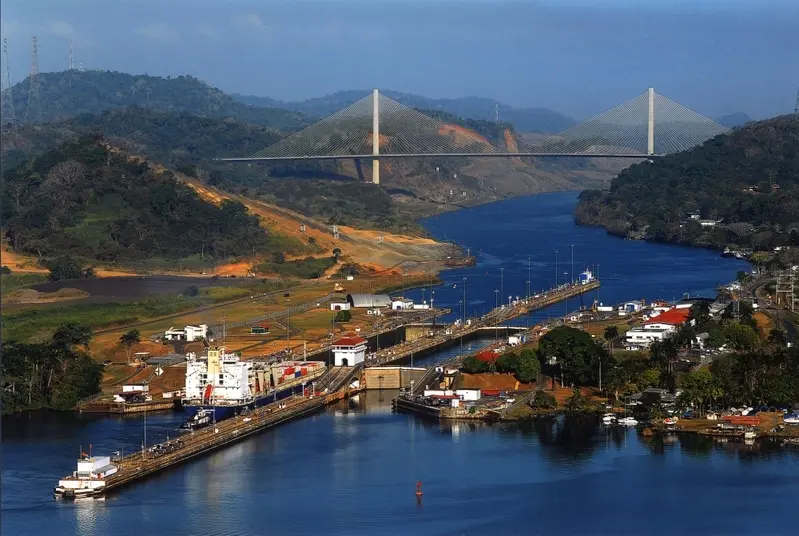
The Panama Canal heavily relies on abundant annual rainfall for its operation. Two years ago, the region experienced the most serious drought in history, forcing ships at the Panama Canal to take several weeks to pass through, sparking a bidding war worth millions of dollars for passage rights.
This year, the El Niño phenomenon has strengthened once again, lasting longer than usual, causing the water level in the canal reservoirs to drop. This is once again threatening the passage of ships through the Panama Canal, with the shipping industry on high alert, preparing for another potential disruption. Some ships have already started to detour around Africa.
This Thursday (August 20), the Panama Canal Authority revoked its earlier commitment to unrestricted passage.
Unlike the Suez Canal in Egypt, the Panama Canal operates with three sets of century-old locks that rely on freshwater to allow ships to navigate the 80-kilometer artificial waterway, connecting the Pacific and Atlantic Oceans. The operation of the canal depends on two artificial lakes: Gatun Lake and Alajuela Lake. When ships pass through, the lakes release millions of gallons of water to raise and lower the ships for passage.
The warming Pacific waters are predicted to reduce the wind patterns that bring rain to Panama, leading to water shortages in the reservoirs. Samuel Muñoz, Associate Professor of Civil and Environmental Engineering at Northeastern University, mentioned that when the reservoir levels drop, the canal authorities must reduce the number of ships passing through to conserve water, leading to interruptions in shipping and potentially impacting the global economy.
Since May of this year, the Smithsonian Tropical Research Institute (STRI) in Panama has recorded some of the highest temperatures since monitoring began. The average monthly temperatures for May, June, and July have reached record highs or come close to them.
The head of the monitoring network, Steven Paton, revealed that rainfall in most parts of Panama has been far below average since May, with some monitoring stations reporting historically low or near-low rainfall levels, especially near the canal.
Starting from September 4, the Panama Canal Authority will limit the daily number of passing ships to 34, decreasing further to 32 from September 15. With the El Niño phenomenon persisting, the water levels are expected to further decline, and the authority may tighten passage restrictions once again.
During the extreme drought of 2023-2024, the daily number of passing ships plummeted to just 22. In the 2026 fiscal year (from October to September of the following year), the average daily number of passing ships through the canal ranges from 34 to 35.
Reports have suggested that a tanker paid over $4 million to obtain priority passage rights. While the Panama Canal Authority did not provide detailed explanations, it acknowledged that some ships recently paid over a million dollars to secure passage rights in auctions to meet specific market demands.
Rohit Rathod, Senior Oil Market Analyst at Vortexa, mentioned that many shipping companies lack long-term berth reservations or sufficient bidding budgets and are therefore opting to detour around Africa. Since August of this year, about half of the liquefied natural gas transport ships destined for Asia have chosen to detour around the Cape of Good Hope, reaching a new high in the past decade.
The cost of detouring around Africa is substantial. For a large liquefied natural gas transport ship sailing from Houston to Japan, the journey through the Panama Canal takes about 26 days, while circumnavigating the Cape of Good Hope extends the journey to 45 days.
Panama is currently considering a long-term solution: building a new reservoir on the Río Indio. The Panama Canal Authority stated that the new reservoir could secure water needs for over half of the population for the next 50 years, ensuring the canal’s normal operation and enhancing living conditions for nearby communities.
However, environmentalists have criticized the need for a new reservoir, suggesting the use of Lake Bayano instead. Previously, environmentalists successfully halted a mining contract by First Quantum in the area.
The Climate Prediction Center of the National Oceanic and Atmospheric Administration (CPCUSNOAA) in the United States released a forecast last week indicating that the El Niño phenomenon is strengthening, with a probability exceeding 90% for a “very strong” El Niño event in the Northern Hemisphere in the fall and winter of 2026-2027.
In a recent research report, Clarkson Securities pointed out that the energy industry is already facing challenges from capacity constraints and increased geopolitical tensions in the Middle East, with the El Niño phenomenon further exacerbating risks.