
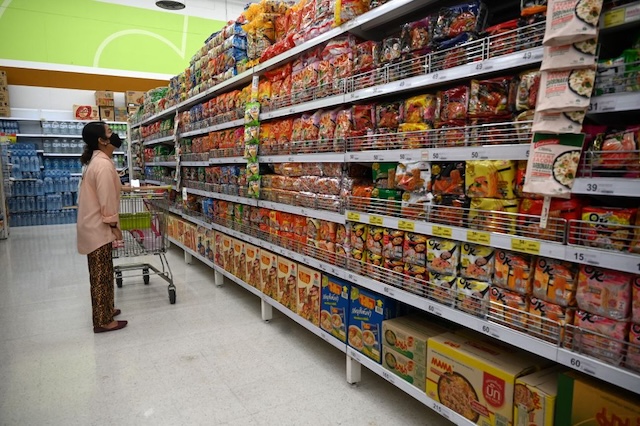
Instant noodles remain one of the most popular convenience foods globally. Data released in August by the World Instant Noodles Association (WINA) revealed that global consumption of instant noodles reached a record high of 12.42 billion packs in 2025, an increase of approximately 904 million packs from around 12.33 billion packs in 2024, with a year-on-year growth of about 0.7%.
According to WINA’s latest global demand data released on August 6th, the annual global demand for instant noodles has been consistently over 1,200 billion packs for many years. This indicates that this affordable, convenient to cook, and easy to store food has become an integral part of global dining culture.
In terms of total consumption, mainland China and Hong Kong remain the largest instant noodle market globally. In 2025, China and Hong Kong collectively consumed 43.268 billion packs, accounting for approximately 34.8% of global demand and ranking first globally. However, there was a decrease of about 1.2% compared to 43.802 billion packs in 2024.
Indonesia ranked second with 14.54 billion packs, followed by India in third place with 9.601 billion packs. India’s consumption increased by about 8.9% from 8.819 billion packs in 2024, making it one of the countries with significant growth among major markets globally.
Vietnam ranked fourth with 8.231 billion packs, and Japan came in fifth with 5.952 billion packs. The United States held the sixth position, consuming about 5.227 billion packs annually. The Philippines, Thailand, and South Korea ranked seventh to ninth, with South Korea consuming approximately 4.061 billion packs.
However, the rankings shift significantly when considering per capita consumption. According to WINA’s data for 2025, Vietnam ranked first globally with an average instant noodle consumption of around 81 packs per person, equivalent to roughly consuming one pack every four days. South Korea followed with about 79 packs per person, and Thailand ranked third with around 60 packs per person.
This indicates that while mainland China and Hong Kong lead in total consumption, Vietnam, South Korea, Thailand, and other Asian countries stand out in terms of per capita consumption.
The history of instant noodles can be traced back to 1958 when Momofuku Ando, the founder of Nissin Foods, developed Chicken Ramen using the oil-frying and dehydration technique. On August 25, 1958, Nissin officially launched “Chicken Ramen,” becoming the world’s first instant noodle product.
With its simplicity in preparation, relatively low cost, and longer shelf life, instant noodles quickly expanded from the Japanese market to the world. WINA noted that global annual consumption of instant noodles now exceeds 1,200 billion packs.
August 25 is also an important day for the instant noodle industry. Nissin Foods refers to this day as “Ramen Anniversary,” commemorating the launch of Chicken Ramen on August 25, 1958. WINA has designated August 25 as WINA DAY, encouraging member companies to respond to societal needs through food aid, community activities, and other social welfare initiatives.
From the first bowl of Chicken Ramen in 1958 to the global consumption surpassing 1,240 billion packs annually today, instant noodles have evolved from a Japanese food innovation into a truly global culinary phenomenon.