
A thin lotus leaf, how much weight can it actually bear?
According to a report from The Chiswick Calendar website, the Royal Botanic Gardens, Kew in London, United Kingdom recently participated in the annual “Waterlily Weigh-Off” competition. A leaf of the Bolivia Giant Water Lily, with a diameter of about 2 meters, successfully supported a gardener along with equipment totaling around 102 kilograms (224.9 pounds).
On August 19th, Kew Gardens announced the test results. Gardener Martin Silnevs, dressed in work gear and waders, carefully stepped onto a large leaf of the Bolivia Giant Water Lily.
Surprisingly, the seemingly soft leaf did not sink into the water but instead securely held him and the equipment, totaling 102 kilograms, on the water surface.
Kew Garden also conducted a different weight-bearing test on another water lily leaf. This time, instead of a person, they stacked cans of baked beans on the leaf. The leaf finally gave way when the weight reached about 81 kilograms (178.5 pounds).
This interesting competition was initiated by the Denver Botanic Gardens in the United States, aiming to compare the weight-bearing capacity of giant water lily leaves from different regions. The “weights” used by participating botanical gardens and zoos were diverse, including adults, canned goods, fitness equipment, bricks, coins, and other items.
The Denver Botanic Gardens stated that this year’s “Waterlily Weigh-Off” took place from August 17th to 28th, with 72 participants expected from 8 countries.
This year’s event also introduced a category for family gardening enthusiasts and nurseries for the first time, and established the “Featherweight” champion, allowing smaller plants to have a chance to compete. The ultimate “Heavyweight Champion” will be announced on August 28th.
This competition started in 2023, where participants must test the weight-bearing capacity of the water lily leaves they cultivate.
The championship records have been continuously broken in recent years: in 2023, the Royal Botanic Garden in Edinburgh won with 48 kilograms; in 2024, the Missouri Botanical Garden set a record with 64.45 kilograms; and in 2025, the Bok Tower Gardens claimed victory with 83 kilograms.
The score of 102 kilograms measured by Kew Gardens this year significantly exceeds the previous championship records. Whether this score can win the championship depends on whether there are leaves elsewhere in the world that can bear more weight.
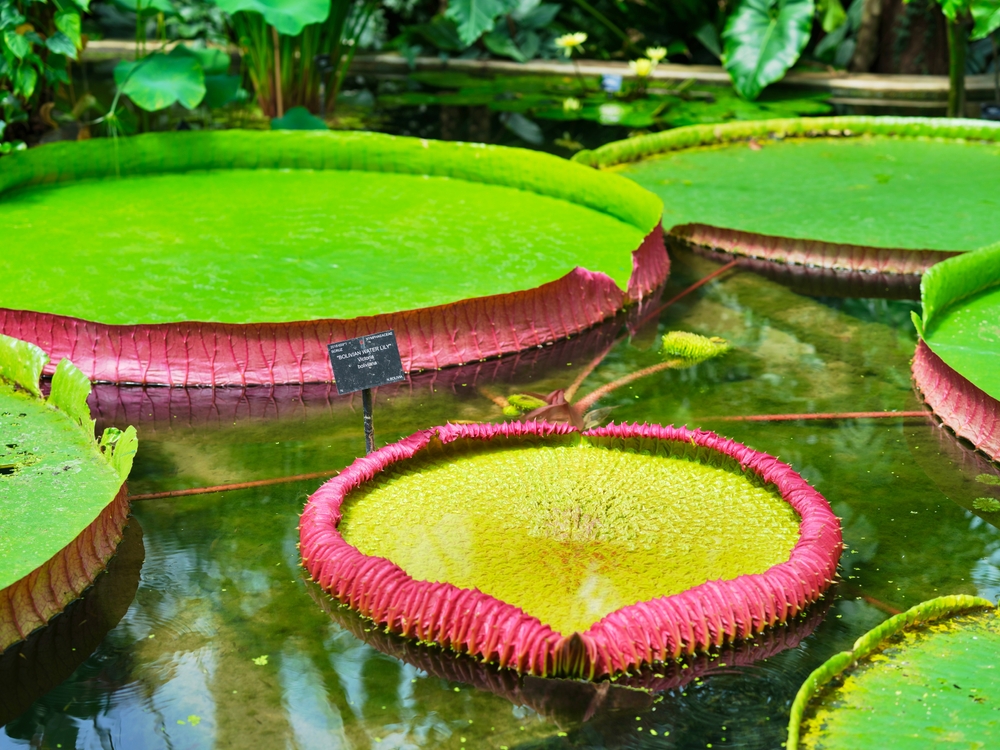
The secret lies in the back of the leaf. According to Kew Gardens, giant water lily leaves have a series of robust and supportive veins at the bottom, forming a complex skeletal structure. These ribs extend from the center of the leaf outward, helping to distribute weight and increase the leaf’s structural strength. Research from the University of Oxford has found that the unique radial and intersecting vein structure at the bottom of the leaf can provide high structural rigidity with less plant material.
In addition, the giant water lily leaves have upturned leaf edges, which help prevent water from flowing onto the leaf surface from the edges; the large leaves float on the water surface, allowing the weight to be distributed over a larger area.
However, despite the remarkable weight-bearing capacity of the water lily leaf, it is not indestructible. If the weight is concentrated in too small an area or exceeds the leaf’s limit, the leaf may still sink or be damaged. Therefore, gardeners usually carefully control the position and distribution of weight during testing.
The Bolivia Giant Water Lily was officially recognized as a separate species in 2022 and is considered the largest known water lily species in the world.
Research from Kew Gardens shows that the diameter of this water lily’s leaf can exceed 3 meters; the largest recorded leaf diameter is 3.2 meters, grown in the La Rinconada Gardens in Bolivia.
In fact, a specimen of the Bolivia Giant Water Lily was mistakenly identified as another water lily species for 177 years in the plant specimen house at Kew Gardens. After historical specimen comparisons, morphological studies, and DNA analysis, scientists from Kew Gardens and researchers from Bolivia finally confirmed it as a new independent species.
Now, this giant water lily not only attracts tourists as the world’s largest water lily but also once again becomes a marvel in the plant world for a leaf that can bear over 100 kilograms of weight.