
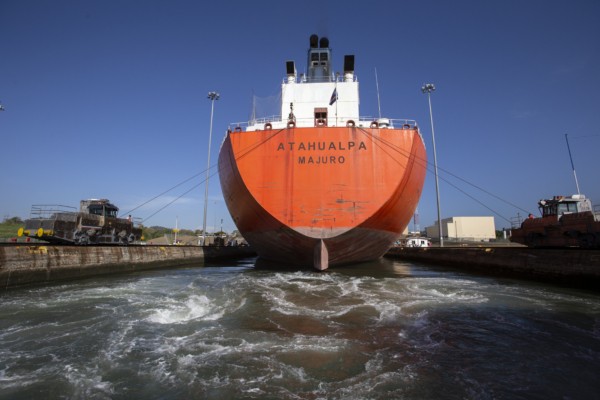
Recently, due to the intensification of the El Niño phenomenon and the impact of insufficient rainfall, the Panama Canal Basin has experienced a sudden 44% decrease in water inflow. Starting from September, authorities will once again limit the number of ships passing through, with a maximum of only 32 ships allowed to pass daily starting from September 15. The global shipping industry is preparing for possible further disruptions.
The Panama Canal Authority announced on Thursday (August 20th) that starting from September 3, the daily passage quota for the new Neopanamax locks will be reduced to 9, and the older Panamax locks will be reduced to 25, totaling 34 ships per day. From September 15, the new Neopanamax locks will be further reduced to 23 slots, bringing the daily total passage capacity down to 32 ships.
Up until June of this year, an average of about 35 ships passed through the Panama Canal daily, with a maximum capacity of approximately 40 ships per day.
The authority had previously indicated in May that there were no plans to restrict ship passages in 2026. However, as the water situation worsened, authorities have adjusted their original plans. Data released by the authority showed that from May to August this year, rainfall in the canal basin was 34% below historical averages, with water inflow levels 44% lower than normal.
Authorities have warned that the El Niño phenomenon from 2026 to 2027 may further reduce rainfall, posing a threat not only to the long-term operation of the canal but also to local water supply.
Connecting the Atlantic and Pacific Oceans, the Panama Canal handles over 3% of global maritime trade. Operation of the locks requires a significant amount of fresh water, and droughts and decreased water levels directly limit ship tonnage and daily passage capacity.
The Panama Canal experienced a historic drought in 2023 to 2024, during which ship reservation quotas were significantly reduced for the first time, and ship drafts were limited. Since then, the authority has continued to implement water-saving measures, but this year’s water situation has once again forced them to tighten passage capacity.
Ricaurte Vasquez, the director of the Panama Canal Authority, stated that this year’s El Niño phenomenon may last longer than previous occurrences. Apart from limiting ship drafts, there is also a need to restrict ship passage volume. In a commercial event on Wednesday, he mentioned, “The experiences of 2023 and 2024 have prepared us adequately for known situations and equipped us with the necessary tactics to deal with unknown situations. The canal will not operate on ad hoc response.”
Due to the decrease in the number of ships passing through the locks daily, the demand for water has significantly decreased, prompting authorities to postpone further tightening measures on ship draft limits. The maximum allowable draft for the new Neopanamax locks has been extended to September 2, adjusting to 14.63 meters (48 feet), and further reduced to 14.48 meters (47.5 feet) by October 1.
According to the Financial Times, global logistics operators have already started preparing for possible further disruptions at the Panama Canal.
The average price for ships passing through the canal in August has risen to around $1.1 million, hitting a new high which is more than 16 times the average cost during the same period last year.
The Financial Times noted that following the outbreak of the US-Iran war in February and the closure of the Strait of Hormuz, the prices for passage through the Panama Canal escalated further, putting pressure on both vital shipping routes simultaneously.
To cope with limited capacity, the Panama Canal Authority will adjust the auction process for daily passage quotas based on four categories of cargo types, prioritizing higher carrying capacity ships in the larger Neopanamax locks. The authority strongly recommends that shipping companies make advance reservations.
The authority stated, “If further operational adjustments are deemed necessary, the Canal will provide customers with the latest information in a timely manner.”
Furthermore, due to weather conditions changing faster than initially anticipated, the authority will make every reasonable effort to announce any future adjustments in advance. The Panama Canal is also a significant source of revenue for the Panamanian government, generating nearly $3 billion in income for the government in the fiscal year of 2025.