
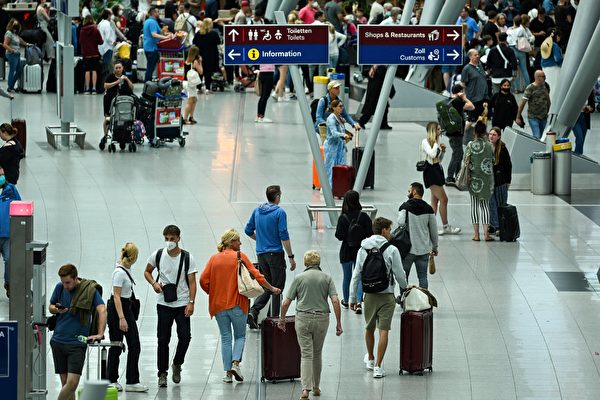
Are you planning to visit Europe this summer? You better pack some extra patience, as travelers have reported that under the new European Union entry screening system, there may be hours-long queues when entering customs from EU countries.
According to a report by “USA Today,” the EU has fully implemented the biometric entry-exit system (EES) in all Schengen Area border checkpoints as of April 10, following a phased rollout starting on October 12, 2025.
However, during the transition period to full operation of the system, reports indicate that the system has led to long lines at airport customs within the EU, even causing some passengers to miss connecting flights. British travelers heading to popular tourist destinations like Italy, Portugal, and Spain were reportedly warned of potential waits of up to six hours. A passenger at Brussels Airport told “Newsweek” that the biometric recognition terminals were either not in use or malfunctioning, with a lack of communication from customs authorities.
According to the latest research by the World Travel & Tourism Council (WTTC), these delays at border entry could lead to some tourists abandoning their trips to Europe.
WTTC President and CEO Gloria Guevara stated in a press release, “Any major change is bound to encounter teething problems in the initial stages. The current challenge lies not in whether to advance the EES but in how governments, border management agencies, and the travel industry can collaborate to ensure the smoothest possible implementation of the system.”
The WTTC surveyed over 2,500 travelers from Australia, Canada, the UK, and the US, revealing that if travelers frequently face three to four-hour border entry waits when entering the Schengen Area, about one-third would significantly reduce their willingness to travel to the region or even completely abandon their plans.
The travel organization pointed out that if “significant delays become the norm in the tourist experience,” it could result in the loss of up to 41 million visitors and a $45.4 billion loss in tourist spending.
While 65% of respondents support modernizing border checkpoints, nearly half said they were unclear on the specific new requirements of the system on their application process.
“The good news is that the solution already exists,” Guevara added. “Through a more extensive digital pre-registration process, enhanced communication with travelers, and ensuring that border customs are adequately prepared behind the scenes, Europe can certainly achieve smooth border crossings and provide travelers with the seamless experience they expect.”