
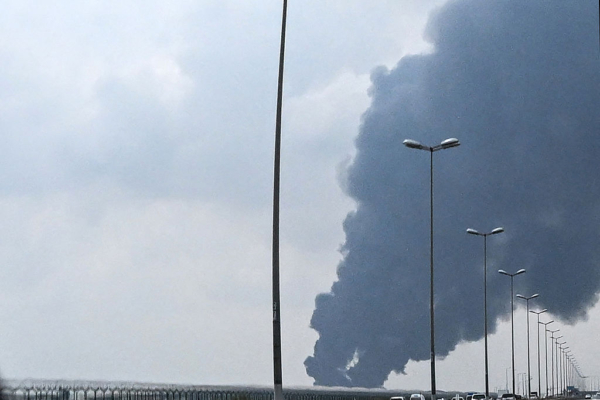
On Thursday, May 28th, the United States Central Command stated that Iran’s missile launch towards Kuwait violated the ceasefire agreement.
The Central Command wrote on X platform: “At 10:17 PM Eastern Time on May 27th, Iran launched a ballistic missile towards Kuwait, which was successfully intercepted by the Kuwaiti military.”
“This egregious ceasefire violation by the Iranian regime occurred after their military launched five one-way attack drones; earlier, these five drones had posed a clear threat in the Strait of Hormuz and its surrounding areas. All drones were successfully intercepted by the US military; furthermore, the US military also prevented Iran from launching a sixth drone from a ground control station in Bandar Abbas,” said the command.
The Central Command described Iran’s missile launch as a serious violation of the ceasefire agreement, and stated that the US military and its regional partners “will continue to remain vigilant and take cautious actions to defend our forces and interests against Iran’s unjust aggression.”
The Kuwaiti government stated that late Wednesday night, Kuwait intercepted missile and drone attacks from Iran. The Kuwaiti Ministry of Foreign Affairs condemned Iran for carrying out “criminal” attacks, stating that these attacks posed a direct threat to civilian lives and critical infrastructure.
The Islamic Revolutionary Guard Corps of Iran claimed that they were responding to earlier US strikes on Bandar Abbas, targeting a US airbase located in Kuwait.
Earlier on Thursday, the Kuwaiti Ministry of Foreign Affairs issued a statement saying that the country reserves the right to take “any and all necessary measures” to defend its territorial sovereignty, and strongly condemned the attacks as “a dangerous escalation of the situation.”
Many countries in the Middle East have also voiced their support for Kuwait.
Saudi Arabia condemned the attacks on Kuwait as “hostile missile and drone attacks,” without directly naming Iran in their statement.
The Saudi Ministry of Foreign Affairs stated: “The Kingdom of Saudi Arabia emphasizes our strong opposition to any acts that violate national sovereignty, and any attempts to threaten the security and stability of the region.”
Qatar regarded the attacks on Kuwait as a “blatant violation of its national sovereignty” and a “serious violation of international law.” Qatar emphasized the urgent need for de-escalation measures to “restore peace and stability to the region and the international community.”
Jordan similarly issued a statement condemning the “barbaric” attacks by Iran; at the same time, Jordan reiterated its steadfast support for Kuwait in defending its “national sovereignty, national security, and the personal safety of its citizens and residents,” and taking all necessary measures.
According to Bahrain News Agency, Bahrain openly expressed support for Kuwait and strongly condemned the attacks launched by Iran. The country’s Ministry of Foreign Affairs also highly praised Kuwait’s armed forces for their “state of readiness.”
The United Arab Emirates labeled the attacks on Kuwait as “terrorist attacks,” constituting a “blatant violation of the country’s sovereignty.” The UAE stated that it condemns such attacks in the “strongest terms.”
Since April 8th, the US and Iran have been in a ceasefire state. Since then, the US military has conducted three rounds of strikes on targets within Iran and Iranian forces to defend against threatening Iranian military actions.