
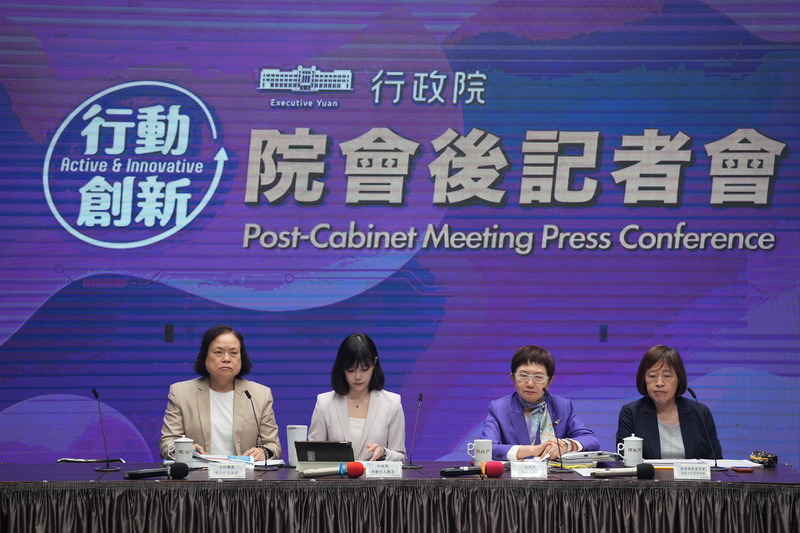
On August 20, 2026, Taiwan’s Premier, Cho Rong-tai, presided over an executive meeting of the Executive Yuan, during which the “116 (2027) Central Government General Budget and Subsidiary Unit Budget and Comprehensive Table” provided by the Directorate-General of Budget, Accounting and Statistics was approved. This budget, amounting to 1.1225 trillion New Taiwan Dollars (NTD), marks the first time it has exceeded 1 trillion NTD, surpassing 3% of the GDP.
In a press conference following the Executive Yuan meeting today, the Directorate-General of Budget, Accounting and Statistics stated that the budget for the 116th fiscal year is formulated under the premise of fiscal prudence, aiming to channel economic growth into enhancing people’s well-being and accumulating Taiwan’s sustainable development capabilities. It will be used to increase salaries, enhance welfare, reduce burdens, and promote infrastructure development.
According to the report from the Directorate-General of Budget, Accounting and Statistics, the budget for the upcoming fiscal year achieves a balance between revenue and expenditure, with 179 billion NTD allocated for debt repayment and an additional 179 billion NTD for financial adjustments, all funded through borrowing. The total debt repayment and borrowing amount remain at the same level, aiming for no net increase in borrowing. In addition to the general budget debt borrowing of 179 billion NTD, there is a separate special budget of 17.8 billion NTD, totaling 196.8 billion NTD.
In terms of defense expenditure, the Ministry of National Defense is allocated a total of 691.9 billion NTD for its management section. Taking into account the earmarked and planned special budgets of 218.2 billion NTD and a non-operating special fund of 60.7 billion NTD, along with the consideration of the expenditure for the retirement benefits of military personnel and veterans supported by the Veterans Affairs Council and the Coast Guard Administration, the overall defense budget amounts to 1.1225 trillion NTD.
The defense budget as a percentage of GDP, based on the 115th fiscal year (with a GDP of 28.6 trillion NTD as of August 114), is calculated at 3.93%. However, based on the GDP estimate for the 116th fiscal year of 37.3 trillion NTD released in August 115, it is 3.01%.
To ensure that the economic benefits are shared by all, 235.7 billion NTD is allocated for general cash distribution. Regarding the adjustment of military and public sector personnel benefits, 39.2 billion NTD is earmarked to enhance the competitiveness in retaining and recruiting talents.
For social welfare expenditure, the budget for the 116th fiscal year is set at 1.1889 trillion NTD, an increase of 41.1% compared to the previous year. Together with a non-operating special fund of 1.549 trillion NTD, the total amount reaches 1.3438 trillion NTD, marking a significant 34.4% increase. Specific allocations include 329.5 billion NTD for the “Taiwan Population Strategy – Family Support” and 171 billion NTD for various social welfare subsidies, reflecting an approximately 36.4% increase from the previous year.
Furthermore, funds of 130 billion NTD are allocated to supplement the labor insurance fund, representing an 8.3% increase from the previous year, while 60 billion NTD is allocated for the health insurance fund. Additionally, 10 billion NTD is designated for the “Healthy Taiwan Deep-plowing Plan,” reflecting a 66.7% increase compared to the previous year.
For assistance measures for small and medium-sized enterprises, 22.2 billion NTD is allocated in the budget for the 116th fiscal year, an increase of 198.6% from the previous year. The total allocation, including the non-operating special fund and special budget for enhancing economic, social, and national security resilience in response to international situations, amounts to 25 billion NTD.
In the cultural sector, the Ministry of Culture is allocated 28.8 billion NTD for its management section, along with general subsidies totaling 3.2 billion NTD, making the total budget 32 billion NTD. This amount is an increase of 7.9% from the previous year. Moreover, the education budget is set at 372.8 billion NTD, indicating a 3.9% increase compared to the previous fiscal year.
Regarding sports, the Sports Administration section is allocated 7 billion NTD, along with 5.2 billion NTD in general subsidies, totaling 12.2 billion NTD. This marks a 7.5% increase from the previous year, with an additional 9.7 billion NTD from the Sports Development Fund, bringing the total allocation to 21.9 billion NTD.
Water resources management is allocated 57 billion NTD in the 116th fiscal year budget, showing a 13.3% increase from the previous year. The budget for technology development projects, including defense technology funds, and both operating and non-operating special funds, amounts to 229.2 billion NTD, representing a 12.7% increase from the previous year.
For public infrastructure projects, 379.4 billion NTD is allocated in the budget, marking a 31.6% increase from the previous year. In addition, 385.4 billion NTD is set aside for general subsidies and project-based grants to local governments, representing a 37.2% increase from the previous year.
In total, the general subsidies and project-based grants to local governments in the 116th fiscal year budget amount to 385.4 billion NTD, with an additional 9.725 trillion NTD allocated in central coordinated tax revenues. The total budget size is 1.3579 trillion NTD, a 16.6% increase from the previous year.
Furthermore, in response to the budget adjustments made by the Legislative Yuan to the 115th fiscal year budget, with cuts of 48 billion NTD and freezes of 34.8 billion NTD, Premier Cho Rong-tai expressed concern over the potential negative impact on the normal operation of various agencies and called for prompt solutions to these freezes to ensure the smooth implementation of governmental operations. He also urged the Legislative Yuan to conduct a thorough and fair review of the 116th fiscal year budget in accordance with legal procedures, allowing for the timely execution of significant policies and projects that benefit the nation and its people.