
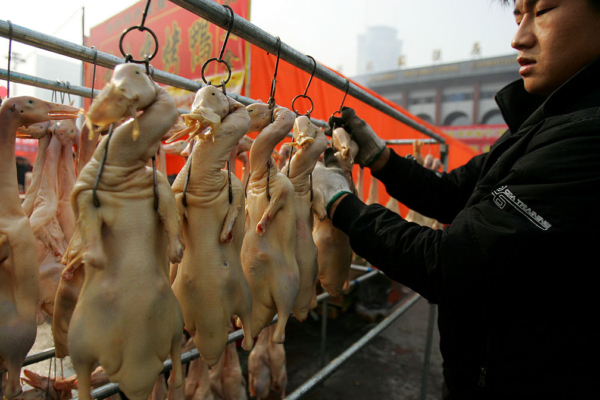
In recent days, the popular “Auntie Goose Leg,” who became famous for selling barbecue near top Chinese universities such as Tsinghua and Peking University, admitted that the “goose legs” she sold were actually duck legs, sparking controversy.
Auntie Goose Leg, whose real name is Chen Xiufeng, gained fame for selling barbecue near prestigious universities in Beijing such as Tsinghua and Peking University. Videos of students from these universities lining up to buy “goose legs” went viral on the internet at the end of 2023, generating considerable buzz.
The controversy began when some netizens questioned whether Chen Xiufeng was actually selling goose legs or duck legs. Subsequently, screenshots circulated online showing Chen Xiufeng admitting that due to being reported, she was cooperating with authorities and confessing that the “raw material is duck legs.” She mentioned that she would clearly label the ingredients in the future, but she argued that the moniker “Auntie Goose Leg” had been used for over a decade and denied any fraudulent behavior.
During an interview with mainland Chinese media, Chen Xiufeng further explained that initially, she did sell goose legs but switched to duck legs later due to a shortage of supply in the market. She also claimed that many of her regular customers were aware of this change and emphasized that she was not deceiving anyone.
However, group chat records shared by some netizens revealed that Auntie Goose Leg’s group purchase chats in 2024 and 2025 still used phrases like “Goose legs have arrived” to place orders. The latest group purchase items were labeled as “Spicy legs roasted by Auntie” and “Non-spicy legs roasted by Auntie,” without specifying that the ingredients were duck legs.
According to mainland Chinese reports, frozen duck legs have an average selling price of about 1.43 yuan each on e-commerce platforms, while frozen goose legs can cost nearly 10 yuan each. Legal experts cited by mainland Chinese media stated that if a business deliberately conceals the true nature of the product, such as substituting duck legs for goose legs, it could be considered consumer fraud due to the significant difference in value and quality between the two.
Following the escalation of the incident, Peking University’s official public account deleted a post that had previously recommended Auntie Goose Leg. The post had featured Chen Xiufeng sharing her entrepreneurial experience at Peking University’s centennial lecture hall, where it was mentioned that her supplier delivered fresh goose legs to her every morning.
Reports from mainland Chinese media mentioned that the Yanyuan Street Market Supervision Institute of Haidian District had received related reports and was verifying the situation.
The incident has sparked discussions online, with many netizens believing that if a business has been selling products under the name of goose legs while using duck legs as the actual ingredient, transparency towards consumers is essential. Some netizens commented that “being called Auntie Goose Leg does not mean you can sell duck legs” and emphasized the importance of clearly labeling the products to prevent consumer confusion. Additionally, some netizens pointed out that at the price of 16 yuan per leg, it would be difficult to find genuine goose legs, suggesting that regular customers might have been aware of the substitution for duck legs, but the controversy lies in whether new customers were informed effectively.
Furthermore, food safety concerns have become another hot topic of discussion. On June 10th, several consumers reported purchasing greenish-colored roasted legs, leading to the trending topic of “Zombie Duck Legs” reaching the top of the hot search list.