
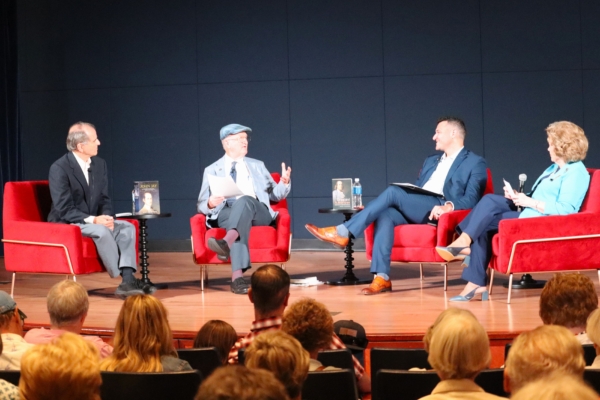
On June 13, the grassroots organization “USA 250-OC” held a themed seminar titled “A Conversation: Forgotten Founders” at the Nixon Library in Orange County, focusing on several key but lesser-known founding fathers – not necessarily signers of the Declaration of Independence, but all played important roles in America’s independence.
“USA 250-OC” is a non-partisan, non-religious organization that spans two years, bringing together individuals from education, business, labor, arts, media, religion, local government, and civic groups, dedicated to commemorating and celebrating the Declaration of Independence, the birth of America, founding principles, as well as the government structure established by the Constitution and Bill of Rights, and the role Orange County residents played in American history.
The co-chairs of the organization, Jo Ellen Chatham, hosted the discussion, which was one of the events in the Nixon Library’s celebration of America’s 250th anniversary. The invited guests included writer and lawyer Walter Stahr, and two writer-professors – Bryan Santin and Mark Skousen, who is a descendant of Benjamin Franklin.
Stahr stated, “In 1760, the people of the Thirteen Colonies did not see themselves as a whole (America), but as individual entities, focusing on London. At that time, the population of the colonies was about 1.6 million, roughly half the current population of Orange County.”
During the middle of the French and Indian War, the two countries faced each other with intense fighting, and when the war ended, Britain’s national debt doubled, plunging into a recession. Britain implemented the Stamp Act in the home country and planned to extend it to all the North American colonies, but the colonists were not willing to pay more taxes.
Skousen mentioned that Franklin, then the resident agent of Pennsylvania in England, did not initially see the severity of the situation until radical protesters threatened to burn down his house. “Franklin presented the unreasonable aspects of the Stamp Act in Parliament, which eventually led to its repeal.” At that time, the Prime Minister of Britain was William Pitt Senior, regarded as a great hero of the war period, who “realized that the tax might lead to colonial rebellion or independence.”
Chatham mentioned that Edmund Burke, a member of the British House of Commons, supported the colonies at the time, stating, “Watching Franklin in Parliament was like watching a teacher being questioned by a group of schoolchildren.”
Chatham continued to say that the British Parliament did not learn from their mistakes and later passed the even more oppressive Declaratory Act after the Stamp Act, essentially saying, “We tell you what to do, and you do it”; and in 1767, the Townshend Acts were passed, imposing new taxes on paper, lead, paint, glass, and tea.
Therefore, John Dickinson, a lawyer from Philadelphia, published a series of 12 “Letters from a Farmer in Pennsylvania” between 1767 and 1768, advocating the principle of “No taxation without representation.”
The Boston Tea Party happened in June 1773. By 1774, the situation had escalated to a breaking point, and Britain enacted the Coercive Acts, known in America as the Intolerable Acts, and reinstated the Quartering Act, which became the final straw in British colonial rule in North America.
From September 5 to October 26, 1774, the First Continental Congress convened at Carpenters’ Hall in Philadelphia, with representatives from twelve out of thirteen colonies present. “The first thing the Congress did was to appoint Charles Thomson as the secretary, responsible for the minutes of the meeting. He held more information than anyone until 1789, when the new Congress established by the Constitution took over the government,” Chatham said, noting that the role of “secretary” back then was akin to a “prime minister.”
“He kept all the documents and records, and personally guarded the original copy of the Declaration of Independence,” Chatham said. Many people encouraged him to write a book after the war, and he did start the work, but never finished it and destroyed all his notes.
At that time, Thomson said, “I am not going to do it; someone will come to write this history – some will tell the truth and some will lie, and I do not want to correct them.”
The First Continental Congress led to four things: representatives coming together for the first time, coordinating actions against Britain; signing a petition to King George III; expressing dissatisfaction with the colonies; and agreeing to meet again the following year (May 10, 1775).
Representatives thought Britain would change its mind, but it didn’t, leading to the Battles of Lexington and Concord on April 19, 1775.
“The colonies began to build armies and considered having Washington lead; on the other hand, they sought reconciliation with Britain, with John Dickinson as a leader of the reconciliation faction,” Stahr explained. “Dickinson emphasized that the thirteen colonies did not want to break from Britain, did not want to declare independence, but wanted to enjoy the equal rights as Englishmen.”
At the second Continental Congress on July 5, representatives passed the Olive Branch Petition drafted by Dickinson to seek King George’s arbitration. Santin said, “The King did not even want to look at it; he saw these disobedient rebels needing discipline.”
In the earlier Hutchinson letters crisis in June 1773, Governor Thomas Hutchinson of Massachusetts proposed to suppress colonial resistors and curtail their rights in letters to his deputy.
Franklin obtained the letters and had them published in a Boston newspaper. In January 1774, he was summoned to a hearing at the Cockpit room in Whitehall Palace in London. “For three hours, he faced verbal attacks, publicly shamed, and stripped of his positions as colonial representative and Postmaster General. He earned £1,500 per year but lost everything instantly,” Skousen said.
Facing the danger of arrest, Franklin left Britain and returned to become a representative at the Second Continental Congress.
John Adams, Thomas Jefferson, Benjamin Franklin, Roger Sherman, and Robert Livingston were the five members of the drafting committee. Jefferson spent a month to complete the first draft, circulated among the four committee members.
“Jefferson initially wrote, ‘We hold these truths to be sacred and undeniable,’ but Franklin argued for a more logical, rational, and scientific approach without religious connotations, so the phrase was changed to, ‘We hold these truths to be self-evident,'” Skousen said, noting that Jefferson’s tombstone lists two achievements: drafting the Declaration of Independence and advocating for religious freedom.
The Declaration listed the reasons for breaking away from Britain, ultimately emphasizing the right to refuse British rule if rights were infringed upon. Chatham said, representatives voted on whether to “independent” on July 2, with representatives from Pennsylvania and South Carolina wavering, and New York representatives abstaining due to lack of instructions.
John Dickinson “abstained” from the vote, but Jefferson praised his crucial role in opposing the Townshend Acts. In 1781, he was elected as Governor of Delaware for two years; in 1782, he was elected as Governor of Pennsylvania. His family owned estates in both states, and he served as governor in both simultaneously.
“Dickinson was like a wise elder, questioning, ‘Are we a bit impulsive? Are we ready? Do we have external support? Have we strengthened the connections between the colonies? The powerful empire still exists; we should not hastily declare independence,'” Santin noted.
Dickinson once described, “Independence is like sitting in a paper boat heading into a storm.” Though he did not sign the Declaration of Independence and had to withdraw from the Continental Congress, he later joined the Pennsylvania patriotic militia and actively participated in the war.
Skousen stressed that the representatives at the Continental Congress were actually risking their lives, fortunes, and sacred honor when they listed the series of abuses and usurpations against the British king; after all, they were going against the most powerful military force in the world at the time, without any allies.
Apart from Dickinson and Thomson, the discussion highlighted other founding figures such as John Jay, Gouverneur Morris, and James Wilson.