
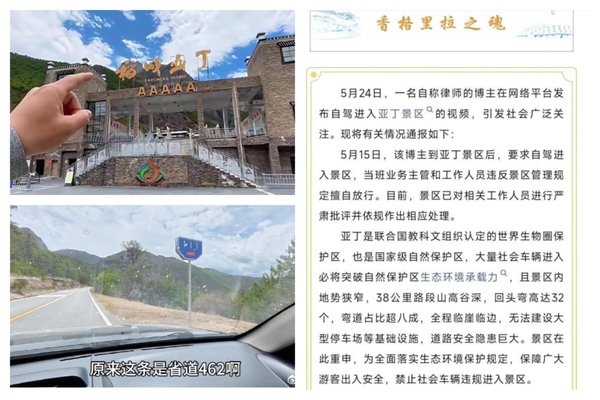
On May 24th, a blogger publicly released a video claiming that Daocheng Yading Scenic Area in Daocheng County, Garze Prefecture, Sichuan Province, had set up toll stations on Provincial Road S462, sparking public debate.
Daocheng Yading Scenic Area is a national-level nature reserve and a provincial-level scenic spot.
A lawyer and blogger stated that when driving to Daocheng Yading Scenic Area, he was informed at the Shangri-La Town Visitor Center that the section of the road leading to the scenic area had been designated as an internal road of the scenic area, prohibiting the passage of social vehicles. Visitors were required to purchase a round-trip shuttle bus ticket for 120 yuan to enter by transferring to the shuttle bus within the area. The blogger questioned on-site that this road was not an exclusive road for the scenic area but a public Provincial Road S462. Eventually, after signing a disclaimer, the blogger was allowed to drive into that section, and the video he released quickly spread widely on the internet.
On May 25th, the Daocheng Yading Scenic Area reported that the area has narrow terrain, with 38 kilometers of steep and deep valleys, 32 hairpin bends, accounting for over 80% of the curves, with cliffs and edges throughout the route, making it impossible to build large parking lots and other basic infrastructure. The road poses significant safety hazards, leading to the prohibition of social vehicles from entering the scenic area to fully implement environmental protection regulations and ensure the safety of visitors.
The report did not provide a direct response to the issue of “toll collection on a provincial road.”
Information shows that the S462 Provincial Road operated by Daocheng Yading Scenic Area (including the 38-kilometer section within the area) is actually maintained by local finances, not funded by the scenic area.
Critics have pointed out that the area’s report is seen as avoiding addressing the core issues. Some media outlets questioned: First, why can a public road be turned into a toll road for the scenic area? Second, by intercepting the provincial road, forcing visitors to pay an extra 120 yuan for shuttle bus services, is this a form of “forced consumption”?
Public skepticism continues to grow.
A prominent Weibo user, “Cangnanyan,” questioned, “Under the guise of environmental protection and road safety, you cannot arbitrarily enclose roads and charge fees. If protection-oriented development is allowed, then the costs related to maintaining the 38-kilometer road should be included in the ticket fees, rather than making additional charges for shuttle services.”
He further stated, “Roads are built with taxpayers’ money, and maintenance costs are also covered by taxpayers. If you collect fees for blocking roads without legal basis, it is illegal. Road tolls without legal basis constitute illegal behavior, and the public should reject such exploitation. Relevant authorities should take strict actions, maintaining that laws should not be trampled upon for the sake of short-term development needs.”
Tech blogger “Mashangtan” posted, “Some scenic spots use deceptive tactics by citing environmental and safety reasons to block provincial roads, forcing visitors to take buses, incurring significant and unnecessary expenses. Such places should consider closing down for the sake of the environment and safety.”
This phenomenon is not uncommon. Previously, controversies arose over preemptively collecting fees by intercepting provincial roads in Yunnan Lugu Lake Scenic Area and reports of charging entrance fees for vehicles passing through Shanxi Wutai Mountain Scenic Area.
According to the official website, the scenic area is located in Yading Village, Xianggelila Town, Daocheng County, Garze Tibetan Autonomous Prefecture, Sichuan Province. It mainly consists of three mountains, “Xianairi, Yangmaiyong, and Xianuoduoji,” along with surrounding rivers, lakes, and alpine meadows. Renowned as the “soul of Shangri-La in China” for its unique topography and pristine natural scenery.