
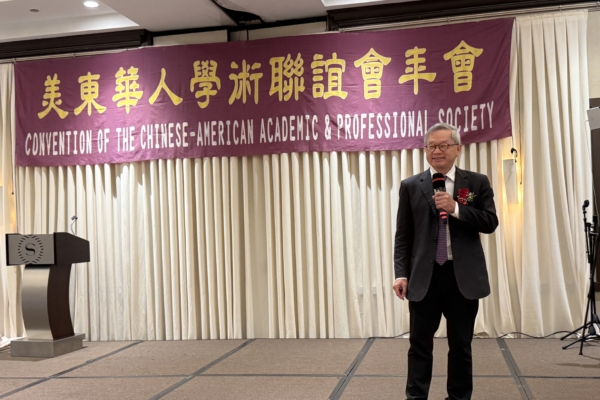
Taiwan’s semiconductor industry has come a long way, but what role has the government played in its development? According to Wu Chengwen, Director of the National Science and Technology Committee of the Republic of China, the establishment of Taiwan Science Parks was not merely a conventional industrial zone, but rather a strategic integration of government resources such as land, water, electricity, talent, tax incentives, and import-export services to meet the needs of businesses, while fostering collaborations between industries, universities, and research institutions in what is known as the “Golden Triangle” model of cooperation between government, academia, and industry.
Reflecting on the history, Wu Chengwen noted that the Hsinchu Science Park was established around 1980, distinctively being placed under the supervision of the National Science Council, responsible for supporting universities and research institutions, instead of the Ministry of Economic Affairs, which oversaw conventional industrial zone development.
This decision established a unique development direction for the Science Parks different from typical industrial zones.
At its inception, the Science Parks made a crucial decision that semiconductor development must be closely linked with academic research. Wu emphasized the importance of this connection by stating that “technologies can only advance through research and collaboration, not solely relying on licensing from others.” Hence, the location of the parks near Industrial Technology Research Institute, National Tsing Hua University, and National Chiao Tung University fostered the access of companies to research, technology, and talent resources.
Wu Chengwen highlighted that the National Science Council’s development of the Science Parks not only provided land for business establishments but also crucially integrated resources from various government departments.
For instance, in setting up a semiconductor wafer plant, the requirements for water and electricity involve the Ministry of Economic Affairs; land acquisition could involve the Ministry of Agriculture, Taiwan Sugar Corporation, and the Ministry of the Interior; and business operations might entail taxations managed by the Ministry of Finance, as well as issues related to raw material imports and product exports.
Hence, the Park Management Bureau acts as a “single window” to assist companies in resolving cross-departmental issues. Wu pointed out, “There are so many details involved, and the government is unified in assisting companies in their development.”
In other words, the role of the government is not to manage businesses but to consolidate the foundational conditions and administrative resources necessary for businesses to develop high-tech industries.
Additionally, companies entering the Science Parks must meet certain conditions. Wu emphasized, “We require a definite commitment to research and development; otherwise, entry is not permitted, with a certain proportion required.”
He noted that this requirement is also why locating the Science Parks near the Industrial Technology Research Institute and universities is crucial. Technological companies need to continually access talent, engage in technological collaborations, and invest in research and development, all of which are facilitated by the surrounding research and educational institutions.
Wu Chengwen summarized this system as the “Golden Triangle” model of close cooperation among Government, Academia, and Industry.
In this model, the government is responsible for establishing the environment necessary for industrial development and integrating administrative resources; universities and research institutions provide talent and research capabilities; and companies continuously invest in research and industrialization.
Starting from the Hsinchu Science Park about 46 years ago, this system has become a crucial foundation for the development of Taiwan’s high-tech industry.