
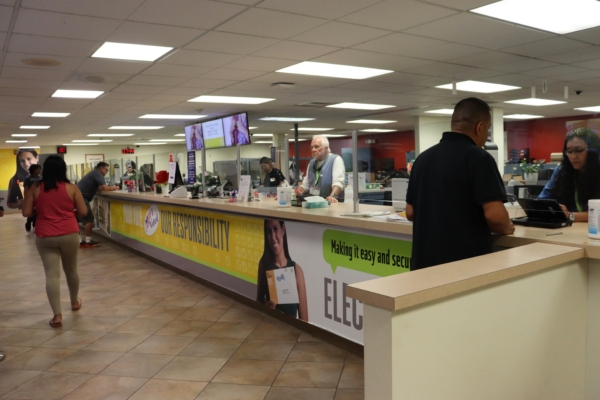
On June 2nd, during the California primary election day, Bob Page, the Orange County Registrar of Voters in Southern California, explained the voting process to reporters. He mentioned that the voter turnout is typically low during primaries and they are still in the process of counting the votes. Orange County residents will have to wait until June 26th to see the official election results.
In the afternoon of June 2nd, people were seen driving to the Orange County Registrar of Voters office. Some dropped their ballots into the outdoor ballot boxes, others submitted their ballots inside, and some scanned their ballots themselves. The turnout for the primary was noticeably lower compared to the November elections. Page estimated that the voter turnout would fall between the special gubernatorial election four years ago and the primary election in 2024.
As of 5:00 PM on June 5th, the voter turnout in Orange County was 32.9%, with California’s average turnout at 28.6%. These figures are expected to increase as the vote counting progresses.
Page discussed two major changes in this year’s election process. One change involved adjusting the opening hours of early voting centers based on voter feedback to be uniformly open from 10 AM to 6 PM. The other change was in the ballot format due to the significant number of 61 gubernatorial candidates, which necessitated printing longer 17-inch ballots instead of the usual 14-inch ones.
This required adjustments in printing and mailing processes in Orange County, such as slowing down the machine speed during verification, requiring proper folding of ballots in envelopes, and ensuring envelopes are shaken to ensure the ballots settle at the bottom for safe machine cutting during envelope opening. The center also created videos and shared them on social media to educate voters on how to fold and insert their ballots into the envelopes.
On the ballot’s first page in Orange County was the gubernatorial election, leaving the back blank. Page explained that the ballots were printed on both sides but candidates for the same election had to be on the same side to prevent voters from overlooking candidates.
Since the ballots sent to active voters’ homes were the same as those printed at election centers, why not have voters directly scan their ballots at the early voting centers? This approach could save time on counting and eliminate the need for signature verification and ballot checking.
Page emphasized that they do not enforce a specific way for voters to return their ballots. Whether filled out at home and scanned at the voting center or returned in sealed envelopes, both methods are accepted, as the state government requires offering multiple voting options to voters.
To ensure voters can cast their votes comfortably and according to their preference, Orange County provides postage for mailing ballots. Additionally, they have 128 convenient ballot drop-off boxes across the county where voters can securely deposit their sealed envelopes containing their ballots. This diversity in voting methods includes in-person scanning, mailing back ballots, or using conditional ballots at voting centers.
California allows voters an extended voting period. The early voting boxes opened concurrently with the mailing of the primary ballots in early May. Some counties with VBM voting started opening select voting centers in the ten days before the election. By the last four days before the election, all voting centers were operational.
Furthermore, California’s vote counting process is prolonged, with the election results not officially confirmed until July 10th despite the primary voting closing on June 2nd. The possibility to scan and transmit ballot chip data directly to the counting center suggests that the election results could be confirmed on the same day.
Orange County’s election and counting center has 54 full-time employees, with about 1,700 temporary workers hired for the primary election. Temporary staff are responsible for various tasks like handling, storing, sorting and inspecting envelopes, verifying signatures, copying ballots when needed, among other duties at the 192 voting centers across the county. After the election night, these workers will close and clear out the voting centers and return all materials.
In Orange County, over 75% of voters typically return their ballots by mail. The process includes sorting by location, envelope opening, flattening, scanning, verifying signatures, and adjudicating ballots, increasing workload significantly.
Page mentioned that while the law prohibits confirming the election results before June 26th, the actual counting work is often completed within a week after the election. The final stages involve manual counting, verification of signatures, and waiting for any outstanding ballots to be returned or rectified.
Based on past elections since 2020, the majority of the vote counting process, around 95%, tends to be concluded within 4-9 days after the election day, except for temporary ballots needing further verification, damaged or erroneously marked ballots requiring duplication, or those necessitating signature corrections, which could take up to a week after the election day to resolve. In the special election in November 2025, they had completed 98.8% of the vote counting within four days after the election day.