
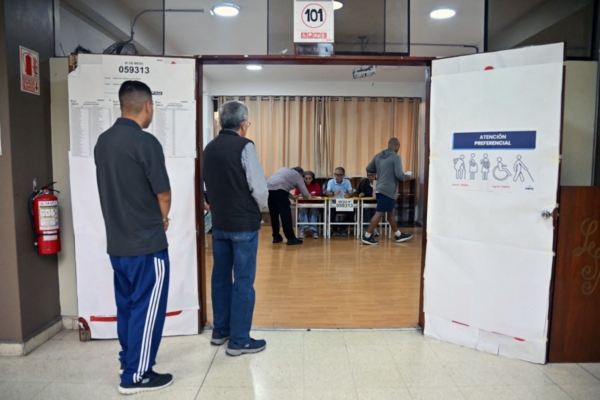
On Sunday, June 7th, Peru held a crucial presidential run-off election. The election results will not only determine the future direction of Peru but also potentially affect the power balance in the Latin American region. This election is also expected to receive close attention from both the United States and China.
Voting began at 7 am local time on Sunday and ended at 5 pm. Preliminary results are expected to be announced within three hours.
There are two candidates vying for the presidency. Keiko Fujimori, the daughter of a former Peruvian president and a conservative presidential candidate, is campaigning on the platform of law and order, free-market policies, and closer ties with the United States. On the other hand, leftist challenger Roberto Sanchez represents a political movement that many see as continuing the leftist challenge to U.S. interests in Latin America.
In the first round of elections in April, Fujimori and Sanchez defeated 33 other candidates to advance to the run-off.
Pre-election polls indicate a neck-and-neck race with both candidates enjoying similar levels of support. Polling agencies estimate that around 30% of voters had not decided on their voting intention before the election.
This is Keiko Fujimori’s fourth presidential campaign. She has successfully advanced to the run-off in the three previous elections. Educated in the United States, she is currently the leader of the largest party in the Peruvian Congress, “Popular Force Party.” Her campaign platform, pledging to combat violent crime, expel illegal immigrants to strengthen order and stability, has resonated with many voters. She has linked her father’s actions against leftist Maoist rebels in the past to Peru’s current struggle against organized crime.
During an interview with AFP on April 10, Fujimori promised to “combat crime and restore order” within the first 100 days if elected. She also stated that she would attract more U.S. investments to safeguard Peru’s economy, and cozy up to neighboring countries like the United States, Argentina, Chile, Ecuador, and Bolivia, continuing the current conservative wave in South America.
Jose Ignacio Beteta, Executive Director of the Peruvian think tank “Association of Taxpayers,” told Fox Digital News that the impact of Peru’s election on June 7 goes far beyond its borders. From the current U.S. national security strategy perspective, this election will determine whether Peru consolidates its position as a partner of the United States or gets further entangled in geopolitical conflicts. Peru’s institutional vulnerabilities have allowed China to expand in some strategic areas.
Beteta stated that the vote is seen as a decision between two options: Fujimori’s return to freer, more competitive economic and security policies, or Sanchez’s attempt at leftist governance once again. This binary opposition reflects a broader ideological split in South America.
For the United States, Peru’s election is not just a domestic political contest but another test of the broader political trends in Latin America. In recent years, several countries in the region have seen shifts towards center-right or conservative governments, including Argentina led by Javier Milei and Ecuador led by Daniel Noboa, both of which have friendly relations with Washington.
If Keiko Fujimori wins, she will strengthen this trend and may lead Peru to join a growing government camp that tends to adopt tougher crime-fighting measures, strengthen relations with the United States, and implement market-oriented economic policies.
Peruvian analyst and legal expert Lucas Ghersi told Fox Digital News that “Roberto Sanchez represents a quite radical left-wing ideology. His campaign platform includes nationalizations and expropriations, and he has close ties to Evo Morales and Nicolas Maduro.”
Ghersi stated that if Sanchez wins, it could escalate tensions between Peru and the United States. In his campaign activities and presidential debates, Sanchez strongly criticized Peru’s purchase of F-16 fighter jets from the United States. He argued that Peru should not buy weapons from the U.S. but instead use that money for healthcare or education. He has also been linked to illegal mining and accused of drug trafficking. All of this could heighten tensions with the United States.
“Peru is a strategically important country that has long been a focal point of competition between the United States and China. Peru is one of the countries with the largest known copper reserves in the world and is a major gold producer. Therefore, both the U.S. and China are vying for influence in Peru, with China advancing large investment projects in Peru, such as a giant port that is already operational. In response, the U.S. has proposed to renovate a Peruvian naval base and invest in large port projects,” Ghersi explained.