
Pilot Jessica Cox has spent her life proving that the ability to soar in the sky is not limited by having arms. Born without arms in Arizona, she has defied expectations and become the world’s first licensed armless pilot, as well as a leading advocate for disability rights internationally.
For over two decades, Cox has shattered barriers and inspired others with her belief in herself, living a life of soaring through the skies, inspiring others, and continual innovation.
In Cox’s life dictionary, there is no such word as “can’t.” Instead, her response is always simple: “Watch me.”
On May 15th, this 43-year-old lady was inducted into Arizona’s Aviation Hall of Fame at the Pima Air & Space Museum in Arizona. She hopes this honor will help her further her non-profit work and inspire others to break through their self-imposed limits.
According to museum curator Andrew Boehly, Cox is one of the three inductees this year. The museum hopes that Cox’s induction and her life story will inspire young visitors to overcome adversity and their own challenges.
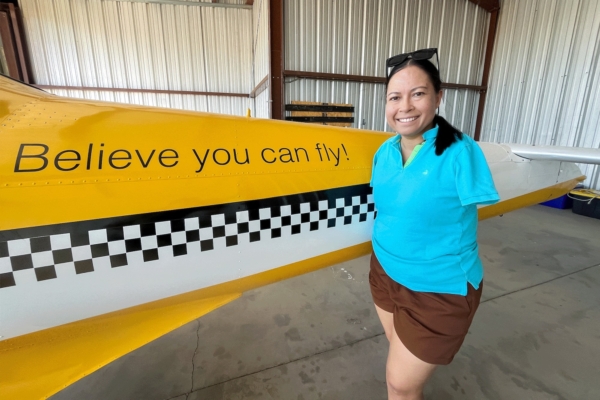
Cox candidly talks about being born without arms, a rare congenital condition that she has embraced as a normal part of her life. Dressed in a blue shirt and shorts, wearing sunglasses with her hair pulled back, she expressed her ease and comfort when discussing her unique situation.
“I wouldn’t even know what to do with arms if I were given them. I’m used to not having arms. It’s just normal for me,” Cox said, adding that it wasn’t until she saw other people that she realized how different she was from them.
On a hot morning at the Marana Regional Airport in the Marana area about 20 miles northwest of Tucson, Cox used her toes to unlock the hangar where her ERCO 415-C Ercoupe light aircraft is kept. The vintage aircraft, manufactured in 1946, is now owned by Cox’s foundation.
The aircraft sports a slogan on its fuselage, which also serves as Cox’s life motto: “Believe you can fly!”
It is this mindset that has propelled Cox further and higher than she ever imagined. “The key is overcoming fear,” she told the Epoch Times.
“I have been doing international speaking engagements for 20 years now, and I want to tell everyone: Sometimes, you need to do the things that scare you. Never let fear stop you from seizing opportunities.”
Once inside the cockpit, she checked the instruments, reflecting on her childhood when people often reminded her of her differences and told her what she couldn’t do.
She responded to these expectations with anger. “As a child, I was angry about many things. What angered me was not having the things others had and being treated differently,” she said. “It made me very angry.”
Cox refuses to be constrained by any obstacles. She has continually expanded her abilities, learning to perform complex tasks solely with her feet. She holds a valid driver’s license and drives a Dodge Durango SUV, refueling on her own.
According to the Amputee Coalition, there is currently no globally unified database tracking the number of armless individuals with driver’s licenses. However, issuing authorities typically require applicants to provide proof of driving an actual vehicle, often necessitating vehicle modifications.
Cox has taken her physical capabilities a step further by earning a fourth-degree black belt in taekwondo in 2019. She has also begun learning surfing and scuba diving.
At the age of 26, she ventured into the aviation industry, controlling airplanes solely with her feet and setting a Guinness World Record.
In 2008, Cox became the world’s first licensed armless pilot, making history. “It was really tough—physically, emotionally, mentally. I went through a lot of tests. Everything was by the book,” she recalled.
In 2017, Cox founded the Rightfooted Foundation International (RFI) for armless individuals in Tucson, aiming to help children with bilateral upper limb deficiencies or disabilities live independently.
Although many organizations provide broad support for disabled children, there is a lack of specialized services for this group, as noted by the organization. The foundation aims to bridge this gap through practical tools, encouragement, and support networks to help children grow. One of the provided tools is a custom dressing hook to assist children in dressing themselves.
The key, Cox says, is to “start things on the right foot.”
To further its core mission and spread its message, the RFI purchased a post-war-production ERCO aircraft, with a dual-tail and single-engine design.
The aircraft has a fuel tank capacity of only 20 gallons, consuming approximately 5 gallons per hour at a top speed of around 100 miles per hour.
Cox maneuvers herself awkwardly into the cramped cockpit, leaning back at an angle to use her right foot to operate the throttle and control devices.
“There’s no autopilot. It’s basically ‘what you see is what you get.’ I operate the controls with my feet just as naturally as with hands, or else I’d be all thumbs,” she chuckled.
“I guess I need some coordination. Definitely.”
The aircraft’s dashboard remains mostly unchanged, and as Cox accumulates about 100 hours of flight time and at least 20 solo flights during her travels across the country, she talks about how she continually trains her body to tackle difficult tasks.
“When landing, you have to pull back on the control stick. The pull isn’t muscle memory. I have to work out my abdominal muscles to do it,” she shared.
“I was very scared at the time. Overcoming fear was a challenge for me.”
Years ago, Cox published her autobiography, “Disarm Your Limits: The Flight Formula to Lift You to Success and Propel You to the Next Horizon,” in 2015, detailing how to face fears and overcome limitations through belief and determination.
“Beyond the obstacles we set for ourselves, there are no high walls. Those walls are climbable,” Cox said. “The wall exists only to block those whose desire is not strong enough.”
Through her foundation, engineers, university partners, and aviation volunteers are working on building the world’s first long-distance aircraft controlled by feet, aiming to replace the vintage Ercoupe aircraft.
Named “The Impossible Airplane” project, it seeks to expand the foundation’s reach and enable Cox to fly further, faster, and safer using a specially designed control device.
The “Impossible Airplane” project is set to be completed in July this year.
“For me, this plane makes me realize how capable I am,” Cox reflected while looking forward to the new aircraft’s arrival. “Throughout my life, people have been telling me what I can’t do because of my lack of arms.”
One day, Cox suddenly realized she could fly a plane.
Since then, her inspiring story of flying aircraft with her feet has etched itself into aviation history.