
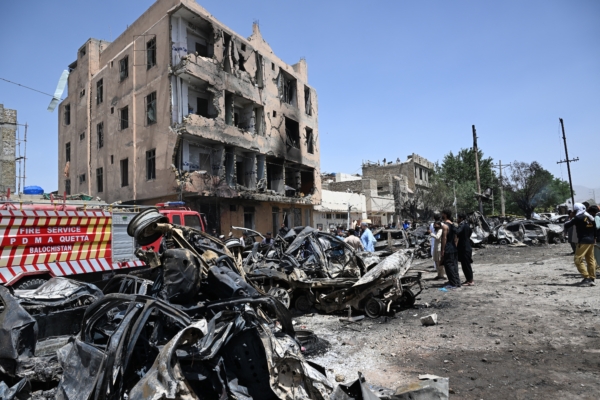
On Sunday, a significant bomb attack occurred in Quetta, the capital of Balochistan province in southwestern Pakistan. A suicide bomber detonated a vehicle containing explosives near the railway track as a train passed by, resulting in at least 24 deaths and approximately 70 injuries.
According to reports from Reuters, the targeted train was a shuttle carrying Pakistani security personnel and their families. The separatist group Balochistan Liberation Army (BLA) claimed responsibility for the attack, stating their aim for independence from the central Pakistani government.
The Pakistan Railways department stated that the shuttle train was departing from the Quetta military camp area to connect passengers to the long-distance Jaffar Express train.
The explosion took place near a residential area next to the railway track. A security official informed Reuters that the vehicle carrying explosives collided with a train carriage changer. The blast was of great magnitude, causing the train engine and three carriages to derail, with two carriages overturning and catching fire, sending black smoke billowing into the air.
The attack led to a devastating loss of lives and injuries, prompting local hospitals to declare an emergency situation. Doctors reported that 20 of the injured were in critical condition. A security official mentioned that some of the deceased were residents of a nearby apartment building.
Visuals from the scene displayed burnt vehicles, twisted metal, and scattered debris along the railway track, with nearby residential buildings severely damaged. The Pakistan Railways department confirmed that security forces had cordoned off the area, and rescue operations were underway.
Prime Minister Shehbaz Sharif condemned the “heinous bomb explosion incident” on the social media platform, X, and extended condolences to the families of the victims.
Shahid Rind, a spokesperson for the Balochistan provincial government, emphasized, “We strongly condemn the acts against innocent civilians and feel deep sorrow for the loss of precious lives. Terrorists should not receive any forgiveness.”
Chief Minister Sarfraz Bugti also strongly denounced the attack in Quetta, stating that the militants targeted “innocent civilians, including women and children,” and vowed to “track them down.”
Despite the Pakistani government’s claims of quelling insurgency, Balochistan province, rich in resources, continues to experience ongoing conflicts, with separatist militants frequently targeting security forces, government facilities, and infrastructure.
The attack comes at a geopolitically sensitive moment. President Asif Ali Zardari of Pakistan noted that the armed militants and their supporters aimed to disrupt Pakistan’s role in regional and international peace efforts.
The day before this attack, under Pakistani mediation, the US and Iran were nearing a memorandum of understanding to end the Middle East war that began on February 28.
Furthermore, Pakistan regularly refers to BLA as “Fitna al-Hindustan” and accuses the organization of receiving support from India; however, New Delhi has repeatedly denied these allegations.