
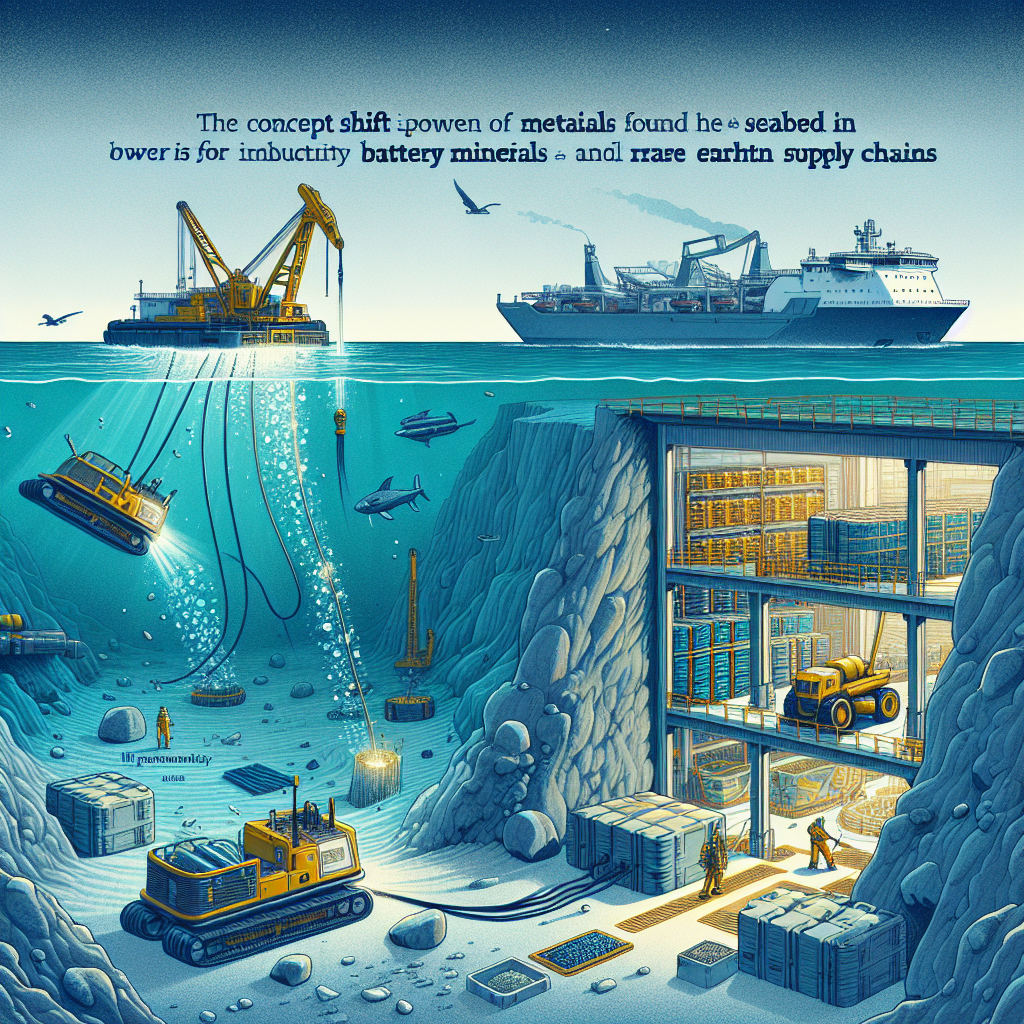
According to sources familiar with the matter, the Trump administration is drafting an executive order that would allow metals found on the seabed of the Pacific Ocean to be stored, in order to counter the Chinese Communist Party’s dominant position in battery minerals and rare earth supply chains. The reserve plan could also help the United States respond to restrictions on key metal exports by China in the event of a conflict.
These pea-sized nodules, formed under high pressure on the seabed over millions of years, contain nickel, cobalt, copper, and manganese used in making batteries, wires, or ammunition, as well as trace rare earth minerals, as reported by the Financial Times. They can be added to existing federal oil and metal reserves. The U.S. Department of Commerce did not respond to requests for comment. The White House National Security Council declined to comment.
Alexander Gray, an Asia specialist who served as Chief of Staff to the U.S. National Security Advisor in the first Trump administration, stated that as China increasingly views the deep seabed as “a frontier for economic and military competition with the United States,” it is reasonable for the White House to be concerned about deep-sea mining issues.
Gray added that just as the Trump administration has done in shipbuilding and broader critical mineral sectors, pushing the U.S. government to focus on areas most vulnerable to China’s ambitions is crucial.
Insiders indicate that this reserve plan is seen as part of a broader effort under U.S. law to expedite deep-sea mining applications and establish onshore nodules processing capabilities.
Last year’s annual defense authorization bill directed the Pentagon to study the feasibility of refining nodules for defense applications.
According to sources, these reserves, as part of these plans, would “create a large stockpile readily available within the United States for future use” in the event of conflicts with China that could restrict metal and rare earth imports.
Establishing a national strategic reserve for deep-sea polymetallic nodules will help the U.S. catch up with China in the global competition to develop the resource-rich seabed of the Pacific Ocean. China produces about 90% of the world’s refined rare earths. Rare earths are widely used in defense, electric vehicles, clean energy, and electronics industries. The U.S. heavily relies on imports for most rare earths, with a significant portion coming from China. In recent years, Beijing has increasingly used restrictions on critical metal exports as an economic leverage tool. Last week, Beijing imposed export restrictions on some rare earth elements in response to Trump’s tariffs.
In recent years, China’s control over rare earth mining and processing has raised concerns among Western countries. U.S. government researchers are working to analyze mineral deposits worldwide to assess progress in increasing rare earth supplies from regions outside of China.
The United States is seeking to achieve self-sufficiency in critical minerals. Apart from seeking key minerals agreements with Ukraine, measures have been announced to increase domestic production. The U.S. is also aiming to curb China’s control over critical minerals in Greenland. Tanbreez Mining, the developer of Greenland’s largest rare earth deposit, revealed that U.S. and Danish officials lobbied them last year, urging them not to sell the rare earth project to companies associated with China.
President Trump is currently seeking to purchase Greenland, stating that Greenland is crucial for U.S. national security. Greg Barnes, CEO of Tanbreez Mining, told Reuters that U.S. officials visited Greenland twice last year and repeatedly conveyed a message to the financially strapped company: do not sell the deposits to buyers connected to China.