
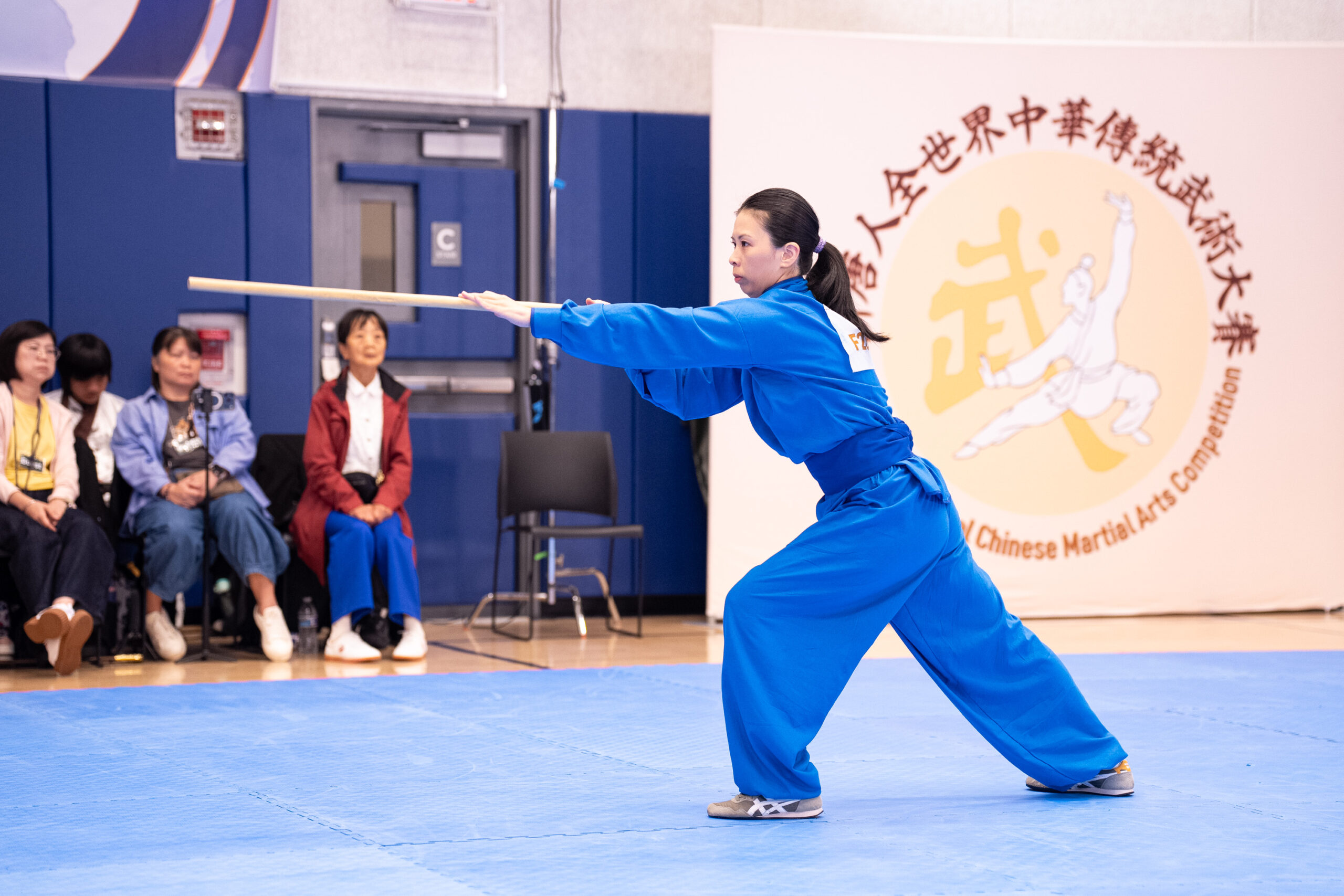
In the news report dated August 16, 2026, two-time participant in the New Tang Dynasty Worldwide Traditional Chinese Martial Arts Competition, Jin Huan, a student from the Martial Arts Department of Renaissance University, won the bronze award in the previous competition. This year, she participated again and clinched the silver award in the women’s apparatus category during the finals held on August 15.
For Jin Huan, winning awards is not the purpose of practicing martial arts and competing. She believes that traditional martial arts are about skill level and martial virtue, as well as personal requirements. “It’s about whether we have reached that level, whether we have met the requirements of martial virtue.”
Jin Huan believes that in learning traditional martial arts, one must first learn how to be a good person. “If you want to make progress in martial arts, you must cultivate character, that is, practicing martial virtue.” In her view, martial arts is not just physical training but also involves spiritual cultivation. The process of martial arts practice is also a journey towards becoming a better person.
Having participated in the New Tang Dynasty Martial Arts Competition twice, Jin Huan’s greatest realization has been the deepening of her understanding of “practice”.
“After the last martial arts competition, I learned that what we are competing in is discipline,” she said. It’s about “whether we have truly learned traditional martial arts, whether we practice every day, whether we practice with dedication, and practice in the correct way.”
Therefore, after the last competition ended, she immediately began practicing from the next day.
This year, she raised the bar for herself. “What I have learned this year is, every time you practice, have you exceeded your own limits.”
After the preliminary round this year, she became more aware of her shortcomings. “I can feel areas where I can do better.” As a result, she is more eager to continue practicing and aims to improve constantly.
Another insight that this competition brought to her is a renewed understanding of perseverance.
“Some people may think that practicing martial arts is a hardship, but I find it to be a very enjoyable experience.” In her opinion, enduring hardships is a form of tempering oneself, and the dedication and self-demand in practicing martial arts can accelerate personal growth.
She believes that the key to improvement lies in “both practicing and emphasizing martial virtue”; “in addition to persistence, one must also focus on character and strive to be a good person.”
“What is martial virtue? This is something worth pondering,” she said.
Jin Huan considers herself fortunate to have a great environment for martial arts practice.
She mentioned that the way martial arts are taught at Renaissance University is different from the traditional method. In addition to physical training, equal emphasis is placed on spiritual and ethical development. Meanwhile, classmates are very willing to help each other, share what they have learned and understood without reservation.
One memorable experience for her was when learning a new set of boxing techniques, there was a difficult jumping movement that required kicking in mid-air. She struggled with the timing, unsure when to jump, lift her leg, or kick due to overthinking, which held her back from executing it correctly.
The first time she successfully completed the move, her classmates applauded and celebrated for her. “That kind of emotion truly came from the heart.”
This incident further highlighted to her the mutual support among classmates. “Even if you are busy or in an inconvenient situation, you are still happy to help others, putting others first. I think this is also an expression of our practice of martial virtue.”
In her view, “letting go of oneself is actually a very difficult thing to do,” which is itself a form of tempering and cultivation.
In Jin Huan’s eyes, traditional martial arts are worthy of being understood by more people and passed down. This legacy not only involves preserving the techniques and routines but also encompasses the underlying principles of morality and spiritual essence.
“I think traditional martial arts have a profound connotation,” she said, indicating that martial arts are not just about external physical training but also about moral cultivation. The process of practicing martial arts is about continually demanding and improving oneself.
She believes that the cultural values carried by traditional martial arts are worth more people’s recognition. “To spread, inherit, and revive a lost culture, is such an essential thing to do and worth doing!”
In her opinion, the New Tang Dynasty Martial Arts Competition provides not only a platform for competition but also an opportunity for traditional culture to be seen by more people. “My classmates and I came from Renaissance University to showcase traditional culture and martial arts here.”
As for the awards, she remains nonchalant. “I did not think about this because for me, it is not something I need to consider.” She views awards more as encouragement, and the true significance lies in whether she has mastered traditional martial arts, practiced earnestly, and improved herself in every practice session.
Regarding this year’s silver award, she expressed gratitude for the encouragement given by the competition. She pledged to hone her skills and showcase traditional culture to the best of her abilities.