
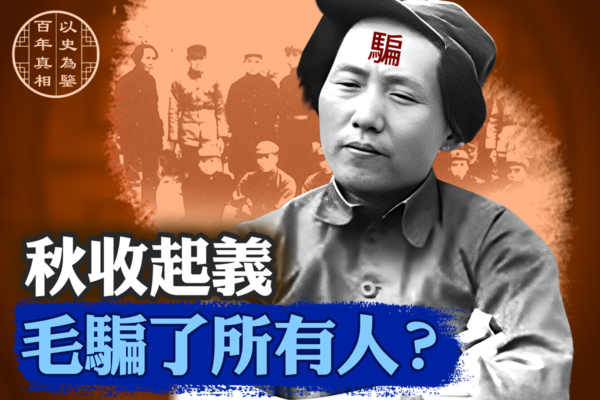
Hello, viewers, welcome to “Century Truths”.
In the history propaganda of the Chinese Communist Party, the “Autumn Harvest Uprising” has been portrayed as a peasant rebellion personally led by Mao Zedong. It has been packaged as the starting point of the armed struggle of the CCP and used to shape Mao Zedong’s image as a “leader of the peasant movement”.
According to official accounts, in 1927, Mao Zedong ventured deep into rural Hunan, inciting the masses to rise up, allegedly igniting the so-called “spark of revolution”.
However, as more historical records have been made public, many studies have found that this “uprising”, whether in terms of mobilization scale, operational methods, or final outcomes, is far from the official propaganda version.
So the question arises: Was the Autumn Harvest Uprising really a peasant revolution? Was Mao Zedong really leading the peasants in a “revolutionary uproar” at that time?
In today’s episode, we will travel back to 1927 and talk about what really happened during the Autumn Harvest Uprising.
According to the book “Mao Zedong – Little-known Stories”, in April 1927, when Chiang Kai-shek began the “anti-communist” campaign, Stalin had just become the top figure at the Kremlin. As the “emperor behind the scenes” of the CCP, Stalin personally set the course for China to counter Chiang Kai-shek’s party purge.
Moscow issued clear instructions to the CCP: they must establish their own army and base, ultimately overthrow the Nationalist government by force, and seize political power in China.
To implement this plan, Stalin sent his confidant Beso Lominadze to China. Meanwhile, the Soviet military intelligence system also became fully involved. Jan Berzin, head of Soviet military intelligence, wrote to the “Chinese Committee” Chairman Kliment Voroshilov, stating that the top priority for the Soviet Union in China was to establish the Red Army. As part of this effort, the Soviet Union deployed intelligence personnel in major Chinese cities to provide weapons, funds, drugs, intelligence to the CCP, sent military advisors, intensified training for CCP military backbone within the Soviet Union.
In other words, the CCP’s armed path in 1927 was not a result of “circumstances”, but a set of arrangements from Moscow.
According to Moscow’s deployment, the CCP’s armed path consisted of two steps.
The first step involved transferring the assembled troops to the southern coast to receive Soviet-supplied weapons and establish a base there.
The second step was to incite so-called “peasant uprisings” in Hunan and three other provinces with peasant associations.
Mao Zedong fully supported this route. At the emergency meeting hosted by Beso Lominadze on August 7, Mao stated, “Political power grows out of the barrel of a gun.” This statement later evolved into his famous quote – “Political power grows out of the barrel of a gun”.
At that time, Moscow had just removed CCP leader Chen Duxiu, shifted all blame for the split between the Kuomintang and the CCP onto Chen Duxiu, and appointed the more trusted young intellectual, Qu Qiubai. Mao was then only an alternate member of the Politburo, with no military authority or territory, and could be replaced at any time at the top level.
He understood that to maintain his position, he needed his own armed forces and territory to have the confidence to demand power from Moscow. However, Mao didn’t even have a gun in his hands, let alone a soldier. Moscow also did not arrange for him to be in charge of the military. Mao could only acquire a military force through other means.
In the summer of 1927, the largest armed force that the CCP could mobilize was the over 20,000 troops stationed in Nanchang. On August 1, under the direct command of Soviet adviser Kuyanting, CCP military officials including Zhou Enlai organized these troops to stage a mutiny. This became known as the “Nanchang Uprising” in CCP terms, and later this day was designated as the CCP’s “Founding Army Day”.
According to Stalin himself, this action was “the idea of the Communist International, completely the idea of the Communist International”. The uprising troops subsequently moved southward towards the port of Shantou, six hundred kilometers away, in order to receive weapons prepared for transport by the Soviet Union.
It was at this moment that Mao Zedong saw an opportunity.
Mao planned to seize a portion of these troops for himself. Since their planned route would pass through southern Hunan, in early August, Mao proposed to the Central Committee that he personally take charge in Xiangnan for the imminent Hunan Autumn Harvest Uprising.
Mao stated that if the Central Committee could allocate a regiment from the Nanchang Uprising forces and combine it with local peasant forces in Hunan, he would have the confidence to capture at least five counties.
At the time, Mao’s suggestion was approved.
According to the plan, the person responsible for the full-scale rebellion in Hunan Province was scheduled to meet at the Soviet Consulate in Changsha on August 15.
However, on that day, Mao was inexplicably absent. In fact, he had returned to Changsha three days earlier and was staying at the maternal home of Yang Kaihui. As one of the main leaders, the meeting had to be postponed to the next day.
When Mao finally appeared on August 16, everyone was displeased with his lateness, but he claimed to have conducted a “peasant investigation”.
In reality, those days Mao was not conducting any investigation. He delayed showing up because he was waiting for a result – whether the troops from the Nanchang Uprising could actually reach Xiangnan. If it wasn’t possible, he didn’t want to bother with the “Xiangnan Uprising” anymore.
Soon, the answer came.
Three days after the Nanchang Uprising troops left Nanchang, one-third deserted and half of the ammunition was lost. With temperatures soaring to over thirty degrees Celsius, in the high-temperature, water-deprived environment, soldiers could only drink water from puddles, getting sick and even dying. The troops scattered in disarray, making it impossible to detour to Xiangnan, with the only option being a rush towards Shantou.
Upon confirming that the troops would not pass through Xiangnan, Mao Zedong immediately changed his stance at the Soviet Consulate.
He strongly demanded the cancellation of his proposed Xiangnan uprising plan. The reason he gave was that the rebellion scope was too wide, it should be scaled down, focusing the forces and directly attacking Changsha. The Hunan CCP Provincial Committee later reported to the Central Committee that “Zedong is the most staunch supporter of the scaled-down uprising plan”.
Outsiders saw Mao Zedong’s actions as tactical adjustments, but in reality, he had no intention of actually attacking Changsha.
He proposed the idea of “attacking” because there were conveniently three red armed forces near Changsha that he could take under the guise of “attacking Changsha”. These three forces included active participants in the agricultural movement, unemployed miners and mine police after the closing of Anyuan coal mine; and a force that was originally stationed in Wuhan but was late to join the Nanchang Uprising. Collectively, they amounted to several thousand people.
Soon enough, Mao Zedong achieved his goal, becoming the Secretary of the “Front Commission” commanding these forces, ostensibly under the leadership of the Hunan CCP Provincial Committee. Mao had received no military training, yet he was acting as the front-line commander, mainly because of his enthusiastic adherence to Moscow’s instructions for “seizing power through uprising”.
Mao’s enthusiasm could be seen in a letter he sent to the Central Committee on August 20, in which he mentioned, “A certain comrade from the Soviet Union came to Hunan, mentioned the new international directives, advocated the immediate implementation of the Soviet of Workers, Peasants, and Soldiers in China, and upon hearing this, I am all ears. Objectively, China has long reached 1917… At this moment, we should have the determination to immediately establish the power of the Workers, Peasants, and Soldiers in the provinces of Guangdong, Hunan, Hubei, and Jiangxi. Once this power is established, victory on a national scale will be quickly achieved. I hope the Central Committee unquestionably accepts the international directives and implements them in Hunan.”
According to the original plan, September 11 was the agreed-upon uprising date. By that day, operations were set to commence in Changsha, with the Soviet Consulate closely monitoring the situation.
But at this critical juncture, Mao Zedong’s whereabouts suddenly became mysterious.
According to official accounts, Mao led one of the three troops from Jiangxi’s Tonggu. However, comrades who were close to Mao at the time, like He Changgong, stated that Mao never went to Tonggu that day but quietly stayed in Wenjiashi, one hundred kilometers outside Changsha. Eventually, all three troops were redirected to Wenjiashi.
This operational maneuver puzzled the Hunan CCP Provincial Committee. Caught off guard, they were forced to hastily announce the cancellation of the entire uprising on September 15.
Afterwards, the secretary of the Soviet Consulate, Marshalov, described the events as “the most shameful betrayal and desertion in history.” Moscow even directly denounced the incident as a “joke of an uprising”.
They evidently failed to realize that what seemed like enthusiastic statements and fervent calls for “uprising” and “attacking Changsha” by Mao Zedong before were merely a political ploy to rally troops to his command.
Thus, the Autumn Harvest Uprising, despite being glorified by the CCP, was essentially a far cry from the reality.
Even the self-critique provided by the Hunan CCP Provincial Committee to the Central Committee admitted that at the time, “not only did it not incite a revolutionary fervor among peasants to seize land, even the interest of peasants in this uprising did not exist”.
Mao Zedong had already planned out the true destination for these troops – Jinggang Mountain. Jinggang Mountain bordered Hunan and Jiangxi, an area where local governments paid little attention and had historically been a haven for bandits.
At that time, Jinggang Mountain was already under the control of two local leaders – Yuan Wencai, a former student, and Wang Zuo, a former tailor. These two men commanded around five hundred followers, controlling a significant portion of Ninggang County. With a population of one hundred thirty thousand, they maintained their influence through rent and taxation. Mao’s intention in going to the mountain was not to ally with them, but to take over their territory.
However, Mao was aware that leading troops into Jinggang Mountain without clear directives from the central authorities and approval from superiors could easily be condemned as “deviating from the organization” and may even lead to being treated as bandits. Mao feared that once this was revealed, it could directly endanger his life, so prior to announcing the decision at Wenjiashi, he sought support from several familiar individuals within the troops to back him up.
One of these individuals was He Changgong, a name given to him by Mao himself. He later recalled that Mao asked him and Yang Lisan to ensure his safety at the venue. He Changgong’s exact words were, “Yang Lisan and I were doing odd jobs and fetching cigarettes at the meeting place. We took turns – when you came in, I went out; when I went out, he went in.”
At the commander meeting convened in Wenjiashi, the discussions were heated. Almost all the commanders opposed going to the mountain, but eventually reluctantly obeyed Mao, as he was the only “representative of the Party” present.
Subsequently, the troops set off for Jinggang Mountain. Along the way, Mao wore his favorite long gown, with a cloth scarf tied around his neck, resembling a rural teacher. Initially, many officers and soldiers didn’t even recognize him, mistaking him for an ordinary civilian and nearly making him carry a gun.
However, when Mao declared that the troops were going up the mountain to become “kings”, everyone was stunned. They had joined the revolution not to become bandits. But Mao reassured them in the “name of the Party”, stating they were not ordinary mountain kings but “red mountain kings”, part of a global revolution, and going up the mountain was their only way out.
Despite this, many were still skeptical, and some even deserted. Mao didn’t force anyone to stay but set one rule – they could leave, but not with their weapons. He knew he had no means to force anyone to stay. Subsequently, the top two commanders left; they went to the Central in Shanghai and later defected to the Kuomintang.
The exhausted and sick troops faced difficulties on the way, with blistered feet, leg sores, dysentery; the campsite had a strong stench. Many individuals fell by the roadside and never got up.
Two weeks later, the troops finally reached Jinggang Mountain. By then, only around six hundred people remained with Mao Zedong, who had persisted till the end. Many who stayed were not so much steadfast but simply had no other path left.
However, it was this tattered and battered force that later became the core foundation for Mao Zedong’s continued expansion.
Thus, the so-called “Autumn Harvest Uprising”, in essence, was Mao Zedong deceiving people, seizing the opportunity to consolidate troops under his command, and not the peasant movement it was purported to be. The title “leader of the agricultural movement” ascribed to Mao Zedong was merely a facade.
Thank you for watching today’s episode. If you enjoyed our program, don’t forget to like, subscribe, and share. See you in the next episode.