
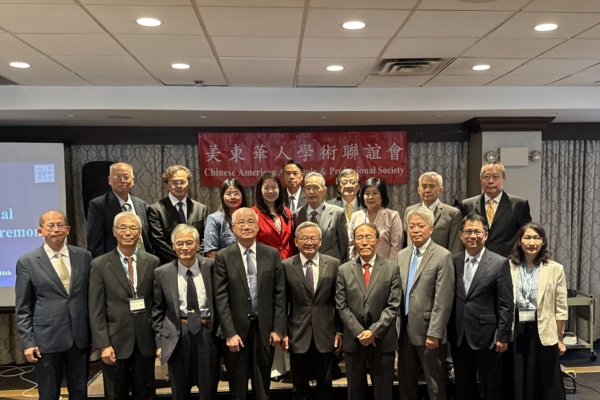
The Chinese American Academic and Professional Society (CAAPS) held its 51st annual conference at the Sheraton Hotel in Flushing, New York on August 16th with the theme “Advancing Academic Knowledge in the Era of Artificial Intelligence.” Experts and scholars gathered to deliver 23 speeches, focusing on the latest developments of artificial intelligence (AI) in fields such as healthcare, education, urban planning, transportation, and technological innovation.
During the opening ceremony and dinner, Dr. Lin Qingyong, founder of Graphen Inc., and Chairman Wu Chengwen of the National Science Council, along with former President of National Taiwan University Yang Panchi, respectively gave keynote speeches. They not only discussed global technological competition and trends in AI development, but also emphasized the importance of Taiwan-US cooperation.
As part of the welcoming ceremony at the opening and dinner, the organizers arranged for Taiwan’s first independently developed humanoid robot, “Aiter One,” to greet the guests, providing a captivating experience for the attendees.
At the opening ceremony, the Chairman of the Academic Society, Lin Fengbao, and President Wu Zhenfan delivered speeches welcoming the distinguished guests and expert scholars.
Chairman of the National Science Council, Wu Chengwen, expressed during the opening ceremony that the United States is a formidable force in innovation due to its freedom. He highlighted the importance of Taiwan-US cooperation, spanning from academia to industry, in fostering Taiwan’s industrial sector to embrace the spirit of free development seen in the United States.
Director of the Taipei Economic and Cultural Office in New York, Lee Chichiang, stated that the conference’s theme each year reflects the pulse of the times, showcasing various technological trends of different periods. Director Wang Yiru of the New York Overseas Chinese Cultural and Educational Services Center mentioned that CAAPS serves as a crucial bridge for academic and professional exchanges between Taiwan and the United States.
During the keynote speech at the opening ceremony, Dr. Lin Qingyong of Graphen Inc. shared the latest developments in artificial intelligence and humanoid robotics. He noted that the English pronunciation of Taiwan’s independently designed humanoid robot, Aiter One, resembles the Taiwanese phrase “Love Taiwan.”
Dr. Lin emphasized that humanoid robots of the future may directly enter households, hospitals, and enterprises, possessing the ability to see, hear, connect to networks, and perform practical tasks. Therefore, the sensitivity of information security and national security in these robots far exceeds that of typical consumer electronic products. The United States has closed its doors to humanoid robots manufactured in China, presenting an opportunity for Taiwan to gain trust and opportunities in the American market with a “non-red” supply chain. On July 28th, the United States banned Chinese-made humanoid robots and quadruped robots from entering the country.
Discussing the development of humanoid robots, Dr. Lin Qingyong pointed out that these robots also need to possess ethics and compassion, refraining from wrongful actions. Furthermore, in the future, robots may become platform products similar to the iPhone, offering different “souls” and functions through various apps, creating an expandable ecosystem that attracts software companies for joint development. Those who truly master the underlying platform have the opportunity to dominate the global competition, ensuring security and risk management to prevent dangerous or abnormal actions.
In the afternoon’s panel discussions, 20 experts engaged in multilingual exchanges in six major areas, freely sharing new knowledge with the public. The six areas included: 1. How artificial intelligence reshapes healthcare and health care services, 2. AI in healthcare: from discovery to clinical applications, 3. Education and culture, 4. Urban planning and transportation, 5. Technological innovation and applications, and 6. Trustworthy AI agents: from security towards autonomous businesses.
During the dinner, Chairman Wu Chengwen of the National Science Council delivered a keynote speech on “The Layout of AI Technology Development Policy under Geopolitical Challenges,” exploring global technological competition and trends in AI development. Professor Yang Panchi, former President of National Taiwan University, presented a keynote speech on “How Artificial Intelligence Assists in Enhancing Early Cancer Diagnosis and Precision Medical Capabilities.”
At the awards ceremony during the dinner, Chairman Wu Chengwen and Professor Yang Panchi were presented with the “Outstanding Leadership Achievement Award”; Dr. Lin Qingyong received the “Outstanding Technical Achievement Award”; Su Chunhuai was awarded the “Outstanding Community Leader Award”; New York First Bank received the “Outstanding Enterprise Award”; and the 2025 President of the Chinese American Academic and Professional Society, Xiao Xinghua, received the “Outstanding Service Award.”