
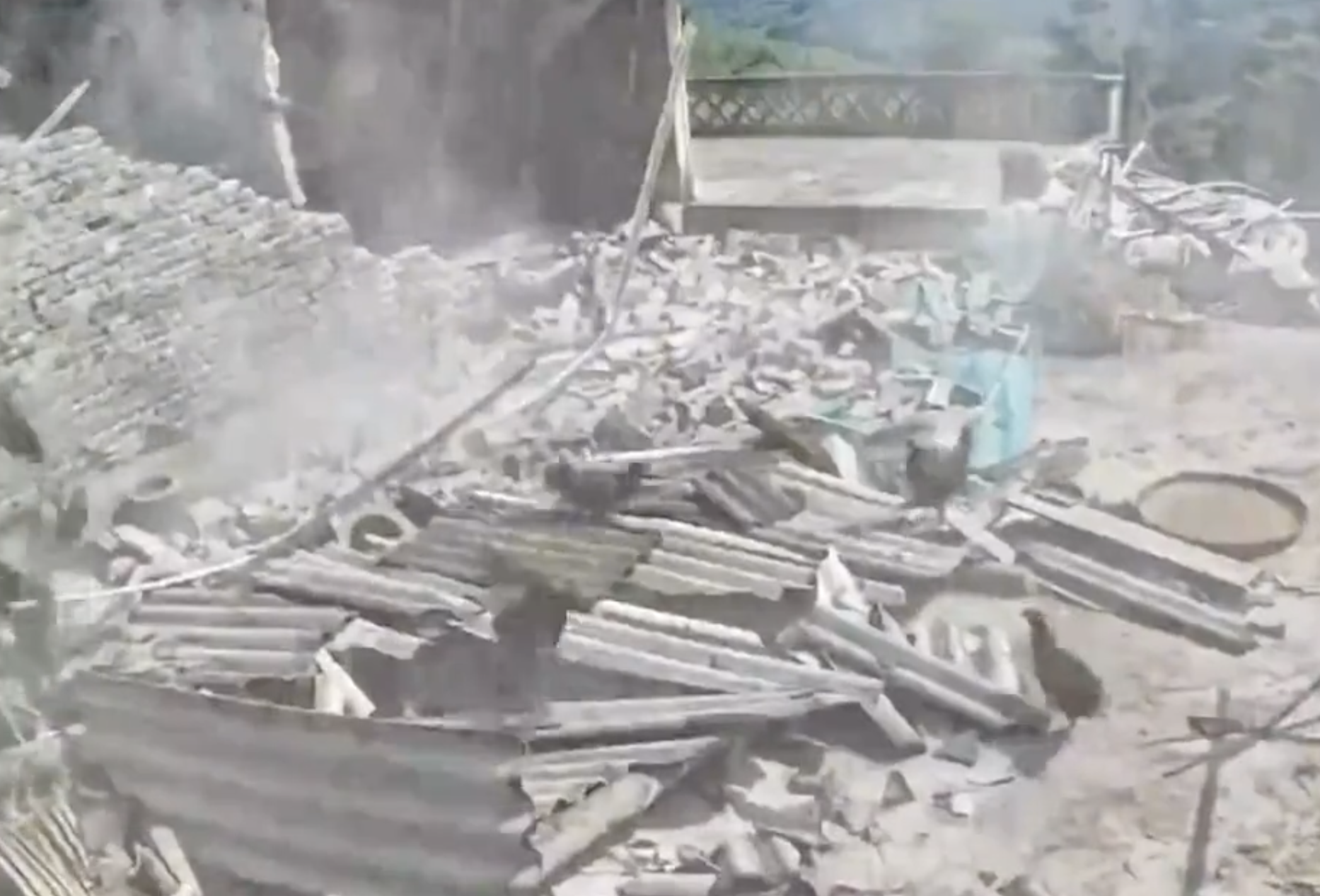
From June 29 to August 11 this year, a total of 35 earthquakes of magnitude 3.0 and above have occurred in Yibin City, Sichuan Province. The epicenters were concentrated near the border of Gaohsien and Gongxian counties in the southern part of Yibin City. Houses have been cracked, and some people were so afraid of the earthquakes that they moved out and slept in tents.
According to a report from Southern Weekend on August 15, records from the China Earthquake Networks Center show that Yibin City has experienced 35 earthquakes within a two-month period. Just on the early morning of August 11, Gongxian County had three earthquakes, all below magnitude 4 but with noticeable shaking. A 25-year-old resident named Tang Lin revealed that during the first earthquake, she didn’t wake up; during the second one when it was getting light, she was shaken awake feeling like the bed was shaking violently, as if someone was vigorously stirring a pot. The third earthquake occurred at 10:51 am, when Tang Lin was on the first floor of an office building. She first heard a rumbling noise, then felt waves of trembling earth coming towards her. According to the rapid report from the China Earthquake Networks Center, a 3.4 magnitude earthquake happened near Fuxing Town in Gaohsien County. The new area in Gongxian County where Tang Lin resides is less than twenty minutes’ drive from the epicenter.
Many people took to social media to share their experiences after the constant earthquakes: being woken up at night and too afraid to fall back asleep, cracks appearing in their homes, worrying about safety, and moving out to sleep in tents but feeling like they were being steamed due to the heat.
Although the 35 earthquakes did not cause serious damage, Wang Tan, director of the Chengdu High-tech Disaster Reduction Research Institute, said that the damage caused by earthquakes has a cumulative effect. “It’s not just the damage to buildings that accumulates but also the long-term psychological pressure on residents. For such a series of earthquakes, ongoing assessments of building earthquake resistance and psychological support for residents are needed,” Wang Tan mentioned.
After entering summer, Yibin began to experience frequent earthquakes. On June 29 at 12:02 am, Gaohsien’s Shahe Town in Yibin was hit by a 5.5 magnitude earthquake with a depth of only 6 kilometers. On August 8, the Sichuan Provincial Seismological Bureau announced that up to that day, there had been eight earthquakes of magnitude 4 and above recorded in the sequence of the 5.5 magnitude earthquake in Gaohsien.
Public information shows that Yibin is located on the south bank of the upper Yangtze River, situated at the southern edge of the Sichuan Basin and the northern foothills of the Yungui Plateau, in a transitional zone from a plateau to a basin where folds and faults intertwine underground. This means that the region has highly concentrated crustal stress and extremely unstable structures. This geological structure is a key characteristic of earthquake zones or seismic structural zones. Yibin is indeed located on the eastern edge of the southern segment of China’s north-south seismic belt.