
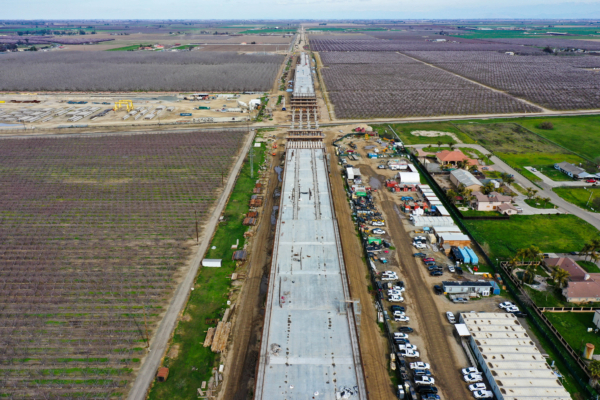
California High-Speed Rail Authority (HSRA) released its “2026 Commercial Plan” on June 1, indicating that due to the continuous expansion of funding gaps, cost-reduction measures will be implemented for the early operational section scheduled to open in 2032-2033 from Bakersfield to Merced, spanning 171 miles. These measures include streamlined station designs, infrastructure configurations, and reduced service levels.
The initially designed high-speed rail project linking San Francisco and Los Angeles has seen its estimated total cost soar to $126.08 billion, far exceeding the $33 billion estimated at the time of voter approval in 2008. In 2025, the U.S. Federal Railroad Administration revoked about $4 billion in grants, citing cost overruns and severe delays in construction progress.
In accordance with the revised “2026 Commercial Plan,” stations in Merced, Fresno, Kings/Tulare, and Bakersfield will be designed and built to meet the initial operational requirements of eight trains in each direction daily.
Under the strategy to reduce construction costs, the Merced station will be relocated from the city center to the southeast area. Bakersfield will have a temporary station set up first, around 5 miles away from the originally planned city center station.
Matt Serratto, the Mayor of Merced, mentioned in an interview with a media outlet that this approach would save a significant amount of time and funds, reduce construction inconvenience, and avoid the demolition of many crucial businesses and municipal facilities. However, he acknowledged that some individuals support having the station in the city center to drive economic activities.
Karen Goh, the Mayor of Bakersfield, previously wrote to the High-Speed Rail Authority expressing concerns. She stated that the sudden shift to a temporary station on the outskirts of the city contradicts the long-standing efforts and investments made by the city government based on the promise of a world-class downtown station, raising doubts about the credibility of the project’s promised benefits.
According to the “2026 Commercial Plan,” the total cost of the Merced to Bakersfield section is approximately $34.76 billion, a reduction of about $1.9 billion from the estimate provided by HSRA Chief Executive Ian Choudri on August 28, 2025; however, there is still a funding gap of $6.6 billion.
To fill this gap, the California High-Speed Rail Authority plans to allocate $1 billion annually from 2025 to 2045. The funding source is the California Cap-and-Trade program, which allows companies to purchase carbon emissions quotas in the carbon trading market.
On the other hand, to address the long-term funding gap, the HSRA introduced new financing concepts in the draft commercial plan, facing strong opposition from cities along the route.
The HSRA proposed the “Enhanced Infrastructure Financing District” (EIFD) in the draft commercial plan, seeking legislative authorization. This involves establishing Tax Increment Financing (TIF) districts within half a mile of the planned stations to invest the future property tax and partial sales tax revenue growth into high-speed rail construction and related commercial development.
This proposal sparked intense backlash from local governments. After the release of the “2026 Commercial Plan” draft on February 28 this year, in April, ten mayors from cities including Bakersfield, Gilroy, and Hanford jointly wrote to the Rail Authority opposing the use of additional tax revenues around the stations as a funding source for the high-speed rail.
The mayors expressed in their joint letter: “The proposal in the draft ‘2026 Commercial Plan’ essentially attempts to divert locally controlled tax revenue sources, undermine constitutional protections passed by voters, and erode the fiscal stability of California cities to fill the substantial financial uncertainties of this project.”
Greg Bozzo, the Mayor of Gilroy, expressed initial confusion about the proposal which later turned into dissatisfaction upon understanding its implications. Bozzo pointed out a lack of coordination with local governments throughout the process, stating that it seems the High-Speed Rail Authority is trying to push this through unnoticed and unopposed.
A spokesperson for the Rail Authority replied, asserting that no policies overriding local land use rights or taxation authorities were proposed. The discussion was centered on whether there might be opportunities in the future to reinvest a portion of the increased value generated by surrounding developments and state government investments into relevant infrastructure construction. Similar cooperation models have been observed between other local governments and transportation agencies in California.
Karen Goh mentioned that she has been in discussions with the Rail Authority on various feasible solutions, hoping to achieve a win-win outcome and ultimately construct a world-class station in the downtown area of Bakersfield.
Other mayors contacted by the media outlet, including Mark Kairis from Hanford, Bozzo, and Serratto, confirmed signing the joint letter of opposition. Serratto stated, “Using local tax revenues to fund such a massive project is inappropriate. This project is of such a scale that it should be funded by state and federal governments.”