
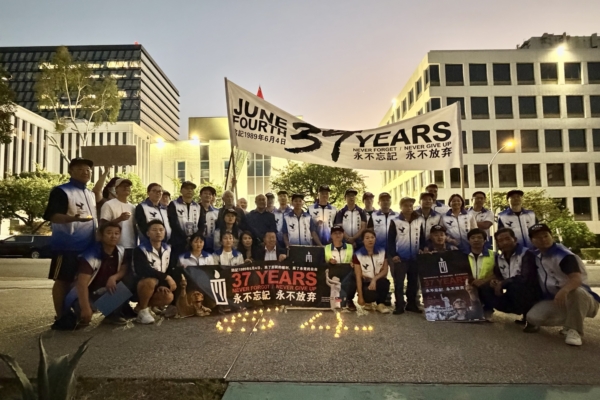
37 years have passed since the Tiananmen Square massacre, where the university students who gathered there are now approaching old age. However, the memories of the atrocities committed by the Chinese Communist Party have not faded. This year in Los Angeles, the number of people participating in memorial events has increased, with more and more young people taking on leading roles.
Born in the 1990s, Cao Wenbo, with his skilled guitar playing and powerful voice, has garnered much attention for cheering on the events. Leading the gathering in singing “Wounds of History” and performing his original song “Tiananmen Square of June Fourth,” he has become a unique feature of the series of assemblies.
Cao Wenbo told reporters that he had a deep love for music and particularly for the guitar since he was young, practicing diligently every day. To learn more techniques, he used a VPN to access educational resources and discovered a wealth of truths that were not visible within the Great Firewall.
“I saw the long-covered up crimes and lies of the Chinese Communist Party. At that moment, I felt a huge shock, and my worldview began to crumble,” Cao Wenbo said. The most profound impression for him was the truth about the June Fourth incident.
He learned that the students on Tiananmen Square were brutally suppressed simply for calling for democracy and reform. “The young people who should have been the pillars of the country were labeled as ‘counter-revolutionaries’ and had to face tanks and guns,” which left him shocked and heartbroken.
Afterward, Cao Wenbo began to reexamine all the information indoctrinated by the CCP and treated the “system long shrouded in lies” with skepticism and criticism. “At that time, I even felt that in China, only music was real,” he said.
Later, Cao Wenbo was summoned and warned by the police for posting online to refute the propaganda against Taiwan and the threats of attacking Taiwan by the internet “50-cent army.” After fleeing to the US, he joined a pro-democracy group and showcased his musical talents in numerous activities.
Similar in age to Cao Wenbo, pro-democracy activists are now the main force protesting against the CCP in Los Angeles. Apart from being logistics volunteers, they often take on vital roles such as event hosts and speakers.
At a recent “China Forum” seminar held by the June Fourth Memorial Museum, dedicated to exploring how the “Generation of June Fourth” and the “Blank Generation” can cooperate. Lui Yiheng, born in the 1990s, expressed that many young people in China have awakened to realizing that the true way to change their lives and future is “to rise up and overthrow the Communist Party.”
Lui Yiheng mentioned that the best time of the 1990s generation was delayed for years due to the CCP’s mismanagement during the pandemic. “If there had been no blank paper revolution and resistance back then, our lives would have been wasted for much longer,” he said. “If everyone stands up to resist, in ten years, we will surely thank our current selves.”
Regarding how to better cooperate with the younger generation, Zheng Cunzhu, Chairman of the Joint Headquarters of the Chinese Democratic Party, suggested drawing lessons from the “Blank Paper Movement”: when the movement suddenly erupted, overseas pro-democracy movements failed to intervene in time, and by the time they began to pay attention, the movement had already ended.
Zheng Cunzhu advocated learning from the early approach of the Democratic Progressive Party in Taiwan, repeatedly training and cultivating a “new army” domestically to quickly build teams and intervene in movements, thereby better seizing opportunities when the anti-Communist wave rises again among the people.
The Joint Headquarters of the Chinese Democratic Party held the June Fourth memorial gathering in front of the Chinese Consulate on the evening of the 3rd, with about 150 participants, many of whom were young people.
Zheng Cunzhu believes that compared to the era of the 1989 pro-democracy movement, the CCP seems to have more financial resources and appears very powerful with high-tech surveillance methods. Therefore, ending the CCP’s rule requires more public support than 37 years ago.
However, he also pointed out that the CCP is currently outwardly strong but inwardly weak. Over the past few years, people from all walks of life in China have been continuously relocating overseas, with many industry elites, including CEOs of listed companies, moving their businesses and families to the United States this year alone.
“The totalitarian rule of the CCP is like a meat grinder, where anyone, including high-level CCP members and so-called party and state leaders, is always worried about their own lives and fortunes,” he said. Those within the system who want a way out “must embrace a future China of freedom and democracy just like us.” ◇