
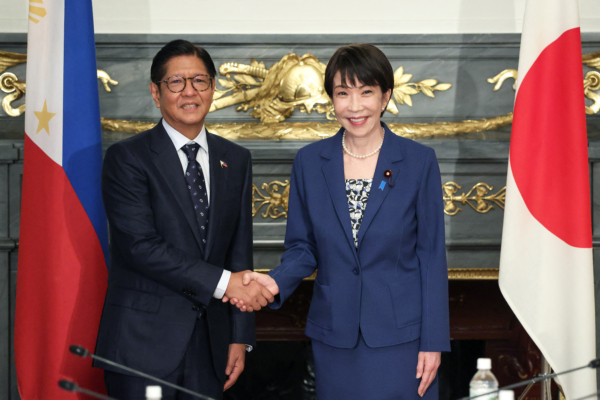
In response to the invitation from the Japanese government, Philippine President Ferdinand Marcos Jr. embarked on a four-day state visit to Japan. On Thursday, May 28th, Marcos held a summit meeting with Japanese Prime Minister Sanae Takichi in Tokyo, announcing the elevation of the bilateral relationship to a “Comprehensive Strategic Partnership.”
This visit sends a clear signal: amidst growing concerns over China’s military expansion activities in Asia, Japan is eager to upgrade its ties with the Philippines. Japan regards the Philippines as a key partner in defense cooperation and a major arms customer. Both leaders agree that as like-minded maritime democracies, the Philippines and Japan have entered a “platinum era” of unprecedented trust and strategic coordination.
To address China’s increasingly brazen provocations in the South China Sea and around Taiwan, Japan and the Philippines have been steadily enhancing their defense and security relationship. For Marcos, closer alignment with Japan aligns with the Philippines’ efforts to strengthen strategic ties with the United States and its allies in response to conflicts with Chinese vessels in disputed waters.
The leaders of both countries emphasized the importance of trilateral cooperation among the US, Japan, and the Philippines in maintaining regional stability. They also pledged to further enhance coordination with like-minded partners such as Australia and India to collectively uphold a rules-based, free and open international order, building a robust barrier against Beijing’s ambitions.
In a joint statement, both countries expressed serious concerns over the situations in the East China Sea and the South China Sea, reiterating strong opposition to any attempts to unilaterally change the peaceful status quo through force or coercion. They highlighted the importance of maintaining peace and stability in the Taiwan Strait and reiterated support for the final arbitration ruling on the South China Sea issued in 2016, emphasizing that all parties involved in disputes must adhere to international law and the United Nations Convention on the Law of the Sea (UNCLOS).
Within the framework of a “Comprehensive Strategic Partnership,” Japan and the Philippines have made significant progress in military cooperation, particularly in four key areas:
1. Military Intelligence Sharing Agreement:
The leaders of both countries have decided to officially begin negotiations on an agreement to protect classified military intelligence. This initiative will establish a higher level framework for intelligence sharing, deepening bilateral defense cooperation and significantly enhancing trilateral military coordination and interoperability among the Philippines, Japan, and their common ally, the United States.
2. Key Access and Logistics Support:
Both sides praised the Philippines-Japan Reciprocal Access Agreement (RAA), which officially took effect in September 2025 and has been applied in multiple joint exercises. Additionally, the two countries are coordinating closely to facilitate the early implementation of the Agreement on Mutual Provision of Supplies and Services (ACSA) signed in January 2026, providing legal safeguards for visits and logistical support between the Japan Self-Defense Forces and the Philippine Armed Forces.
3. Defense Equipment and Technology Transfer:
With the Takichi government lifting the ban on lethal weapons exports and revising the Principles of Defense Equipment Transfer, the Philippines has become a core customer for Japanese arms. Japan is considering providing naval destroyers and TC-90 patrol aircraft to the Philippines through the Official Development Assistance (ODA) framework. The Philippine Defense Minister has also expressed strong interest in Japan’s Type 88 anti-ship missiles.
4. Maritime Legal Order and Boundary Setting:
In order to counter China’s illegal expansion in the region, both countries have decided to initiate negotiations on the delimitation of Exclusive Economic Zones (EEZs) and continental shelf areas. Marcos extended gratitude to Japan for ongoing assistance to the Philippine Coast Guard, including the provision of multiple coastal surveillance radars and patrol vessels.
Beyond military alliance, Japan and the Philippines will also extend cooperation to economic security, aiming to mitigate the risk of supply chains being “weaponized” by China.
Both sides expressed deep concerns over various forms of economic coercion and non-market policies, deciding to deepen the resilience of supply chains in strategic industries such as critical minerals, semiconductor and electronics, renewable energy, and automotive manufacturing. Japan encourages its companies to actively participate in the construction of the Philippine manufacturing ecosystem, supporting the industrial upgrade of the Philippines.
Furthermore, in advanced technologies, the two countries will cooperate through the “Japan-ASEAN Artificial Intelligence (AI) Co-creation Initiative” to construct a secure and trustworthy AI ecosystem, and implement the concept of the Free and Open Indo-Pacific (FOIP) digital corridor, strengthening cooperation on submarine cables and 5G Open RAN and other digital infrastructure to reduce excessive reliance on specific countries’ technologies.
Japanese officials have expressed strong desire to extend the partnership with the Philippines beyond Marcos’s presidential term ending in 2028. The core consideration is to establish a institutionalized, multi-layered, and stable framework to avoid the vacillations in Philippines’ policy towards China seen in the past.
Takichi and Marcos emphasized in their joint statement that against a backdrop of geopolitical uncertainty, the two countries, as like-minded nations sharing fundamental values and principles, will continue to develop a resilient long-term partnership, jointly facing future strategic challenges.