
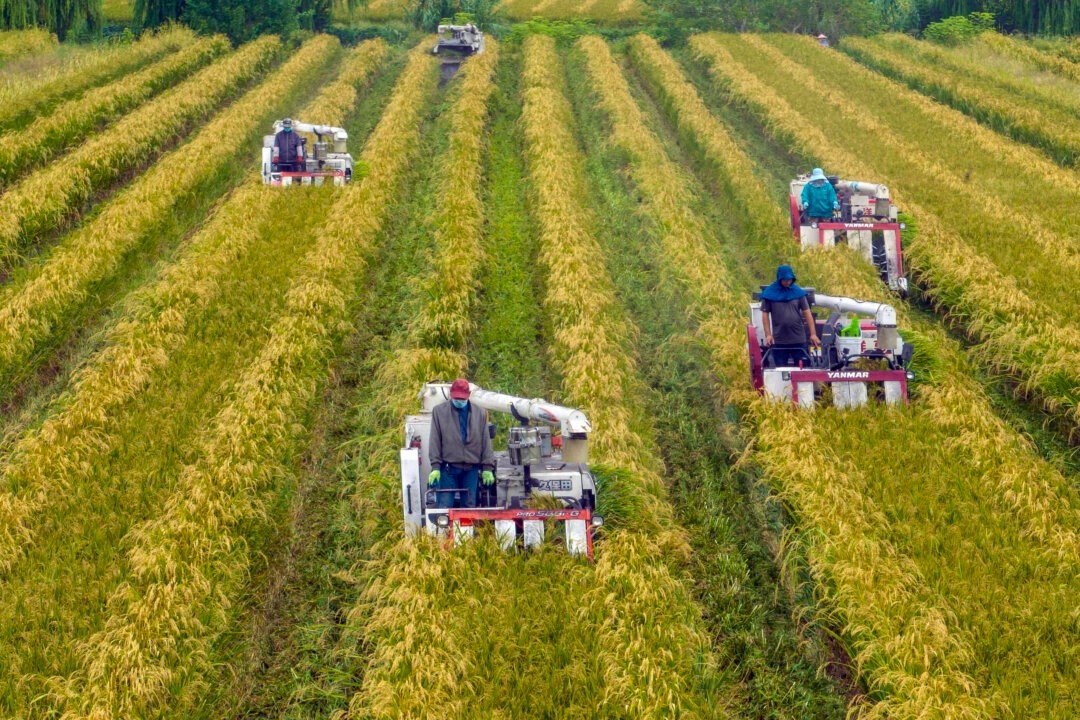
In the wake of the confusion caused by the “returning forest to farmland” campaign, a new scandal called “paper farming” has recently been exposed in Hunan Province. According to reports, in Jianghua County, Hunan, the actual area of rice cultivation is only 230,000 mu (approximately 38,000 acres). However, in order to meet the rigid agricultural targets set by the authorities, they fictitiously fabricated nearly 150,000 mu (approximately 24,800 acres) on paper, falsely reporting it as 389,000 mu (approximately 64,300 acres).
On the CCTV program “Focus Interview,” it was reported that since 2023, when Jianghua County released its annual statistical bulletin, the local rice area has consistently been around 390,000 mu. However, journalists found through verifying the actual area for which rice subsidy targets were issued that the real rice planting area is only around 238,000 mu, with nearly 150,000 mu of “rice” being falsely reported.
More ironically, a statistics table on the area of early rice in 2025 from Taowei Township office showed that not only did each village “complete” the task, but the actual area of early rice planted exceeded the target area.
In reality, in order to “complete” the 390,000 mu rice task, the Taowei Township demonstration base for double-season rice in Jianghua County, New Dashankou Village, invented the “visible range farming method.” They only planted rice in areas visible from the roadside and to inspectors, while planting economic crops such as loofah and pumpkin in the deep fields. A leader in Jianghua County stated, “To accomplish the task, you must plant rice where the eye can see.”
A town official in Taowei Township of Jianghua County mentioned that there is a lot of “leeway” in their annual task of around 35,000 mu of rice. An employee in Taowei Township stated that they actually only managed to complete 20,000 mu, so in order to pass inspections, they falsely added another 20,000 mu to the accounts, which were then distributed to village cadres, each claiming 200 mu, but in reality, nothing was planted.
Investigations showed that a ledger in Luojiazhai Village in Taowei Township indicated that three major contractors in the village planted over 100 mu of early rice each, with a total area of over 450 mu. However, further inquiry revealed that two of them were village cadres, who were not listed in the early rice planting list. The 2026 early rice planting form for Luojiazhai Village confirmed that the actual area of early rice planted in the village was only 140 mu.
The ledger also showed that in 2025, the early rice planting area in Cangwu Village of Taowei Township was recorded as 201 mu, but another statistics table from 2025 for early rice in townships listed the reported planting area by farmers as 0. After “verification by the village and township,” it was changed to 11 mu. The rice planting area in 2026 was reported as 41 mu, but only 23 mu were actually planted. The rice planting tasks in other villages of Taowei Township also have “leeway.”
Faced with blatant data manipulation, the local agricultural department officials responded by likening the reporting of data to “writing articles,” stating that “as long as there is no wasteland, the task is considered completed,” and that it is “impossible to be completely accurate.”
After the exposure of these practices, netizens expressed their discontent, with some saying, “This kind of situation exists everywhere, with rice seedlings drawn in the scenic rivers of wetland parks just to pass inspection, or even turning lawns into fields of rapeseed.” Others noted that the culture of falsifying data has persisted, with deception between different levels of authority becoming all too common. Some also highlighted the issue of forest coverage rates, noting that they only seem to go up each year because they cannot decrease.