
A young man in his twenties walks the streets of Shenzhen at night. He says that over twenty days ago, he came from Sichuan to this city once known as the “Chinese Dream Factory,” hoping to find a job. However, not only did he not find work, but he was also cheated out of some money by unscrupulous intermediaries. Today he hasn’t eaten all day and worries about where he will sleep at night. The weary man asks in a weak voice, “What should I do next?”
This scene was captured on the “Dark Side of China” Youtube channel. In the same video, on a dark summer night in Shenzhen, looking down from a bridge near the Sanhe Talent Market in the Longgang District, there are about twenty people in dim light, some in thin clothes, some shirtless, lying on the roadside. The videographer sighs, “Most of them are day laborers who can’t even afford a 15 yuan bed for the night. This is the current situation in Shenzhen.”
A segment from the “Real China” YouTube channel shows a scene on the hot summer streets where a recruitment organizer yells at a group of people with suitcases who look like students, saying, “Temporary workers for 9 yuan, those who can’t accept it, leave with your luggage.” No one in the crowd negotiates or leaves, just quietly listening to the job details.
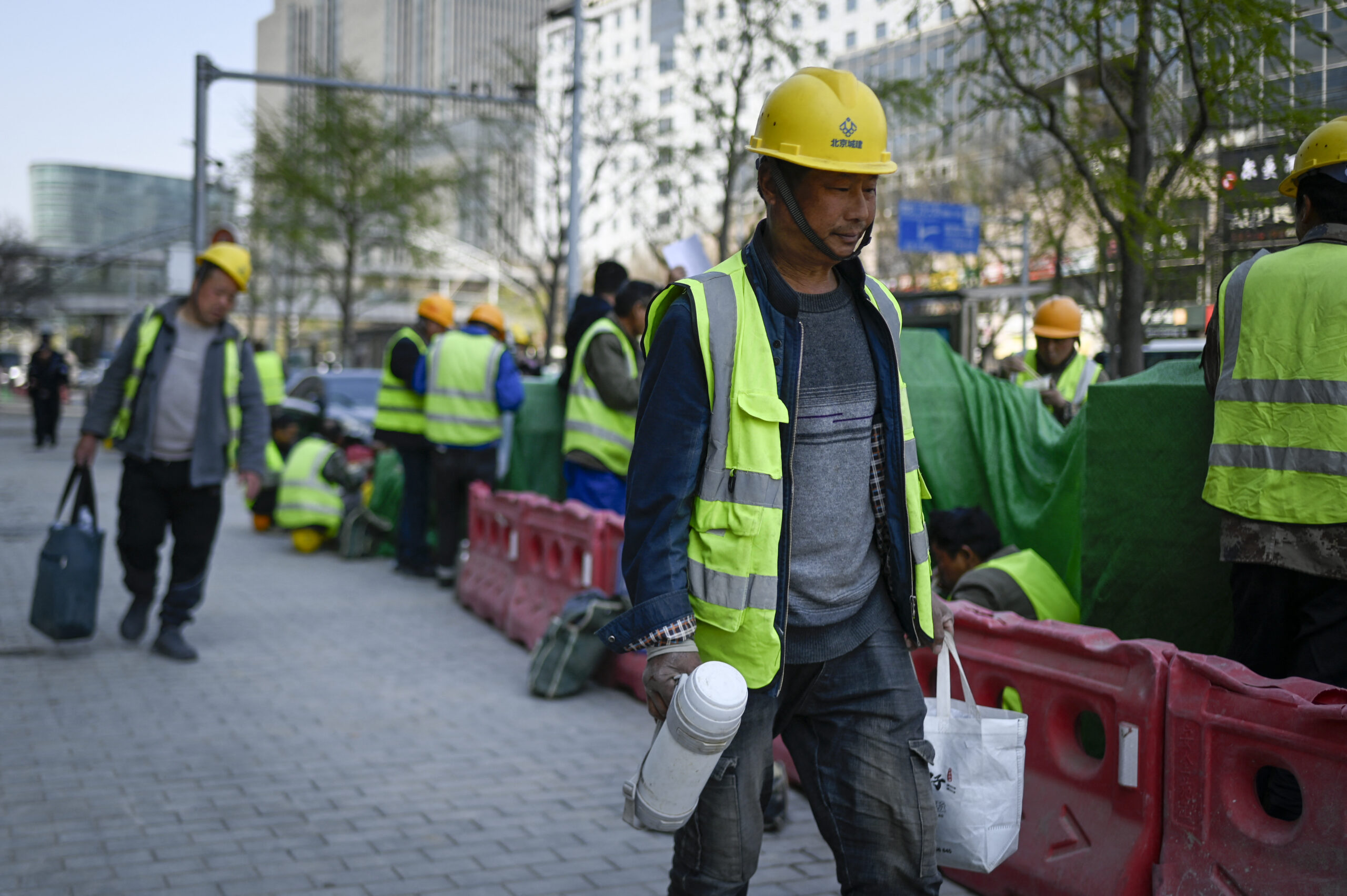
This reflects the harsh reality of China’s current labor market – against the backdrop of continued economic decline, countless ordinary people find it extravagant to even “find a job that can support themselves and their families.” At the same time, the CCP recently launched a 5-year consumption plan worth 6 trillion yuan. Experts point out that if labor protection, household income, and social safety nets are not substantially improved, the official plan to “boost domestic demand” may have difficulty truly materializing.
If the above situation represents a real portrait of a segment of the bottom of the Chinese labor market, recent reports of lay-offs from tech companies seen as representatives of China’s new economy have started to attract market attention.
On July 14, mainland China’s Caixin website quoted multiple Meituan employees who revealed that since early May this year, several departments including core business areas have started laying off employees with a compensation scheme of “N+1 (one month’s salary for each year of service).” The layoffs covered core business departments such as “Group Purchasing in Stores,” “Meituan Flash Purchase,” and “Commercialization.” An employee mentioned that in her non-core business department, 20% of employees were laid off, while another 60% face job transfers.
In response, Meituan stated that the actual number of employees who left in the past two months was less than 2,000, and it does not constitute a high proportion of the overall workforce. According to Meituan’s annual report, the company had around 110,000 employees last year.
Furthermore, Xiaomi Group recently reported on lay-offs. The report cited Xiaomi employees who mentioned that the company initiated lay-offs in March this year, involving departments such as smartphones, automobiles, networks, international, covering positions in research and development, testing, product, and marketing. It is understood that the lay-offs are still ongoing.
However, Xiaomi explained the changes as “normal business team adjustments” and emphasized that there is no such thing as “mass lay-offs.”
While Meituan and Xiaomi have clarified or denied the layoff reports, such news still quickly drew widespread attention on social media. Some people expressed on social media, “Companies like Meituan and Xiaomi, which are best adapted to the Chinese environment, are laying off employees. Are there any other companies with a way out? A stable job is the biggest ‘domestic demand’ for the current ordinary people.”
As ordinary people seek stable jobs to support their families, the Chinese authorities announced the first five-year plan to promote consumption with a goal of reaching a total of 60 trillion yuan in social retail sales by 2030.
According to a report from China’s official Xinhua News Agency, the State Council of the CCP approved the “Expansion of Consumption Fifteen-Five Plan” on July 13, aimed at expanding consumer scale and increasing resident consumption rates over the next five years. The plan focuses on “service consumption” areas such as elderly care, childcare, cultural tourism, new energy, new quality productivity, and medical services, and proposes promoting “AI + consumption” to create new consumption scenarios.
The “plan” also promises to increase income, optimize social security systems, so that by 2030, residents will have more solid consumption foundations and more stable expectations and confidence, while making progress in high-quality and full employment.
Reuters points out that the “plan” reflects the slowing pace of consumer goods consumption and the decision-making level is seeking to transform resident consumption into a more robust economic growth engine.
However, in the harsh economic environment of China, there is a serious mismatch between the immediate concerns of the people and the direction of the government’s policies on how to address economic issues. Former head of Morgan Stanley’s Asia region, Stephen Roach, has repeatedly issued warnings. In his view, the biggest issue with the Chinese economy is not how to “force” people to consume, but how to increase residents’ income so that they “dare to spend.” Roach has thus become the first Western economist to emphasize the necessity for China to undergo economic rebalancing.
Just about a week before the CCP announced the above “plan,” Roach, who currently teaches at Yale University, published an article titled “Failed Economic Rebalancing in China.”
Roach points out that China’s efforts to shift its economy from investment and export-driven to consumption-driven rebalancing have been ongoing for nearly 20 years but have been thoroughly unsuccessful. The share of household consumption in GDP has remained stagnant at around 39.9%, almost the same as when Premier Wen Jiabao raised the issue of the “Four Inadequacies” in 2005, if not lower.
It is reported that Premier Wen Jiabao admitted that there were “instabilities, disharmonies, imbalances, and unsustainability” in China’s economic development at that time.
Roach further points out that China is currently facing exacerbated structural issues such as a real estate crisis, low share of household income, youth unemployment, aging population, etc. Meanwhile, in May this year, China’s retail sales fell by 0.6% year-on-year, the first monthly decline in three and a half years, highlighting weak consumption. He emphasizes that the core obstacle lies in the incomplete social safety net for residents, leading people to engage in serious precautionary savings, thereby suppressing consumption. In other words, residents are not unwilling to spend; they are afraid to spend.
Roach bluntly states that the fundamental reason for the ongoing worsening issues is that the authorities “promise a lot but deliver little, losing all credibility.” He points out that despite Xi Jinping and Li Keqiang repeatedly emphasizing boosting domestic demand, policies over the past 20 years have lacked substantive breakthroughs, leading to a loss of credibility. The recent measures like some relaxation in household registration restrictions and facilitation for joining social security in different regions, while a small step, are still far from enough.
He also highlights a grim reality: the Chinese people are still outsiders in economic growth, with most gains being monopolized by the state, state-owned enterprises, and large companies. He also expresses strong skepticism about the prospects of China’s “middle-class” population that symbolizes social prosperity.
Roach’s doubts are confirmed in the daily lives of ordinary Chinese people. As income anxiety is not only limited to young individuals starting their careers but is also affecting middle-aged and middle-class citizens. A segment from the “Bottom of China” YouTube channel shows Ms. Li, 38, who used to have a stable life, having lost her job and accumulated debts of 890,000 yuan. She spends her days driving a smelly garbage collection truck in the community and also works part-time delivering food because she needs to support her two children.
“My house won’t sell, I can’t borrow money, and my car keeps depreciating.” She helplessly says, “This kind of life really leaves one breathless.”
Another middle-aged woman in the video, who used to be a private entrepreneur with hundreds of employees and assets worth tens of millions of yuan, now faces an even more tragic fate. After her company went bankrupt, she borrowed money everywhere to repay debts. Now, she can only afford to eat one steamed bun a day, and she can’t even borrow money to raise 500 yuan to buy medicine for her over 80-year-old, seriously ill grandfather.
“Now I realize, when you fall down and have no money, nothing really matters.” She says.
These stories reflect the harsh reality of shrinking household assets and declining income expectations in ordinary families in China under economic downturn, indicating the rapid disappearance of the “wealth effect” among the middle class.
Roach warns once again that if China’s economic policies continue to heavily rely on export trade and are reluctant to transition to a consumption-led economy, they will ultimately pay the price. He points out that the authorities still rely on exports and “new quality productivity,” with the expectation that by 2030, China’s share in global manufacturing will rise to 45%, which is expected to exacerbate the trend of resistance to Chinese goods from the US to Europe. Roach warns that the lack of rebalanced growth remains the biggest macro challenge facing China and could become its “Achilles’ heel” in global ascension.
American economist David Wong, in an interview with The Epoch Times, pointed out from another perspective that Western economists’ belief that “the long-term low share of Chinese household consumption in GDP is misplaced” is actually a misjudgment. He explained that in Western societies, services like healthcare, education, and elderly care are often public services, with individuals bearing minimal personal burdens. However, in China, it is entirely different; these basic survival needs function largely as “consumption,” with most costs being borne by the people themselves.
David Wong bluntly states that the enormous expenses related to essential survival needs such as healthcare, education, and elderly care lead to a serious lack of discretionary income for Chinese people, making it difficult to increase other forms of daily consumption improvements. In the current severe economic downturn, coping with survival is the primary concern for the people.
During the “Two Sessions” in March 2026, Premier Li Keqiang claimed to increase rural residents’ pensions by 20 yuan per month, which became a hotly debated topic. David Wong cites this example, pointing out that the authorities’ promise to further improve social security by 2030 in the “plan” is essentially a “black comedy” of meager offerings.
David Wong notes that while some hourly wages are compressed to only 9 to 12 yuan, and university and doctoral graduates face unemployment, when the “survival bottom line is mercilessly pierced,” the authorities are talking about social security optimization in 2030, where both the scale and amount optimized are extremely paltry, akin to a detached “wishful thinking.”
He mentioned that although China’s labor laws are strict on paper, they are rarely rigorously enforced at the grassroots level. These regulations serve mainly to address international public opinion and project an image of modern governance, while the true core governance tool is maintaining a low-cost rule of despotism through tolerating exploitation and oppression.
David Wong concludes by stating that if labor protection, resident income, and social safety nets do not undergo substantial simultaneous improvement, the grand plan of the authorities to “boost domestic demand” will struggle to truly materialize.