
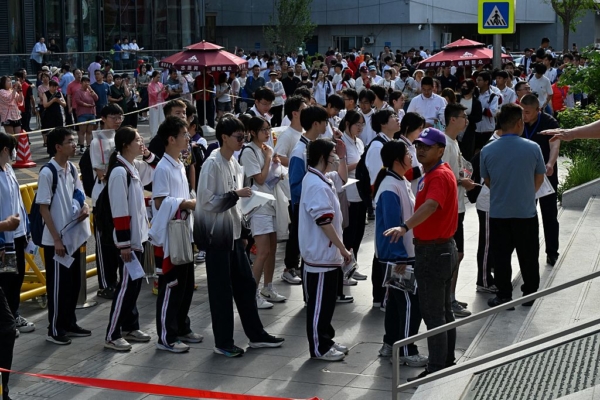
In 2026, the mainland China’s national college entrance examination (Gaokao) is set to begin on June 7th. As the exam approaches, various regions have started issuing reminders about examination room security checks, expanding the precautions from mobile phones, smart watches, smart wristbands, and smart glasses to ordinary glasses worn by examinees. Many places are requiring examinees to remove their glasses before entering the exam hall for specialized inspection by invigilators.
According to reports from mainland Chinese media on June 3rd, the Guangdong Provincial Education Examination Institute issued a reminder for the 2026 National College Entrance Examination, stating that when examinees undergo security checks upon entering the exam hall, they must voluntarily remove the glasses they are wearing or carrying, place them on the table for inspection by invigilators under video surveillance.
The reports mention that several provincial education examination institutes have issued notices requiring Gaokao examinees to undergo inspections of the glasses they wear or carry before entering the examination hall.
On June 1st, the Shanghai Municipal Education Examination Institute released instructions for examinees, stating that if examinees wear framed glasses, they should cooperate with invigilators for inspection before entering the exam hall.
During a training video conference on the examination affairs for the Fujian Province’s National College Entrance Examination, it was mentioned that this year, there will be enhanced security checks upon entry, focusing on preventing the use of new smart glasses. Examination staff will pay attention to factors like the size and shape of the glasses worn by examinees who usually use smart glasses.
The Inner Mongolia Autonomous Region Education Examination Institute reminded that examinees who usually wear smart glasses must prepare regular optical glasses before the exam. Provinces such as Hebei and Guizhou also require examinees who normally wear smart glasses to prepare regular optical glasses in advance and to only wear regular optical glasses when entering the examination site.
The Hubei Provincial Education Examination Institute also issued pre-exam reminders stating that when examinees undergo security checks upon entering the exam hall, all examinees wearing or carrying glasses must voluntarily remove their glasses and place them on the table for inspection by invigilators under video surveillance.
This year, Hubei will implement the “identity verification + smart security check + manual security check” mode for entry into the Gaokao exam. The exam rooms will have manual invigilation, video surveillance, mobile patrols, and real-time intelligent inspections. The reminders from the Hubei Provincial Education Examination Institute also mentioned that the 2026 Gaokao will continue to use real-time intelligent monitoring in examination rooms. Behaviors such as whispering, looking around, peeking at others’ answers, answering questions prematurely, delayed responses, as well as bringing or using prohibited items, will all fall within the scope of artificial intelligence technology identification and early warning.
In recent years, security checks at the mainland China’s Gaokao exam have been continuously upgraded. From mobile phones, wireless earphones, smart watches, to this year’s emphasis on smart glasses in many places, the scope of preventive measures continues to expand.
A high school entrance exam alert issued on June 2nd showed that mobile phones, smart watches, smart wristbands, smart glasses, and other devices are listed as key targets for prevention. The alert states that regardless of the reason or actual usage, bringing any of these devices into the examination hall constitutes cheating; carrying devices with functions to send or receive information will be deemed as exam cheating, leading to invalidation of scores for all subjects and stages.
Apart from cheating with smart devices, there is also concern about scams related to the Gaokao. It has been reported that in recent years, some individuals have hyped up topics such as “expert predicted questions”, “AI predicted questions”, “top-secret real questions”, to lure examinees and their parents into purchasing so-called prediction papers. During the exam period, there may also be online posts claiming to provide “Gaokao questions” and “question answers”, enticing examinees and parents to pay for them. The related alerts warn that such information is mostly scams, and if examinees engage in purchasing, disseminating exam answers or other cheating behaviors, they may be held accountable.