
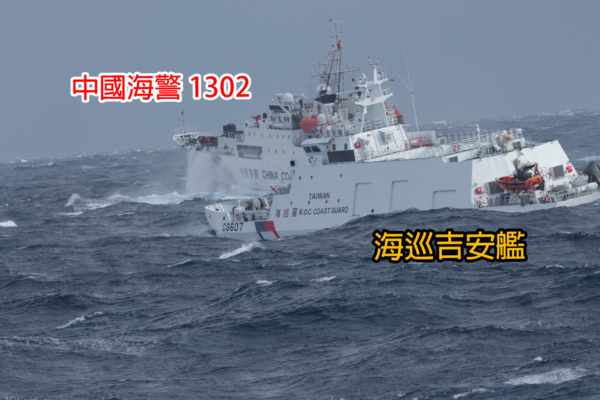
Recently, Japan and the Philippines announced the initiation of negotiations on the delineation of the exclusive economic zone and continental shelf in the waters east of Taiwan. Following this, the Chinese Communist Party’s Coast Guard promptly declared the commencement of “law enforcement patrols in the sea east of Taiwan.” According to individuals close to the Chinese military, choosing to deploy the Coast Guard instead of the Navy in the waters off the coast of Taitung is an attempt to shape the image of “jurisdictional authority” through routine actions, escalating cognitive warfare to exert political pressure on Taiwan.
On May 28, 2026, Japan and the Philippines announced the initiation of negotiations on the exclusive economic zone and continental shelf in overlapping waters that involve the eastern to southeastern offshore areas of Taiwan. On June 1, the Chinese Coast Guard Bureau publicly announced the dispatch of the Dai Shan ship (2502) formation for “law enforcement patrols in the waters east of Taiwan,” describing it as a countermeasure against the Japan-Philippines boundary negotiations.
Tang Jie (pseudonym), who is close to the Chinese military, told Dai Ji Yuan that the focus of this Coast Guard cruise is to further enhance the intensity of cognitive warfare among the Taiwanese people.
He said, “Because we know that these actions against Taiwan cannot intimidate the Taiwanese government, we are now trying to influence the Taiwanese people. We hope to strengthen deterrence among the island residents through news propaganda and affect the 2028 Taiwan election, with hopes pinned on [Kuomintang Chair] Zheng Liwen. Even if she cannot succeed, we must support her.”
In recent years, Chinese military pressure on Taiwan has not decreased, but the most notable trend is the decreasing emphasis on warships and naval fleets in the forefront, and the increasing frequency of Coast Guard, public service vessels, maritime surveillance ships, and so-called “law enforcement patrols.”
Scholar Yu Cheng (pseudonym) from Xiamen University, who researches cross-strait relations, stated that recently, China has increasingly opted for Coast Guard “law enforcement patrols” rather than military actions, primarily due to economic constraints.
He said, “In the simplest terms, they are running out of money. Deploying an aircraft costs tens to hundreds of thousands, with reports suggesting hundreds of millions spent per year. Taiwan is already accustomed to it. Even if they talk about routine operations, the effect is limited. After Zheng Liwen visited Beijing, they might also consider reducing costs. Sending out the Coast Guard saves money, reduces risks, and continues to create psychological pressure of ‘Taiwan being surrounded.'”
Yu acknowledged that China’s approach may seem assertive but actually exposes weaknesses in its ability to attack Taiwan and its decision-making system. He stated, “China is revisiting its pressure strategy on Taiwan, where warships symbolize warfare, and the Coast Guard represents politics. The presence of warships signifies military escalation, while the Coast Guard can be packaged as ‘administrative law enforcement,’ ‘marine management,’ or ‘sovereignty maintenance.'”
He indicated that this pattern has been repeated in the Diaoyu Islands and the South China Sea for over a decade. Currently, Beijing is attempting to replicate this strategy in the waters surrounding Taiwan.
For a long time, Eastern Taiwan has been seen as a strategic rear area and a crucial gateway for potential entry into Taiwan by the United States, Japan, and the Philippines during wartime. Orchid Island, Green Island, and the waters off Taitung are especially essential locations along the first island chain.
Mr. Yang, an insider in Beijing, stated, “Clearly, Beijing aims to gradually weaken Taiwan’s awareness of the security environment in the east by normalizing Coast Guard appearances, gradually transforming the waters, which originally belonged to the international free navigation area, into its so-called ‘jurisdictional waters.'”
Yang believes that the real cause for concern lies not in this patrol, but in whether three trends will emerge in the future.
He said, “First, frequent Coast Guard entries into the waters near Orchid Island and Green Island; second, the patrol frequency increasing from once a year to monthly; and third, Coast Guard formations replacing single-ship activities. However, China’s policy toward Taiwan is currently dictated by a single person without a long-term plan. If that person changes their mind one day, the approach may also change.”
Another source close to the military stated that the recent removal of high-ranking generals like Zhang Yuxia and ongoing adjustments in the command system have not been completed, making it difficult for Beijing to bear the massive risk of initiating a Taiwan Strait war. Therefore, before conditions are ripe for an attack on Taiwan, China can only escalate with more Coast Guard patrols and cognitive warfare.
He said, “China is trying to create the illusion of being ‘ready to strike at any time’ in a low-cost manner. The reason is simple: their financial, human, and military capabilities, along with the command system, are even poorer than perceived. There’s no news of any reorganization of the military commission, indicating a lack of the necessary military conditions for launching a large-scale attack on Taiwan. Before going to war, the military commission leadership needs reorganization to smoothly issue orders.”
The source mentioned that conquering Taiwan is not as simple as giving a “fire” order. He explained, “Amphibious operations require coordination between the Navy, Air Force, Rocket Force, Strategic Support Force, and logistical support systems, as well as cooperation between the Eastern and Southern theater commands. Currently, there are no signs of such preparations. The recent suggestion is to hope for Taiwan’s internal collapse or rely on the Kuomintang, gangs, and other forces.”
In the past two years, high-ranking officials in the Chinese military have undergone unprecedented purges. The Rocket Force system has been extensively rectified, and there have been successive scandals in equipment development systems. After the comprehensive clearance of the Chinese military leadership, it is expected that a return to normalcy will be difficult in the short term.