
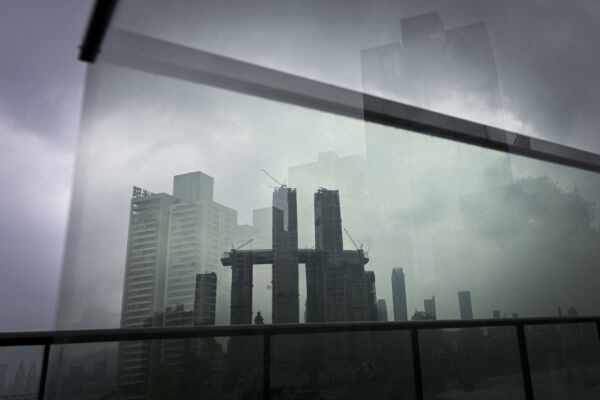
Thirteen years ago, a man from Shaanxi purchased a residential property on the 34th floor, only to discover during the handover that the building was only constructed up to the 32nd floor. Despite going through arbitration and court enforcement procedures, it was found that the developer had no assets under their name that could be executed against, and to this day, the full down payment has not been recovered.
According to a report from the Huashang News on June 3, Mr. Shen, a native of Baoji in Shaanxi province, has been working in Beijing for a long time. In February 2013, he learned from relatives that a new residential community “Gabay Garden” was set to be built in Hejia Village, Sanqiao Street, Xi’an.
The developer’s staff informed Mr. Shen that at the time, the necessary permits were incomplete, but assured him they would be obtained later and that property ownership certificates could be processed. On February 5, Mr. Shen signed a property sales contract with the developer – Xi’an Hejia Village Urban Renewal Limited Liability Company – and made a down payment of 1,177,000 RMB.
Mr. Shen chose apartment number 3401 on the 34th floor of Building 12B, with a floor area of 88.92 square meters at a rate of 2,646 RMB per square meter, totaling 235,282 RMB. The contract stipulated that the seller should deliver the property meeting the contract specifications to the buyer for use by May 3, 2015, in accordance with real estate regulations.
The construction progress of the community was slow and irregular, with Building 12 being halted after reaching the second floor for an extended period due to regulatory issues.
On May 3, 2015, the agreed-upon handover date arrived, but the developer failed to deliver the property. In the summer of 2017, Mr. Shen received a call from the developer informing him that Building 12 had been topped off and requested the remaining payment for the purchase. However, he was informed in a subsequent call that Building 12 had only been constructed up to the 32nd floor, not the originally planned 34th floor.
After many twists and turns, Mr. Shen submitted a refund application as requested by the developer, but they repeatedly claimed they had no funds and asked him to wait. Despite periodic inquiries every two to three months, the response was always the same – no money, just wait. Eventually, Mr. Shen managed to contact the person in charge who had called him in 2015 and after multiple communications, he received a partial refund of 20,000 RMB in 2020 and 50,000 RMB in 2022, after which his calls were no longer answered.
Subsequently, Mr. Shen applied for arbitration with the Xi’an Arbitration Committee, reaching an agreement with the developer to repay the down payment and interest by June 28, 2022. In case of breach, a penalty of 47,056 RMB was to be paid.
Following the developer’s default, Mr. Shen sought enforcement from the Xi’an Intermediate People’s Court but found that the developer had no bank deposits, real estate, vehicles, or securities registered under their name.
In a report on May 28 this year, Mr. Li, the representative of Xi’an Hejia Village Urban Renewal Limited Liability Company involved in the arbitration, stated that the company was currently facing difficulties. They were planning to sell a piece of undeveloped land, which would help resolve their financial situation.
Mr. Li also mentioned that they had originally planned to build up to the 34th floor, but construction was halted at the 32nd floor. He admitted that in theory, the entire building did not comply with the initial planning. This was a property with limited ownership rights, lacking proper procedures, and the issue of only constructing up to the 32nd floor affected more buyers than just Mr. Shen.
On June 3, the news of “Man Buys 34-Storey Apartment Only to Discover it’s Built to 32 Stories” went viral.
Netizens commented, expressing surprise at the situation where a contract clearly stated 34 floors but the actual building fell short by two floors, leaving the house seemingly vanished. They emphasized the risks involved in buying property, especially with incomplete permits and hidden legal issues, cautioning against trusting developers’ promises to remedy such deficiencies.
Some netizens pointed out the lack of early planning supervision and leniency in post-failure penalties, contributing to cases like this where developers evade responsibilities.
Others observed the changing dynamics of the real estate market, suggesting that in 2026, missing out on the 34th floor might have been a blessing in disguise. With a shift in the market’s logic, high-rise residential buildings face future challenges and could become obsolete, raising concerns about the sustainability of tall structures in urban development.
The warning against investing in super-tall buildings post-2026 reflects a growing trend where such properties face discounts and potential issues due to aging infrastructure.