
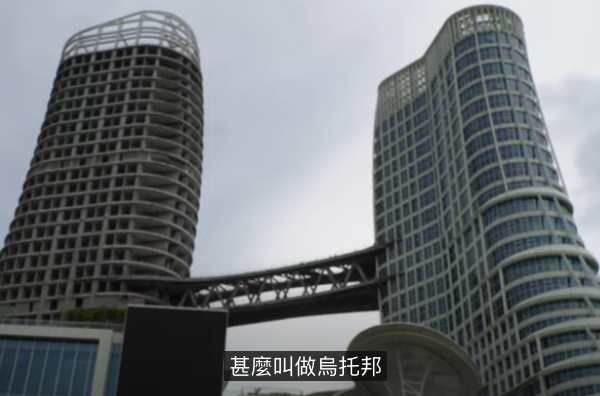
On the occasion of the 25th anniversary of the transfer of sovereignty in Macau, the Chinese Communist Party leader Xi Jinping visited and went to Hengqin for the fifth time. However, recently, several real estate industry professionals released videos showing Hengqin has become a “ghost city” and one of many abandoned projects. Experts and netizens have listed numerous abandoned projects in China, calling Xi Jinping the “Emperor of Abandoned Projects.”
In recent days, scholars and political commentators have analyzed the fundamental reasons for the abandonment of major projects under Xi Jinping’s leadership, pointing out that the biggest abandoned project is the authoritarian rule of the Chinese Communist Party itself, which is currently in a state of abandonment.
According to a report from the official Chinese media Xinhua News Agency, on the morning of December 19th, Xi Jinping inspected the Hengqin Guangdong-Macao Deep Cooperation Zone and visited the “Harmony and Resonance – Hengqin Guangdong-Macao Deep Cooperation Zone Construction Theme Exhibition.” The development and construction of Hengqin are measures personally planned, deployed, and promoted by Xi Jinping.
As early as January 2009, when Xi Jinping, then a member of the Politburo Standing Committee of the Chinese Communist Party and Vice President of the country, visited Macau, he announced the decision to develop Hengqin Island. Since then, the development of Hengqin has become one of Xi’s important “achievements.” In September 2021, the Hengqin “Guangdong-Macao Deep Cooperation Zone” was established, and in March of this year, the zone was officially closed for operation.
However, in recent times, real estate agents inspected several large residential areas around 8 p.m. and found that the occupancy rate was around three to four percent. Even the first comprehensive housing built for Macau residents, “New Street Neighborhood,” has an estimated occupancy rate of less than ten percent. Another development close to the port, which attracted many investors, “Huarong·Qinhai Bay,” also had less than ten percent of households with lights on; and the central hub of the commercial street was also sparsely populated.
In newer shopping malls like Innovation Square, half of the stores were closed, and there was almost no foot traffic in the afternoon, with restaurants having an occupancy rate of less than ten percent. The video creator said, “It’s all dark as if they’re closed.” Five months ago, “Professor Zhu & Senior Real Estate Media Personality Ah Chao” released a video on their YouTube channel, stating that Hengqin has become a rarely seen ghost city, showing empty streets filled with abandoned buildings.
Xi Jinping has led many major projects in recent years, but they have all been left abandoned one by one, earning him the title “Emperor of Abandoned Projects” among the public.
Previously, several media outlets created a ranking of his ten-year abandoned projects, which has recently been widely circulated online. The top three include the “Trillion Dollar Chip Project,” “Belt and Road Initiative,” and “Xiongan New Area.”
The “Chip Project” was initiated in 2014, with the Chinese Communist Party investing billions of yuan in scale over three phases, creating tens of thousands of new enterprises, resulting in huge losses and widespread abandonment. According to data from Qcc, by the end of last year, 22,000 chip companies had closed down. This year, over 14,600 more have shut down.
The “Belt and Road Initiative” saw the Chinese Communist Party layout in developing countries for many years, but the project has led to corruption, environmental destruction, and labor disputes causing increasingly fierce protests; countries like Sri Lanka are on the brink of bankruptcy due to heavy debts, drawing criticism. Xi’s strategic intentions to compete with the West globally have also faltered.
The “Xiongan New Area” was officially established on April 1, 2017, now in its seventh year. Netizens visiting remarked that Xiongan is still a large-scale ghost city, “like a place from the end of the world.” Other abandoned projects include the Beijing Stock Exchange, the Asian Infrastructure Investment Bank, the “Made in China 2025” plan, the Thousand Talents Plan, real estate ventures, poverty alleviation projects, supply-side reforms, energy conservation, carbon reduction, 21 free trade zones, and more.
Most of these abandoned projects were personally directed and led by Xi Jinping. Historian Li Yuanhua commented to Dajiyuan on December 23rd, saying Hengqin is a project led by him and is today like a “dead city.”
Scholar Yuan Hongbing revealed to Dajiyuan that Xi Jinping has now been given the title of “Emperor of Abandoned Projects” in Beijing’s official circles. “Whatever he starts ends up abandoned because of his own flaws. The reason is that Xi Jinping’s whole set of ideologies is from Mao Zedong’s era, cursed by Mao’s orthodox thinking. Apart from Mao’s political and economic ideology, he has nothing else.”
Regarding the fact that many of the Chinese Communist Party’s projects end up abandoned, Li Yuanhua explained, “The core reason is that the initiation of these projects was not based on economic development but on personal achievements and political needs. Under strong government promotion and amid significant investment due to a good economy, many individuals try to gain from such projects. However, the market feedback often embarrasses the Chinese Communist Party itself.”
Li Yuanhua cited many similar incidents, with the classic example being Xiongan, where, despite being unsuitable for human habitation due to its low-lying terrain, the Chinese authorities invested heavily, aiming for it to be a sub-capital, but without any results. They continue to cover up the basic facts, boast, spend money, leading to a vicious cycle.
He noted that the top leadership of the Chinese Communist Party acts decisively but without consulting subordinates’ opinions, merely following conventional reasoning. Economic development has its own rules, but the Chinese Communist Party fails to find economic growth points according to these rules, instead setting political goals to accomplish the so-called “grand accomplishments,” eventually leading to a downward spiral.
Political commentator Tang Jingyuan also spoke to Dajiyuan, stating that some large projects forcibly led by Xi Jinping are considered from a political perspective, not adhering to basic economic principles. “The party controls everything, politics must override the economy, everything must follow the party’s commands, even foreign companies must set up party branches. This serious violation of economic laws inevitably leads to the failure of many projects.”
During Deng Xiaoping’s era, Beijing established numerous development zones and special economic zones that attracted foreign capital and technology. However, Tang Jingyuan explained that the Chinese Communist Party once again acquired some benefits through opportunistic practices, imitating and cutting corners. “But these are not the true capabilities of the Chinese Communist Party. Xi Jinping has a huge misconception that the party has the ability to achieve it all independently. So, after he came to power, whether it’s the Xiongan New Area, the Hainan Free Trade Zone, or the current development zone in Hengqin, they all end up abandoned in the end.”
He further stated that Xi Jinping believed that through the so-called internal circulation model, without relying on external funds and technology, he could magically create a prosperous economic development zone, which is simply not feasible. This shows Xi Jinping’s political naivety.
Tang Jingyuan pointed out that another reason for the failure of various projects is that Xi Jinping has been engaging in aggressive expansionism in diplomacy, adopting measures like wolf warrior diplomacy; “The most direct result is that foreign businesses and capital are deterred from coming in, leading to an unprecedented deterioration in the domestic and international business environment, industrial chains, and more, or causing their relocation or disruption.”
Regarding Xi Jinping’s claims of personally leading and deploying everything, Yuan Hongbing expressed that he is abusing his dictatorial power. “Thus, under the Chinese Communist Party’s authoritarian rule under Xi Jinping, the entire regime will become the biggest abandoned project, currently in a state of abandonment, meaning it is heading towards destruction.”
Yuan Hongbing stated that during Jiang Zemin’s and Hu Jintao’s reign, the Chinese Communist Party was already on the brink of collapse, and Xi Jinping’s main political goal is to save the Communist Party from the verge of collapse, which in itself is a sin. “It is precisely this sinful starting point that determines that all his actions go against the tide of history.”
“He is trying to use the flawed political, economic, and cultural paths of the Communist Party in history to save the current crisis of the Communist Party. To put it in my words, Xi Jinping wants to use the historical sins of the Communist Party to save the Communist Party today from its crisis caused by Jiang Zemin. The result of this will be that his efforts to save the Communist Party will lead to the Party’s burial along with history.”
Li Yuanhua also believes that the Chinese Communist Party has reached a dead end, and facing Xi Jinping’s repeated failures, it is clear that the end is near. “Xi Jinping may have political ambitions and access to funds, but as the Chinese Communist Party approaches its end, there will inevitably be an accelerant of the Party’s demise, squandering off money that was never meant for it, leaving unfinished projects, and plunging the economy into greater distress, hastening the Communist Party’s downfall.”
From a macro perspective, it is evident that when the Chinese Communist Party reaches its end, nothing goes smoothly, project after project is left unfinished, and nothing goes according to plan. Xi Jinping’s attempts to keep the party afloat will only lead to both him and the Party entering the grave together.