
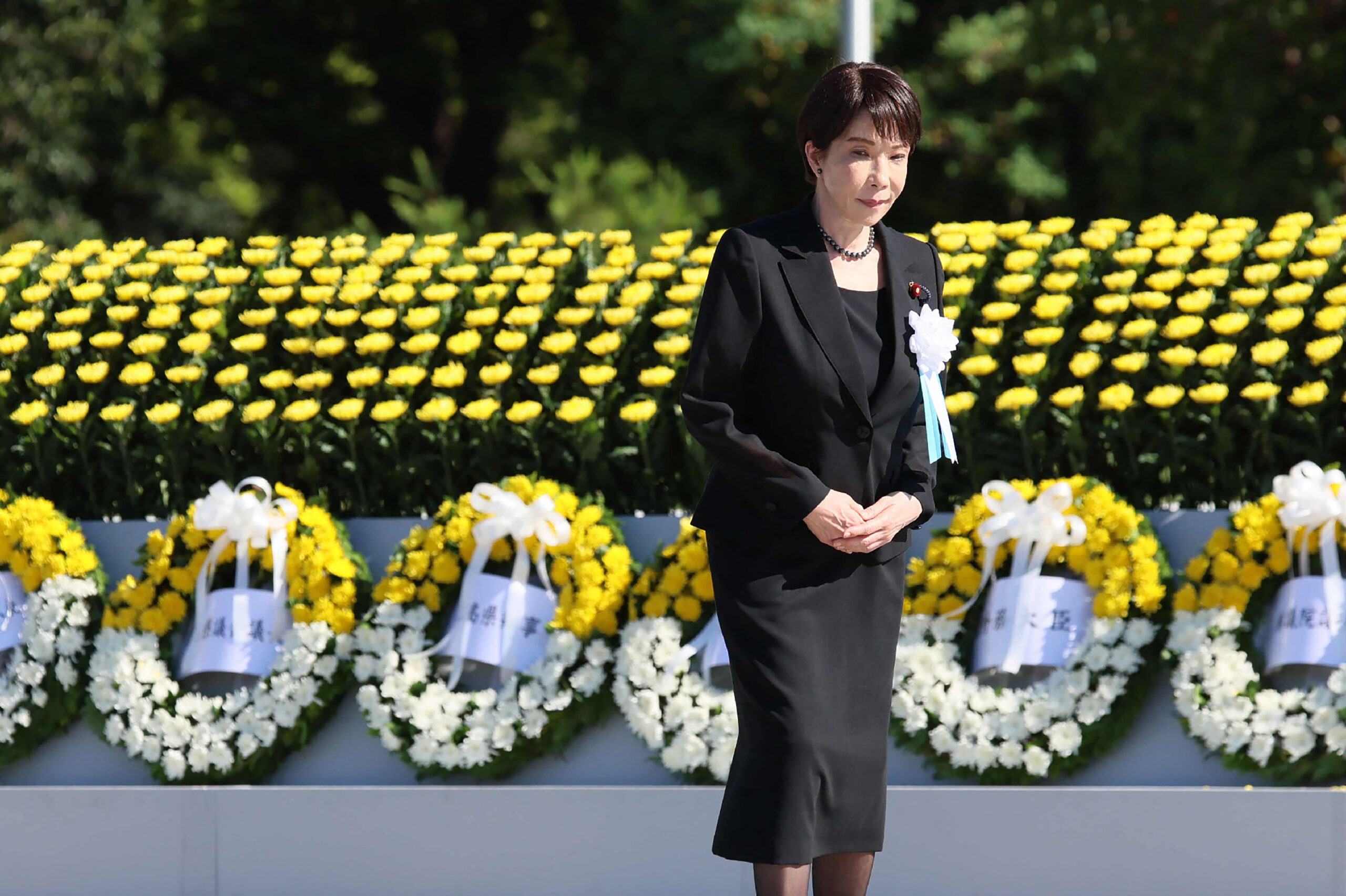
On August 15, 2026, Japanese Prime Minister Sanae Takaichi did not visit the Yasukuni Shrine on the end of World War II day as expected. Instead, she made a distant bow in the direction of the shrine from the Nippon Budokan and presented an offering of ritual cloths as the leader of the Liberal Democratic Party. This marked her first End of War Day since taking office, drawing attention to her handling of matters related to the Yasukuni Shrine.
Takaichi arrived at the Nippon Budokan around 11:20 a.m. to attend the national memorial service for war dead. While waiting at the parking lot, she performed the ritual of “two bows, two claps, one bow.” It was reported that she bowed towards the direction of the Yasukuni Shrine, which is located several hundred meters to the northwest of the Nippon Budokan.
During the national memorial service, she did not use the phrase “reflection” that the former Prime Minister, Shigeru Ishiba, reintroduced last year. Instead, she emphasized Japan’s post-war contributions to global peace and prosperity, as well as its role in the Indo-Pacific region.
On the same day, Japanese Defense Minister Nobuo Kishi, Minister for Economic Security Aiko Onoda, and others visited the Yasukuni Shrine. The Chinese Ministry of Foreign Affairs later expressed protest to the Japanese side for this visit.
At the memorial service held at the Nippon Budokan in Tokyo, Takaichi stated, “Since the end of the war, Japan has consistently contributed to world peace and prosperity. We will never allow the tragedy of war to happen again.”
She also mentioned that “Japan can play an important role in addressing various issues faced by other countries” and referred to Japan as a “shining beacon in the Indo-Pacific region that other countries can rely on.”
Takaichi paid tribute to the victims of the major war disasters in Hiroshima, Nagasaki, and Okinawa, as well as those who perished on overseas battlefields, attributing their sacrifices to the foundation of today’s peace and prosperity in Japan.
Another reason Takaichi’s speech drew attention was her avoidance of using the Japanese term for “reflection” (hansei).
Former Prime Minister Shigeru Ishiba was the first Japanese leader to use the term “reflection” in a prime ministerial speech on August 15 in the past 13 years. The last time before him was in 2012 by then-Prime Minister Yoshihiko Noda.
In contrast to Takaichi’s wording, Emperor Naruhito mentioned the “profound reflection” on the past during the memorial service on Saturday. Emperor Naruhito stated, “As we reflect on the long years of peace since the war and deeply contemplate the past, I sincerely hope that the calamity of war will never happen again.”
Since ascending the throne in 2019, Emperor Naruhito has consistently included the wording of “profound reflection” in his annual memorial speeches for war dead.
Though Takaichi did not visit the Yasukuni Shrine in person, several government officials and senior members of the Liberal Democratic Party made the pilgrimage on Saturday.
Defense Minister Nobuo Kishi, dressed in a dark suit, arrived at the Yasukuni Shrine. It was his first visit on August 15 since taking office as Defense Minister. Kishi has visited the Yasukuni Shrine multiple times in the past, including during his tenure as Minister of Agriculture, Forestry, and Fisheries last year.
Kishi did not respond to questions from reporters upon leaving the shrine. He later posted on Instagram that his visit was to “sincerely mourn the precious lives sacrificed for the nation.”
He further expressed, “While reaffirming the oath to renounce war, I also firmly pledge to continue fulfilling our responsibilities to protect the path Japan has taken as a peaceful nation since the war.”
Aiko Onoda also made a pilgrimage on the same day. Three senior members of the Liberal Democratic Party, including Secretary-General Toshiaki Suzuk, visited the Yasukuni Shrine together.
According to the Associated Press, Suzuk remembered Takaichi’s thoughts towards the “spirits of the war dead” during his pilgrimage and presented the ritual cloths offered by Takaichi as the leader of the Liberal Democratic Party.
Since becoming Prime Minister last year, Takaichi has not personally visited the Yasukuni Shrine but has made offerings of ritual cloths during the shrine’s major festivals.
The Yasukuni Shrine enshrines around 2.5 million war dead, mostly Japanese, including 14 wartime leaders convicted of the most serious war crimes and over 1,000 individuals found guilty by Allied courts after Japan’s defeat in 1945.
China and South Korea have long criticized senior Japanese officials visiting the Yasukuni Shrine, viewing such actions as reflections of how Japan perceives its wartime history.
The Chinese Ministry of Foreign Affairs strongly condemned Sanae Takaichi’s offering of ritual cloths and the Japanese cabinet members’ visits to the Yasukuni Shrine, lodging a “solemn representation and strong protest” with Japan.
Since Shinzo Abe’s visit to the Yasukuni Shrine in December 2013, no incumbent Japanese Prime Minister has made a subsequent visit. The administration of then-US President Barack Obama openly expressed disappointment with Abe’s visit.
The last incumbent Prime Minister to visit the Yasukuni Shrine on the anniversary of Japan’s surrender on August 15 was Junichiro Koizumi, father of Nobuo Kishi, in 2006.
This year, there was anticipation on whether Takaichi would personally visit the shrine.
Despite visiting the Yasukuni Shrine several times before taking office as Prime Minister last October, Takaichi ultimately chose not to go in person on August 15 this year but expressed her sentiments through the offering of ritual cloths.
Currently, tensions persist in Sino-Japanese relations. Last November, Takaichi stated that an attack by the Chinese Communist Party on Taiwan could pose a “survival crisis” for Japan, to which Beijing strongly objected to the remarks.