
According to a new study by a Canadian research institution, the United Front Work Department of the Chinese Communist Party (CCP) has established a network of over 2000 organizations globally, using this to implement intervention strategies against the Group of Seven (G7) industrialized nations.
As the G7 summit of heads of state and government approaches in mid-June in Évian, France, countries are trying to coordinate policies to address the challenges posed by major power competition.
The May 27 report by the Montreal Institute for Global Security (MIGS) reveals China’s systematic and adaptive long-term infiltration strategy targeting the G7 through a combination of legal and covert activities, exploiting vulnerabilities in open societies to exert influence through political, economic, academic, and social channels.
Titled “Protecting the Group of Seven Industrialized Nations against Beijing’s Interference,” the MIGS report sheds light on the CCP’s extensive establishment of networks worldwide, with over 900 entities in the United States alone, covering professional associations, student groups, cultural organizations, and media platforms, engaging in activities ranging from electoral interference, opinion manipulation, persecution of dissidents in exile, to industrial espionage.
The report highlights China’s strategies in France, focusing on politicians by providing exposure opportunities to former French officials in “China-related institutions” or capitalizing on alignment with Beijing’s ideology.
China’s actions in France span local and academic realms, targeting strategic regions, industrial hubs, ports, and research institutions through economic partnerships, university collaborations, 5G infrastructure projects, as summarized by MIGS.
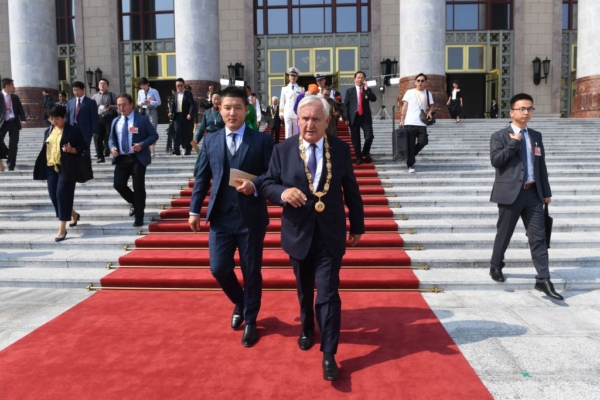
A report by the French Military School’s Institute of Strategic Research (IRSEM) in 2021 labeled former French Prime Minister Jean-Pierre Raffarin as a typical case of such strategic alignment. As Chairman of the “Prospective and Innovation Foundation,” Raffarin maintained consistent discourse with Beijing, praising “Chinese socialism with its characteristics” on the CCP’s official media CGTN and lauding the Party’s role in shaping future rules. He was awarded the “Friendship Medal” by the Chinese regime in 2019, a high honor for foreign individuals.
In a 2022 report by the European Parliament’s Special Committee on Foreign Interference, Raffarin was identified as a political figure actively promoting Chinese (CCP) interests in France and deemed an example of CCP’s “elite capture.” In 2025, French President Macron assigned him a new official mission focusing on relations between France and China.
Former French Prime Minister and ex-President of the Constitutional Council Laurent Fabius also appeared on MIGS’ list of politically influential figures targeted by CCP’s strategies. His case embodies the concept of “parallel diplomacy.” Fabius reportedly maintained frequent contact with Chinese counterparts, meeting with Chinese Foreign Minister Wang Yi in October 2024 to emphasize the importance of bilateral relations.
Fabius participated in the Taihu World Cultural Forum established in 2011, bringing together foreign former leaders and high-ranking figures in the CCP’s influence system.
French far-left leader Jean-Luc Mélenchon of “La France insoumise” was also viewed as a pro-CCP political figure. Following U.S. House Speaker Nancy Pelosi’s visit to Taiwan in 2022, Mélenchon expressed his stance on his blog, emphasizing France’s commitment to recognizing only one China since General de Gaulle in 1965 and rejecting a war on China driven by U.S. interests regarding Taiwan.
He later expressed admiration for CCP figures like former Vice Chairman of the NPC Standing Committee Chen Zhili but omitted her past roles in the CCP’s propaganda system.
Reports in September 2025 by “Le Point” magazine revealed that Mélenchon had clandestine talks with a Chinese diplomat. The diplomat was reportedly former Chinese Ambassador to France Lu Shaye, known for his controversial public remarks. However, the exact details of these informal discussions remain undisclosed.
Facing a collective challenge to democratic governance, national sovereignty, and the integrity of public discourse, the MIGS research center proposed several recommendations for G7 countries.
Experts advocate for establishing a coordinated mechanism to counter foreign intervention, creating a shared registry to record organizations and individuals linked to the CCP’s influence network, and promoting coordinated legislation across nations.