
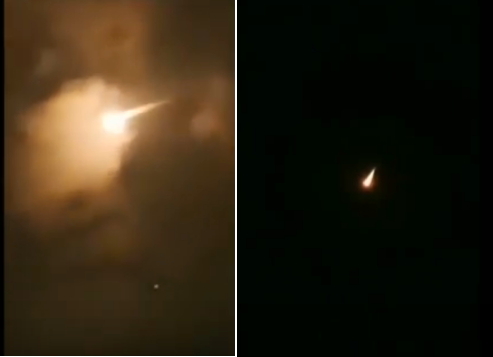
【Epoch Times, August 14, 2026】China’s space launches have suffered a series of failures. On the evening of August 10th, a Long March 7A carrier rocket launched from the Wenchang Space Launch Center in Hainan, China, exploded shortly after liftoff, resulting in a mission failure. This marks the 4th orbital launch failure in China this year, raising concerns about the declining success rate of space launches in recent years.
Rocket experts point out that the continuous decrease in China’s rocket launch success rate is indeed a warning sign, indicating potential flaws in the overall system engineering. The gap between China’s commercial space industry and SpaceX in the global commercial space market remains significant. The recent consolidation of personnel within China’s aerospace and defense systems may have a lasting impact on China’s space development.
Video footage of the Long March 7A launch shows the rocket disintegrating at relatively low altitude and speed. Jonathan McDowell, an honorary professor at Durham University in the UK and member of the Space Environment Center, mentioned in an interview with NBC News that this means both the satellite and debris did not enter orbit.
The accident has also impacted subsequent launch schedules. According to the Chinese media First Financial, the scheduled orbit-level flight test of the private aerospace company iSpace’s Hyperbola-3 scheduled for the morning of the 11th has been postponed.
According to statistics from Hong Kong’s Ming Pao based on publicly available data, China has conducted 56 orbital launches this year, with 52 successes and 4 failures, resulting in a success rate of approximately 92.86%. In 2024, the success rate was 97.1%, and in 2025, it was 95.9%. Therefore, the success rate has been declining over the past 3 years, making this year’s failures more prominent.
Dr. Yen-Sheng Chen, a well-known aerospace scientist from Taiwan who served in NASA for over 30 years, pointed out in an interview with Epoch Times that the continuous decline in China’s space launch success rate over the past 3 years is indeed a warning sign, indicating potential flaws in the overall system engineering.
Dr. Chen founded Taiwan’s first private rocket launch company in 2016. He expressed concerns about the consecutive 3-year decline in the success rate of rocket launches, stating that it cannot be attributed to annual fluctuations.
He believes that China is facing competition pressure from SpaceX, leading to a significant increase in mission quantity to catch up with their launch frequency, potentially resulting in scheduling and system management flaws due to the development of multiple rockets.
Public data shows that China’s space launch scale in the first half of this year reached a historical high, with commercial launches accounting for more than 60%. China is advancing large-scale projects such as low-orbit satellite internet constellations, leading to a rapid increase in launch demands.
In 2025, SpaceX completed 165 Falcon series orbital launches. If Starship test flights are included in the annual launch activities, the number is around 170.
Dr. Chen also highlighted that China’s commercial space industry is still in the development and trial-and-error stage, lagging behind SpaceX in launch frequency, rocket reusability, and overall commercial space capabilities.
According to an official report from the Chinese state media Xinhua News Agency, at 8:02 pm on August 10th, the Long March 7A rocket carried out a mission to launch the Zhongxing-4B satellite, marking the 18th flight of the Long March 7A and the first launch failure since its debut in 2020.
Independent aerospace observer Jonathan McDowell and various analysts pointed out that the satellite carried by this launch, Zhongxing-4B, has military or dual-use characteristics, with relevant footage showing the rocket disintegrating suddenly in the air.
Based on public video analysis, the rocket disintegrated approximately 85 seconds after liftoff while it was still in the first stage of flight. In response, former dean of the National Defense University’s School of Political Warfare, Tsung-Chi Yu, mentioned in an interview with Epoch Times that the Long March 7A series itself is a relatively mature rocket, originally configured with two stages, with the Long March 7A adding an additional stage in its structure. From the footage, it appears that this accident likely occurred in the connecting area between the first and second stages, triggering the subsequent disintegration.
Reuters pointed out that the investigation will determine whether this failure is limited to the Long March 7A or will prompt a broader examination of shared components, production manufacturing, or launch site operations.
Tsung-Chi Yu believes that if the investigation confirms structural engineering issues as the cause, it holds significant implications because the Long March 7A series is considered a relatively mature technology, and theoretically, the Chinese Communist Party has strong confidence in this technology. The official promotion and coverage of this incident through CCTV has therefore attracted extra attention.
As of now, the Chinese authorities have not released a detailed technical investigation report or failure mechanism explanation. Tsung-Chi Yu stated that if the investigation reveals abnormalities stemming from engine or related system failures, the impact may extend to several other mainstay rockets such as the Long March 6A, Long March 7.