
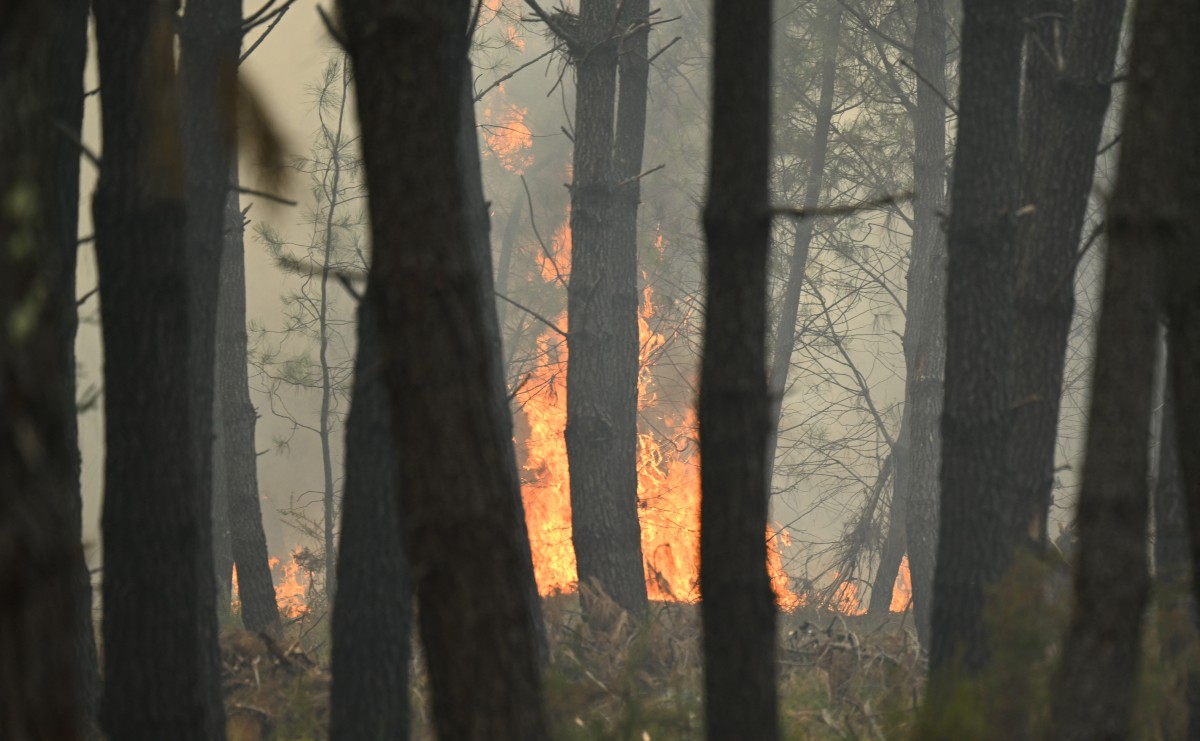
On Friday, August 14th, as a new round of record-breaking high temperatures swept across the European continent, firefighters in several European countries were working tirelessly to extinguish multiple wildfires, with the extreme drought further complicating firefighting efforts.
These countries typically have moderate to cold climates and often lack facilities to deal with such high temperatures, with lower rates of air conditioning penetration.
France is currently facing its driest year on record. On Friday, a new wildfire broke out in the forested areas of Landes along the southwestern coast, rapidly spreading. Local authorities reported that the blaze forced over 500 residents of Luglon town to evacuate their homes, with hundreds of firefighters rushing to the scene for rescue operations.
This week, several wildfires have occurred in forests across France, including regions like the usually cooler and wetter northern areas and Brittany. Last month, a historic forest fire near Bordeaux led to the evacuation of 250,000 people.
Due to the extreme high temperatures and drought, EDF, the French energy company, has closed six nuclear reactors in recent days. Additionally, a large number of jellyfish washed up along the coast of the English Channel, contributing to the shutdown of a nearby power plant. The warm sea water has led to a proliferation of jellyfish on many French beaches.
EDF stated in a release that the shutdowns have had minimal impact on the country’s electricity production and emphasized that extreme weather does not pose a safety risk to nuclear reactors.
In Stourbridge, a central town in England, a major fire broke out on Thursday, engulfing houses with flames consuming rooftops and walls. About 20 to 30 houses were completely destroyed, as mentioned by Stourbridge Councillor Cat Eccles to the BBC.
A resident evacuated from Stourbridge recounted how the police knocked on her door urging immediate evacuation, as the fire’s direction was unpredictable, leading to a chaotic scramble for essentials and escape.
Simon Tuhill, chief of the West Midlands Fire Service, announced an investigation into the Stourbridge fire, believed to have originated in a grassy area before spreading to nearby residences.
According to the UK’s Met Office, London’s western region recorded a temperature of 38.1 degrees Celsius (100.6 degrees Fahrenheit) on Thursday, setting a new high for the year. Despite a slight drop in temperatures on Friday, many parts of the UK have experienced almost no rain for weeks. July was the driest on record (since 1836) for England and Wales.
On Thursday night in Spain, authorities transferred the remains of three 11th-century kings from a monastery in Aragón in the northeast, as wildfires were approaching and spreading in the vicinity.
As of Friday noon, the wildfire remained out of control, with around 800 residents evacuated. A slight temperature drop is expected on Saturday.
In Huelva, southern Spain, a much larger wildfire has scorched over 300 square kilometers (about 120 square miles) of land, prompting evacuations of local residents.
All 1,800 residents of Gey village in western Germany have been evacuated, with the nearby Hürtgen Forest ablaze. The fire posed a threat to residential areas due to changing winds. As of Friday morning, nearly 300 hectares (about 1.16 square miles) of forest had burned.
Reported by the German news agency dpa, unexploded World War II ordnance in the forest hindered firefighting efforts. The fire approached as close as 300 meters (approximately 1,000 feet) to Gey village, located on the edge of the forest near the Belgian border. The cause of the fire is currently unclear.
The Robert Koch Institute reported on Thursday that Germany had seen a record number of deaths due to heat this year, surpassing the total for the entire year of 2018. An estimated 12,500 deaths were related to high temperatures from January 1 to August 2.
A devastating all-night wildfire near Omis, a coastal town in Croatia, forced over a thousand people to evacuate, resulting in one fatality, 14 hospitalized individuals, and seven severely injured persons as of Friday morning. Search efforts in the scorched area uncovered the body of a victim.
Another fire broke out on the outskirts of Omis on Thursday night, rapidly spreading due to strong winds. Maritime authorities reported that 194 people, including children, were rescued from the sea and various vessels during the evacuation process.
Firefighters managed to extinguish the blaze on Friday morning, with additional firefighting crews flying to the more southern Peljesac peninsula, where another wildfire occurred overnight.
In Albania, firefighters have been battling dozens of wildfires in recent weeks, with 11 active wildfires still ongoing across the country.
The most significant wildfire in Albania erupted in the Gure-Lure area, with the fire near residential areas now under control. Three individuals have been charged in connection with the fire at Lura National Park, accused of failing to take necessary precautions to protect their jurisdiction from fire damage.
In northern Greece on Thursday, a large wildfire swept through a vast pine forest, threatening seaside residences, leading to the evacuation of over 300 vacationers and residents via sea routes.
Belgium is expected to reach its highest temperatures since summer began on Friday, with temperatures in the capital Brussels rising to 37 degrees Celsius (98.6 degrees Fahrenheit).
Neighboring Netherlands also anticipates temperatures reaching 37 degrees Celsius (98.6 degrees Fahrenheit), with severe drought conditions in some areas leading to water shortages. However, given the forecasted rainfall in the coming days, Dutch authorities have not declared a water resource crisis yet.