
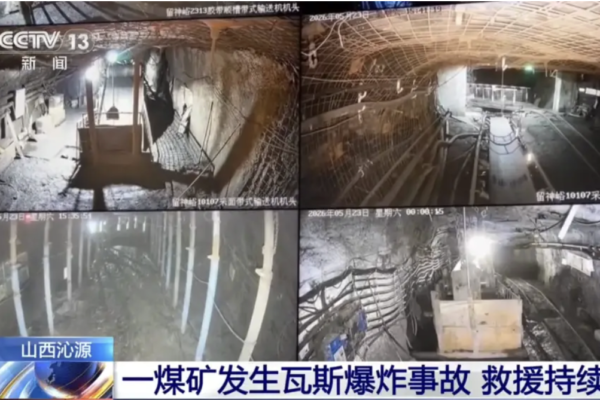
On the evening of May 22, a gas explosion occurred at the Liushenyu Coal Mine, owned by the Shanxi Tongzhou Group, resulting in at least 82 confirmed fatalities, 2 individuals missing, and 128 people hospitalized for injuries. Relatives of the victims revealed that despite the magnitude of the incident, the government has not disclosed any information, forcing families to find out details on their own.
According to official reports from the Chinese state media, among the injured, 27 individuals are still hospitalized, with one in critical condition, while the rest are described as having less severe injuries. Most of the injuries were due to inhaling toxic gases, although the specific type of gas is currently unknown.
One family member of an injured miner informed reporters that they had to rely on others to find out which hospital their father was taken to after the incident. They expressed frustration with the lack of transparency from the government, stating, “We had to find out everything on our own. My father managed to crawl out based on his experience, taking three hours, but I’m not entirely clear on the details.”
A miner from Datong, Shanxi, criticized the supervision of the mine where the accident occurred, stating that production priorities and profit motives often compromise safety standards. He emphasized the importance of continuous gas monitoring, which he believed was not being adequately conducted in the mine.
A miner from Sichuan with a decade of experience explained to reporters that a gas explosion typically requires a concentration level of 5%-15%. He noted that wealthier mines use machines to extract gas, while less affluent ones rely on manual methods with ventilation fans and employ multiple gas inspectors per shift.
The lack of proper safety measures, potential violations of regulations, and rushed production schedules were highlighted as contributing factors by experts and miners interviewed. They raised concerns about inadequate safety protocols, potential unauthorized practices, and blocked ventilation pathways that could lead to accidents.
In an interview with the media, a coal transportation worker who survived the blast described being propelled several dozen meters by the force of the explosion, engulfed in thick smoke resembling a dust storm.
Another miner, using the pseudonym Zhu Zhen, recounted the harrowing evacuation process that took over four hours for him and his colleagues to cover five kilometers before finally escaping around 11 p.m. He mentioned a shortage of self-rescue devices and revealed that the equipment hadn’t been replaced in four to five years.
Self-rescue devices are essential for underground miners, providing independent oxygen supply in emergencies to prevent gas poisoning or asphyxiation, aiding in safe evacuation or awaiting rescue.
Liang Jianwei, a worker in another operational area of the mine, shared that his self-rescue device ran out of oxygen within just 7-8 minutes during the evacuation, despite the regulations stipulating a minimum protection time of 30 minutes. He witnessed several colleagues collapsing in the tunnels, further highlighting deficiencies in safety equipment and protocols.
Rescue operations revealed hidden passages within the mine, with concerns raised about potentially missing individuals trapped within these passages. Efforts are underway to locate and rescue anyone stranded in these areas, with lengths of the passages estimated to be around a kilometer each.
Reports from the media unveiled possible clandestine mining operations within the coal mine, partitioned into approved “open-face” areas and unauthorized “black-face” regions. Workers in the latter areas often lack tracking devices, and even if they possess them, these devices may not function correctly.
Initial public records indicated that 124 miners were accounted for initially during the incident, but subsequent verifications revealed that a total of 247 individuals were actually underground at the time of the explosion. Official reports stated that 82 people have lost their lives, 2 are still missing, and 128 are hospitalized for injuries, differing from the previous official count of 90 fatalities.
The Shanxi Tongzhou Group Liushenyu Coal Industry Co., Ltd., a subsidiary of Shanxi Tongzhou Coal Coking Group Co., Ltd., which operates with a high-risk gas level, had previously faced administrative penalties twice in 2025, as cited in public records. These incidents involved safety breaches related to equipment malfunctions and worker attire violations, highlighting potential operational irregularities within the company.
Overall, the tragedy at the Liushenyu Coal Mine underscores the pressing need for thorough investigations, improved safety regulations, and stringent enforcement to prevent similar disasters in the future. Efforts to hold accountable those responsible for lapses in safety protocols and to provide adequate support for the affected families and injured individuals must be prioritized in the aftermath of this devastating incident.