
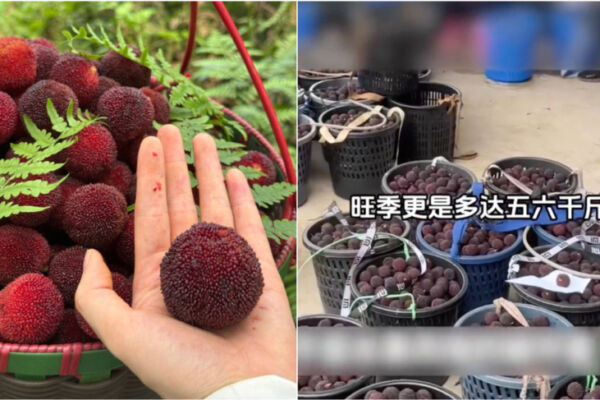
In mid-May, it was discovered in Zhangzhou, Fujian, a major production area for ya-mei in China, that ya-mei was being soaked in sweeteners and preservatives, causing the market to collapse and the ya-mei to remain unsold. The authorities took action against six units and 23 officials in Longhai District and its subordinate villages and towns. However, netizens commented, “Won’t eat anything, good or bad.”
On May 24, Longhai District of Zhangzhou City, Fujian Province, reported late at night that some responsible persons at some ya-mei acquisition points were held accountable for the illegal use of additives. The Agriculture and Rural Affairs Bureau, Market Supervision Bureau, Fugong, Baishui Town, Jiaobian Village, and Hou Bao Village in Longhai District were reported for “inadequate oversight.” Additionally, 23 Communist Party cadres were held accountable. Two of them were dismissed, while others faced measures such as “party discipline, political affairs case filing,” “admonishment,” and “criticism through notification.”
The handling of “accountability” by the authorities was met with mockery from mainland netizens: “This treatment is like taking three sips of wine as punishment.” “It’s always held up high and set down lightly, only to return next time.” “No change.” “Never want to eat ya-mei again.” “Won’t eat anything, good or bad, goodbye.” “Eat less or not at all, only eat ordinary food arranged by the Creator, stay away from heavily processed foods, don’t eat out-of-season fruits! You will find that you live healthier!”
Previously, according to reports from mainland media on May 15, Fugong Town and Baishui Town in Longhai District, Zhangzhou, Fujian, were the two major ya-mei production areas in the region, with Fugong Town being known as the “first town of Fujian ya-mei.” When reporters visited more than ten ya-mei acquisition and wholesale points, they found that fresh ya-mei were soaked in a solution containing prohibited preservatives and “triple none” sweeteners, which had long been an industry norm. “Triple none” refers to no ingredient description, no production date, and no quality certification.
Investigations revealed that more than ten ya-mei acquisition points in the area were all found to be illegally using additives. Each day, thousands of kilograms of ya-mei were sent out by these points, with peak seasons sometimes exceeding five thousand kilograms. These soaked ya-mei were sent through cold chains to wholesale markets in Zhejiang, Shanghai, Guangdong, and other locations.
On the evening of May 20, the Food Safety Committee Office of Zhangzhou City, Fujian Province, reported on the “medicated ya-mei” incident, stating that five problem ya-mei acquisition points had been identified, with 225 kilograms of problematic ya-mei and a batch of illegal additives seized for investigation. Furthermore, 540 kilograms of problematic ya-mei were retrieved, along with 20.1 kilograms of confiscated illegal additives. There were 12 administrative cases opened, two criminal cases initiated, and five individuals held in criminal detention. All the problematic ya-mei and confiscated illegal additives have been destroyed.
Regarding the official claim of recovering a total of 540 kilograms of problematic ya-mei, netizens questioned, “Recovering 540 kilograms, while investigation shows thousands of kilograms of soaked ya-mei daily, indicating that many more soaked ya-mei have flowed out.”
For a long time, mainland-produced fruits, vegetables, and various processed foods have been found to contain various “black technologies,” making food safety hard to guarantee. Public opinion generally questions the connection between the Chinese Communist Party’s atheistic indoctrination over the years and the resulting moral decay.
Dissident Wu Renhua posted on X, saying, “Seeing the news of ya-mei being soaked in medicine for profit on the mainland, it is inevitable to feel some anger. This is a life-threatening act for the sake of profit. In my hometown of Wenzhou, ya-mei is abundant, and I remember the famous tea mountain ya-mei, big, sweet, and among the best. In ancient times, Wenzhou had ya-mei soaked in liquor, soaking ya-mei in liquor. The medicated ya-mei is a product of China today, highlighting the seriousness of moral decay.”
While the controversy surrounding “medicated” ya-mei has yet to subside, Fujian peaches have been reported to contain added sweeteners. In a recent undercover video released by Fujian TV, businesses in Xiamen, Fujian, were shown using saccharin, aspartame, and other sweeteners to soak and process crispy peaches before sale, to enhance taste and sweetness, without any standards, solely based on feel.
In the undercover video, a business owner said, “Almost every store soaks them. Eating this stuff repeatedly is definitely harmful, but due to the high cost of (white sugar), one packet of sweeteners costs only 20 yuan but can substitute for hundreds of kilograms of white sugar in sweetness.”
These crispy peaches soaked in technology-infused water then made their way to fruit shops and night market stalls throughout the streets and alleys.
Some netizens expressed, “Everything soaked in medicine, everything is toxic. Who dares to eat? If you’re too afraid to eat it yourself, who are you selling it to?”