
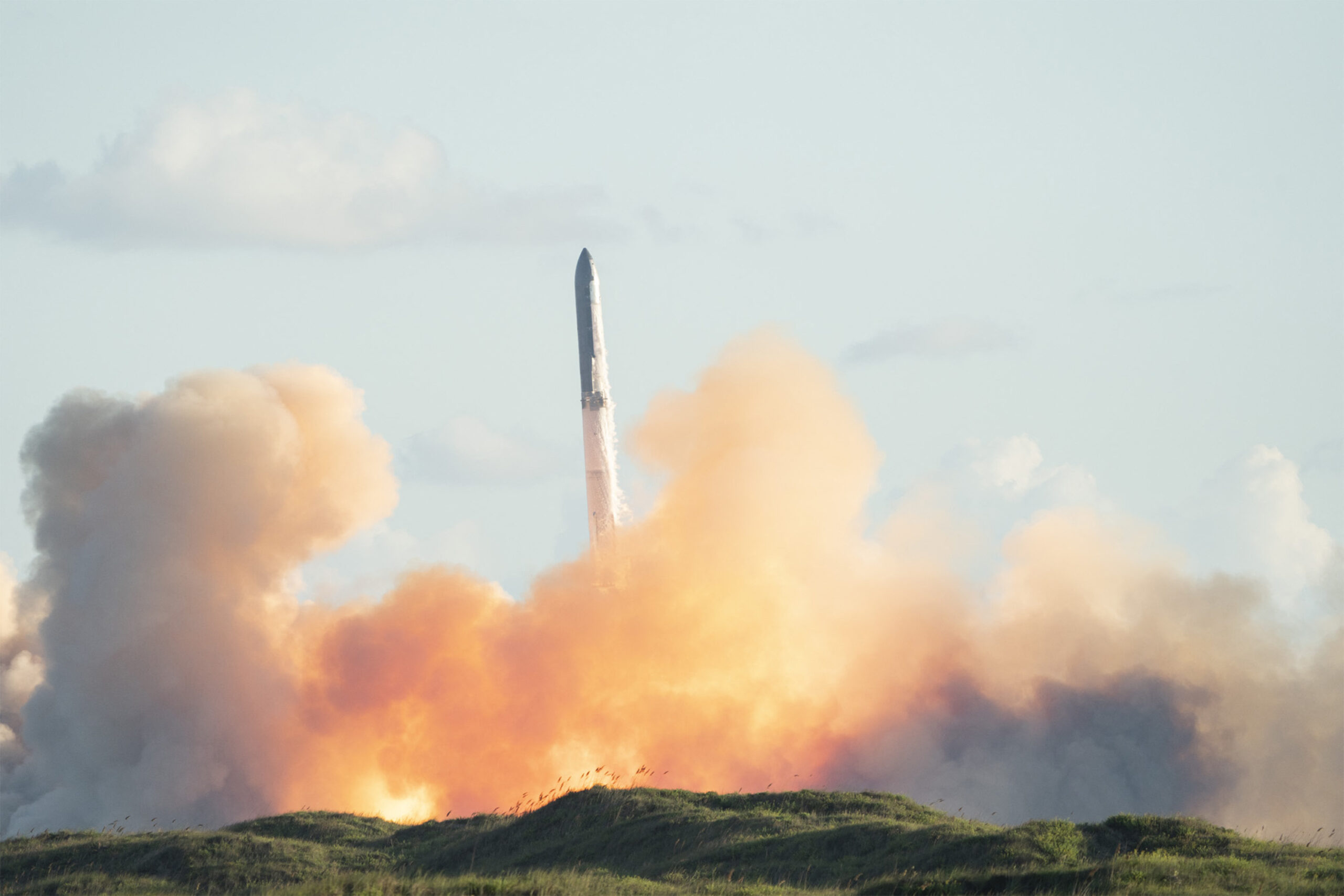
On Thursday, July 16th, SpaceX was scheduled to conduct a test flight of its Starship rocket, but it was aborted at the last moment due to an abnormal engine ignition.
The CEO of the company, Elon Musk, mentioned that they are likely to attempt the launch again early next week.
During the 13th test flight of the Starship rocket at SpaceX’s Starbase in Texas on Thursday, the launch was canceled as some of the engines failed to ignite.
The Starship was originally planned to launch at 5:45 PM Central Time on the same day, but the system automatically aborted the launch at the last moment before ignition.
According to live broadcasts and media reports, out of the 33 Raptor engines at the bottom of the Super Heavy Booster of the Starship rocket, 29 successfully ignited while 4 did not.
Upon detecting this anomaly, the onboard computer of the Starship immediately intervened for safety reasons, triggering the Automated Flight Abort safety procedure, leading to the emergency cancellation of the launch.
The automated abort occurred just seconds before the scheduled liftoff time. Following the incident, SpaceX promptly began the safe unloading of the rocket’s low-temperature liquid oxygen and liquid methane propellants.
Musk also explained on the social media platform X, “A few engines did not start, triggering the automatic launch abort procedure.” With all systems emergency shutdown, catastrophic consequences of a rocket forcefully taking off underpowered or unbalanced were averted.
Musk stated, “To ensure a successful next test flight, we will dismantle and replace two of the engines… The most likely launch time will be delayed until early next week.”
This was the 13th test flight of the Starship (IFT-13), which garnered significant attention for two key reasons:
1. Commercial Mission Unlock: This was supposed to be the second flight of the third-generation Starship and planned to deploy 20 new-generation Starlink V3 test satellites for the first time during a suborbital flight to verify satellite deployment and related technologies. This test flight is seen as a significant milestone in transitioning the Starship from flight testing to commercial launches.
2. Capital Market Debut: This was SpaceX’s first launch mission after going public in June 2026. Due to recent scrutiny of the return on investment in artificial intelligence and space infrastructure in the market, coupled with the last-minute cancellation of this launch, SpaceX’s stock price faced around a 3% decline in after-hours trading, briefly dropping below the $135 IPO price.
On Friday, July 17th, SpaceX’s stock price did not rebound and continued to fall, dropping to around $124.85 at one point during trading, representing a nearly 5% decrease from Thursday’s closing price.
In April this year, Musk mentioned on his X account that the Super Heavy Booster of the Starship is currently the most powerful and capable mobile vehicle built by humans.
According to the Starship website, the Starship rocket is a reusable transport system being developed by SpaceX, consisting of the Super Heavy Booster and the Starship spacecraft. Its goal is to significantly reduce space transportation costs. The Starship rocket can carry up to 100 people for long-duration interstellar travel, deploy satellites, perform missions to the moon, Mars, and beyond, serving as the core vehicle for SpaceX to achieve its vision of human multi-planetary living.