
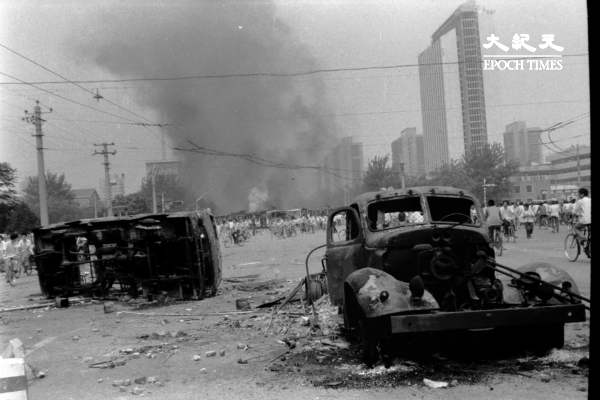
For 37 years, the Chinese Communist regime has been attempting to cover up the truth of the 1989 Tiananmen Square massacre, and trying to erase this bloody history through methods such as internet censorship. However, this has not stopped some young people from discovering the truth, often in unexpected ways.
On the early morning of June 4, 1989, the Chinese government used tactics like shooting with military forces and running over protestors with tanks to brutally suppress students and workers advocating for democracy, resulting in the shocking Tiananmen Square massacre that reverberated around the world. The bloody crackdown led to the deaths of numerous students and civilians, with some individuals fleeing overseas. That year, the image of a man in a white shirt blocking a tank gained global attention, with the West dubbing him the “Tank Man,” making it a symbol of the events of June 4.
Over the decades, the Chinese authorities have never admitted to any wrongdoing, instead actively trying to conceal the truth, suppress participants, and forbid the public from commemorating the event. On the Chinese internet, any content related to the protests and crackdown of June 4 will be filtered and deleted, even artificial intelligence models like DeepSeek engage in self-censorship on such topics. Nonetheless, Chinese youth manage to unexpectedly uncover the truth through various means.
According to a report by The Washington Post, on June 3, 2022, a student from Zhejiang province was watching a livestream by Li Jiaqi, a well-known mainland Chinese influencer dubbed the “King of Lipsticks.” During the livestream, the internet celebrity showcased a tank-shaped cake, prompting an immediate interruption of the broadcast.
The 18-year-old student told The Washington Post that she was puzzled by the sudden interruption of Li Jiaqi’s livestream and took it upon herself to circumvent the firewall to uncover what had transpired.
“When the truth was revealed, I saw not just the blood and tears of history, but also the collapse of my worldview that I’ve held onto for over a decade,” she said, requesting anonymity out of fear of reprisal. She now desires to leave China.
In February of this year, when American figure skater Alysa Liu won a gold medal at the Winter Olympics in Milan, her father, Arthur Liu (also known as Liu Jun), stirred conversations on the Chinese internet. Liu had participated in the 1989 Tiananmen Square protests and sought refuge in the United States after the crackdown. He stated that he would not allow his daughter to represent China in competitions due to concerns over the country’s human rights record under the CCP’s rule and ongoing human rights violations.
When Alysa Liu won the gold medal in Milan, some social media users in China labeled Liu Jun as a “traitor,” while others praised him as a single father who raised a champion.
On the Xiaohongshu platform, a user posted a query about why Liu Jun was so controversial. Anji, a 20-year-old university student from Wuhan, advised other users to research Liu Jun’s background. Within a few hours, her post was taken down.
“I didn’t expect the post to be removed at first, because I didn’t even directly mention the ‘June 4th incident’,” Anji said. Fearing government retaliation, she only agreed to be interviewed by The Washington Post using a nickname.
On Threads, a social platform under Instagram, a Chinese user started delving deeper into research after coming across information about Liu Jun.
“I can only say I was extremely shocked,” the user said. “I had no idea such a massive protest had taken place.”
Molly first heard about the Tiananmen Square incident in high school. A history teacher closed the classroom door before revealing the details. Many students were hearing about it for the first time. The 25-year-old Molly is pleased to see other young people learning about this history through following Alysa Liu’s story.
Margaret Roberts, a political scientist at the University of California, San Diego, noted that inadvertent disclosures about the Tiananmen incident often arise from entertainment content.
Roberts mentioned that a notable aspect of China is its high interaction with the world via the internet, yet it still maintains a highly complex information control system, significantly influencing how ordinary citizens consume information.
She also pointed out that when political information merges with entertainment content, it becomes particularly dangerous and challenging for governments attempting to censor, making it hard to handle.