
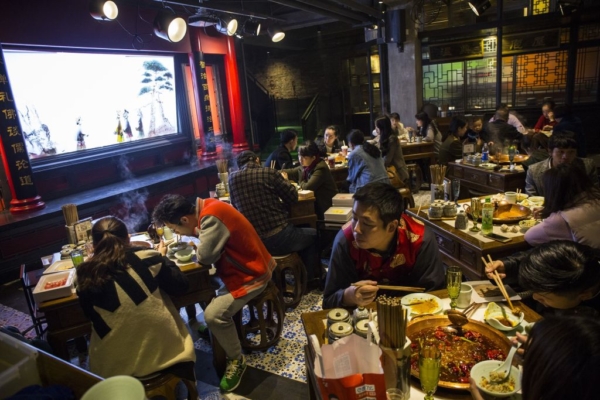
Recently, the chain hotpot brand “Shang Shang Qian,” co-founded by mainland singer Xue Zhiqian, has been exposed to have closed its last store located on Nanjing East Road in Shanghai. With this closure, the hotpot brand that once gained popularity due to celebrity endorsements has ceased all offline operations.
According to “Blue Whale News” on May 29th, all “Shang Shang Qian” stores are no longer in operation. In November 2025, after closing the last store in Guangzhou, only the Nanjing East Road store in Shanghai continued to operate nationwide. Recently, the Nanjing East Road store also closed down.
Public records show that “Shang Shang Qian” was co-founded by mainland singer Xue Zhiqian and his friend Li Yuanlin, with the first skewer hotpot restaurant opening in 2012. During its peak development, the brand had 8 self-operated stores and 20 franchise stores, with outlets in cities such as Shanghai, Guangzhou, and Hangzhou. According to reports from mainland media, in 2017, “Shang Shang Qian” store’s daily turnover was stable at around 1.5 million yuan.
In recent years, Xue Zhiqian himself has gradually withdrawn from any commercial relations with “Shang Shang Qian.” In February 2019, he withdrew from the shareholder list of the brand’s related company, Shanghai Shangqian Catering Management Co., Ltd., and was succeeded by his father, Xue Liangyuan. The company was deregistered in September 2021. Since then, the number of “Shang Shang Qian” stores has continued to decrease.
The situation of “Shang Shang Qian” is not unique. Many dining brands in the mainland entertainment industry, in which multiple celebrities have invested or been involved, have also faced store closures, operational disputes, or other challenges in recent years. For instance, dining brands such as “Xianhe Zhuang” founded by actor Chen He, “Huo Feng Xiang” in which Zheng Kai participated in investment, “Shao Jiangnan” involving Huang Xiaoming, and “Meng Fei’s Xiaomian” established by host Meng Fei have all garnered attention due to the influence of celebrity endorsements.
Previously reported by “21st Century Economic Report,” hotpot, as a food category, has a high level of standardization, limited reliance on chef skills, and relatively straightforward procurement and store opening processes, making it a popular choice for celebrity entrepreneurship. However, the sustained operation of these projects faces challenges such as consumer prices, food safety, decoration disputes, and franchise management. Public data also indicates that some celebrity dining companies have faced issues like deregistration or revocation of business licenses.
Food industry analyst Zhu Danpeng expressed to “First Financial” last year that celebrities typically do not directly participate in the actual operation of dining projects, which is usually managed by third-party teams. He believes that some teams may prioritize short-term profits, expand franchise numbers with the help of celebrity endorsements, but may lack finesse in operation and product innovation.
Another industry insider mentioned to mainland media that while celebrity dining establishments can initially attract consumers through celebrity endorsements, the subsequent operation depends on product quality, store management, supply chains, and service systems. Although hotpot restaurants are relatively easier to start, the restaurant industry differs from the entertainment industry, requiring professional operational capabilities for sustained success.