
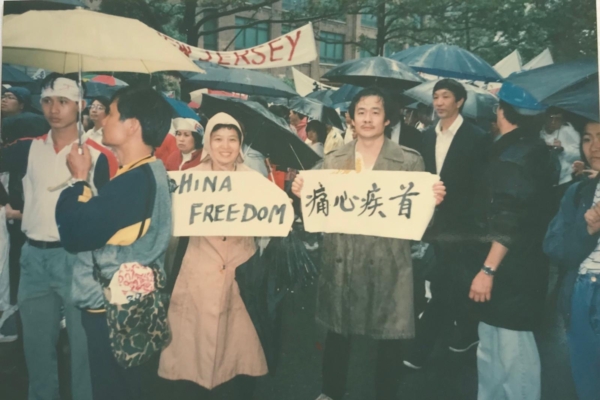
On June 4th, which marked the 37th anniversary of the Tiananmen Square massacre, overseas Chinese in New York City shared with media like us some precious photos that have been kept for 37 years. The photos highlighted the anger and protest of thousands of overseas Chinese in New York City who took to the streets following the massacre, denouncing the brutality of the Chinese Communist Party with banners that read “Broken-hearted” and “Blood debts must be repaid.” The massacre, which took place on June 4, 1989, saw the Chinese military open fire on the pro-democracy movement in Beijing, resulting in numerous casualties among students and civilians. This shocking event not only altered modern Chinese history but also deeply resonated with the Chinese community in New York City, thousands of miles away.
One immigrant to the U.S. in 1978, Ms. Chen, shared with us photos that her friend, Mr. Tang, had kept for 37 years. The slightly yellowed images captured the swift response of New York City’s Chinatown, university campuses, and Chinese community to the bloody events of June 4.
Ms. Chen recalled being at home in New York on the night of June 3rd, watching the television as the events unfolded, “I heard the sound of gunfire, watched the scenes, and cried in front of the TV. I never expected the Communist Party to actually open fire on the people; I felt deeply saddened and indignant.”
She remembered the TV screen suddenly going black that night, but the sound of gunfire still echoed in her mind, “After the Tiananmen massacre, the Communist Party distorted the truth, but no one believed their narrative because we all saw the shots being fired.”
According to Ms. Chen, upon witnessing the bloody crackdown on the student movement, overseas Chinese and students in New York City couldn’t contain their outrage and spontaneously organized protests and demonstrations. The first march took place in Manhattan’s Chinatown, where people gathered from Pell Street to Canal Street and then to Canal Street, spurred by calls to “support the students” and expressions of determination to take action even if it meant skipping work for the day.
She vividly remembered the rainy day of the Chinatown march, “It was pouring rain that day, and I kept crying, the media even captured me.”
“The initial Chinatown protest had about a thousand participants, and the subsequent large-scale demonstration near the United Nations far exceeded that,” she said. “People from all five boroughs came out, marching from the United Nations to Times Square on 42nd street, then to demonstrate in front of the Chinese consulate, so many people that the end of the line wasn’t visible.”
From the images in the old photos, banners bearing slogans like “Blood debts must be repaid,” “China Freedom,” and “Broken-hearted” could be seen, alongside people holding up recently published Chinese-language newspapers with headlines reading “Tiananmen Tragedy” and “Large numbers of PLA troops suppress,” informing passersby about the events in Beijing.
The photos depicting not only young students but also elderly Chinese immigrants, business owners, citizens, and individuals of different ethnic backgrounds. One protester held a sign in English that read, “China People’s Republic is a Joke,” expressing dissatisfaction and anger towards the authorities in Beijing.
For many participants of that time, June 4 was not just a political event but a crucial turning point in their lives.
After the events of June 4, American society paid close attention to the plight of Chinese students. In 1992, the U.S. Congress passed the “Chinese Student Protection Act,” allowing eligible Chinese citizens to adjust their status and obtain permanent residency. This was widely referred to as the “June 4 Green Card,” granting thousands of Chinese students the opportunity to stay in the U.S., with their families subsequently immigrating as well.
Ms. Chen emphasized that history may be covered up but will never truly disappear, and the truth may be suppressed but will never remain silent. The continuous unearthing and revelation of the photos from the June 4, 1989 events serve as a reminder to refuse to forget and to maintain a sense of conscience.
* From Street Protests to Providing Support for Exiled Students*
After June 4, the Chinese community in New York City not only took to the streets to protest but also swiftly engaged in assisting exiled students and activists.
Ms. Chen mentioned that during the “Operation Yellowbird” to help fleeing student leaders and dissidents from China, New York City became a crucial landing point for many exiles, “Many rescued individuals’ first stop was New York.”
She recounted that the Chinese Journalists Association played a critical role in the reception efforts and collaborated with the Chinese Consolidated Benevolent Association in organizing large welcoming banquets and fundraising events at Silver Palace Restaurant in Chinatown to help the exiles settle in. The first batch of exiles to arrive in New York included student leaders such as Wuer Kaixi, Li Lu, intellectual Yan Jiaqi, and businessman Wan Runnan.
She noted that the Chinese community at the time widely empathized with the student protesters and dissidents, with many overseas Chinese voluntarily donating money, providing accommodations, or assisting in arranging onward journeys to help these exiled individuals start new lives in various parts of the U.S. and even in third countries.