
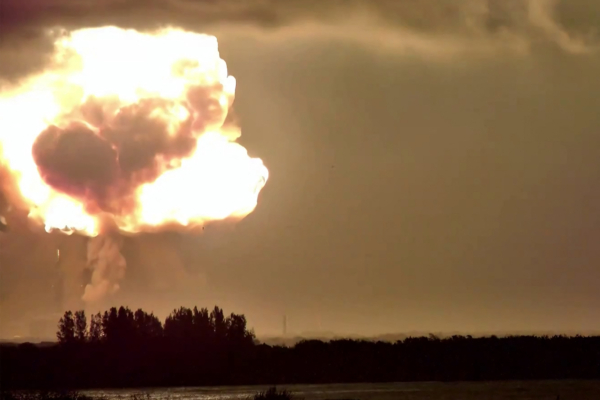
Amazon founder Jeff Bezos’ aerospace company, Blue Origin, faced a major setback on Thursday, May 28th, as its heavy-lift rocket, New Glenn, suffered an explosion during a ground test at Cape Canaveral in Florida, turning the scene into a massive fireball with thick smoke billowing.
Official sources confirmed that no one was injured in the incident and there was no threat to the public, as all personnel had been evacuated.
The accident occurred at 9 p.m. Eastern Time on Thursday when New Glenn was undergoing a hot-fire test at the U.S. Space Force launch site, which involves igniting the engine while the rocket is fixed to the ground.
According to social media and live broadcast footage, the 29-story rocket exploded shortly after ignition, sending flames and smoke shooting into the sky.
Jeff Bezos, the founder of Blue Origin, later confirmed the “anomaly” on social media, stating, “It was a difficult day, but we will rebuild any parts that need to be rebuilt and return to flight. It’s all worth it.”
Bezos added that it is too early to determine the root cause of the accident, but the company has initiated an investigation.
Jared Isaacman, the administrator of NASA, expressed that NASA will support Blue Origin’s accident investigation and assess the potential impact of the incident on the Artemis lunar mission and moon base construction.
Coincidentally, just the day before the incident, NASA had awarded Blue Origin with a contract worth $188 million.
Isaacman lamented, “Spaceflight does not tolerate mistakes, and developing new heavy-lift launch capabilities is extremely challenging.”
Elon Musk, CEO of Blue Origin’s competitor SpaceX, also responded to the news on social media, writing, “Very unfortunate. Rocket development is indeed very difficult.”
The damaged New Glenn was originally scheduled for its fourth launch mission, intending to carry 48 satellites for Amazon’s Amazon Leo project to challenge the Starlink network. Fortunately, the satellites had not been loaded onto the rocket at the time of the explosion.
The Federal Aviation Administration (FAA) has been informed of the incident, but due to the explosion occurring during a ground test and not affecting regional air traffic, no further regulatory actions have been taken at present.
This accident undoubtedly adds a variable to Blue Origin’s race to catch up with SpaceX and puts pressure on the reevaluation of the timeline for American astronauts to return to the moon in 2028.