
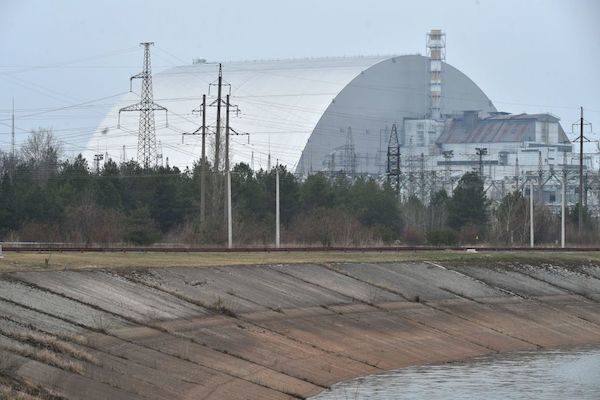
Ukrainian President Zelensky stated on Sunday (June 7th) that the Russian military intentionally attacked a spent nuclear fuel storage facility near the Chornobyl nuclear power plant in Ukraine. Fortunately, this attack did not result in increased radiation levels.
Zelensky condemned the use of the “Shahed” drones by the Russian military to target the facility for storing waste nuclear fuel as “an extremely despicable attack.” He mentioned that the Ukrainian Ministry of Foreign Affairs, Ministry of Energy, and other government departments are collaborating with Ukraine’s partners to investigate this attack.
“This is an extremely critical piece of infrastructure,” Zelensky wrote on social media. “As of now, there have been no readings above normal background radiation levels.”
He criticized, “Russia’s brazenness is undoubtedly escalating and has long crossed the line.”
The Ukrainian state nuclear power company Energoatom stated that there was no spent fuel stored inside the building at the time of the attack. Ukrainian emergency responders extinguished the large fire at the facility after the attack, and there are currently no reports of casualties.
The International Atomic Energy Agency (IAEA) reported that the attack severely damaged a fuel reception building, which was only a few meters away from where “a large amount of nuclear material” is stored. The agency mentioned that Ukraine has notified them about the situation.
The IAEA Director General Rafael Grossi expressed deep concern in a statement, emphasizing that attacks on nuclear facilities are “completely unacceptable and directly violate key principles of nuclear safety.”
The IAEA also mentioned that they will soon dispatch a team to the site to “assess the impact.”
As of now, Russia has not publicly admitted to launching this attack.
In February 2025, a Russian “Shahed” drone had damaged the protective dome above a reactor at the Chornobyl nuclear plant. The reactor had been destroyed in an explosion in April 1986, resulting in a leak of over 8 tons of radioactive material, which led to the worst nuclear disaster in human history up to that point.
(Reference: Reuters)