
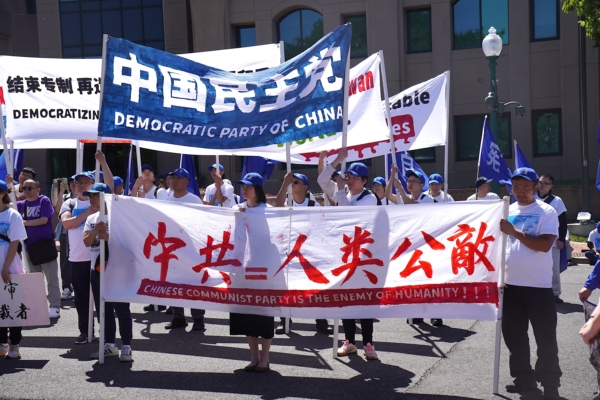
Overseas democracy elites have released a series of June 4th songs for the third consecutive year. This year, they have launched a new song expressing the deep love of overseas children for their motherland, the pursuit of freedom and democracy, and calling for the replacement of the old regime of the Chinese Communist Party. This has sparked more resonance.
This year marks the 37th anniversary of the Tiananmen Square massacre. More and more long-hidden photos and videos have been released, allowing people to see the passionate and firm beliefs in the midst of blood and fire. People firmly believe that “from that moment on, the Chinese people awakened, and a new era began.” June 4th has been forever etched in history, its spirit indelible.
“The pursuit of freedom is better than death” has become a spirit upheld by many passionate Chinese youth.
Jiang Pichao, editor of the “June 4th Poetry Collection,” president of a wealthy real estate company in the United States, and director of the June 4th Cultural Communication Association, said in an interview with reporters that every June in cities like New York, Los Angeles, and Sydney, people come to express their grief, vent their ideals, express their demands for the vision advocated during June 4th, and speak out for their conscience, which cannot be suppressed and stands far above those with low spirits, a spirit that will endure.
Jiang Pichao has been creating and releasing June 4th songs since 2024, and this year’s “Motherland” has been praised for its combination of artistry and political themes.
The lyrics read:
The motherland, weary of their hands, will no longer rest
They see me galloping on a spirited horse
Why am I still rubbing sticks for fire
…
The fiery alcohol I brew has already allied with the fallen bones in June
The spring we’re waiting for
Will bloom every year in the June spring
The remains of centuries will nurture my spirit of a thousand years.
Jiang Pichao told the reporter that in China, the authorities’ promotion of the motherland only represents the Chinese Communist government. The true motherland includes a large portion of elites living overseas, who are treasures of China, a group of passionate individuals with talent, ideals, and aspirations.
“Because of these individuals, the Chinese Communist Party dares not to act audaciously like Hitler against the Chinese people, and there are still many political and cultural elites detained within China, as well as figures like Jimmy Lai, Martin Lee, and Albert Ho in Hong Kong, who are the true conscience of Hong Kong.
“And these individuals of the CCP have dragged down such a good country. This country should have been thriving and prospering. The old regime of the CCP has fallen far behind the times, leading to the fundamental extinction of people’s freedom, human rights, and democracy. Therefore, to adapt to the development under the new situation, adapt to the tide of democracy, and provide the people with what they truly need, let universal values replace dictatorial authoritarianism.”
One of the advisors for the song, Kang Zhengguo, a retired teacher from Yale University and a witness to the June 4th incident, shared and reflected on this history with reporters.
In May 1989, Hu Yaobang passed away. Under the severe rule of the Communist Party, any protest on a campus would immediately face harsh suppression. Students took the opportunity to protest their dissatisfaction with reality by commemorating Hu Yaobang, such as the skyrocketing prices and privileged individuals profiteering by selling scarce foreign goods, known as official profiteering.
At that time, Kang Zhengguo was teaching at Xi’an Jiaotong University, offering a popular course on the appreciation of Tang and Song poetry with over a hundred students. When the sit-in at Tiananmen Square began, approximately a third of his students went to Beijing, leading to a quieter classroom.
However, Kang Zhengguo did not participate in the student activities as he didn’t believe that the Communist Party would relinquish its proletarian dictatorship through peaceful sit-ins and students pleading with the authorities.
“This was not due to my cowardice,” Kang Zhengguo, hailing from a landlord family, had never written an application to join the Communist Party. He loved reading and writing diaries, having enrolled in Shaanxi Normal University in 1963. During an anti-revisionist political movement in 1964, the school accused him of “reactionary thinking” and burning reactionary diaries, resulting in his expulsion and subsequent re-education sentence.
In the early morning of June 4, 1989, Kang Zhengguo listened to Voice of America and Taiwan’s Central People’s Broadcasting Station’s truthful reports on the Tiananmen Square massacre on the night of June 3. He also heard that over 40 students from his university had been crushed by tanks while protecting the Statue of Liberty (later confirmed as fake news). In defiance of his wife’s attempts to dissuade him, Kang Zhengguo wrote “Aim here” on a piece of paper, pinned it to a T-shirt, wrapped a white cloth around his head, and rode a bicycle to Xi’an’s New City Square.
“As a teacher, with students of mine being crushed by the illustrious Communist government’s tanks, if I didn’t express anger, I wouldn’t be worthy of being a teacher. My actions were not purely political but ethical. I have always been involved in politics, but I’m not a political person; I’m a defender of humanity,” he said.
Throughout the entire citywide protest march, even members of the Marxist-Leninist study department began joining the student protests. During the march, Kang Zhengguo keenly observed people taking photographs and videos. By June 7 and 8, the Ministry of Education ordered universities nationwide to be on holiday. On August 15, universities nationwide reopened, commencing a 50-day cleanup campaign.
Kang Zhengguo underwent several months of investigation by the Public Security Bureau and was denied the opportunity to apply for a senior position due to his involvement in the events of June 4. Other teachers were also arrested for giving speeches.
In the summer of 1990, Kang Zhengguo received a letter from Yale University in the United States, as his works had garnered attention from international scholars. In the summer of 1993, Kang Zhengguo attended a conference at Yale University on classical literature and women’s studies. In the spring of 1994, he was invited to teach at Yale University.
Recalling the process, Kang Zhengguo underwent rigorous scrutiny, with a need to “sanitize” before leaving the country, not allowed to say this or that. Due to his records at the public security bureau, he had to attend safety courses and sign off on video sessions detailing what to say and do.
Even his submitted conference papers had to be reviewed by authoritative professors in his department to check for any ideological issues. As he specialized in classical literature, an older professor remarked, “The starting point is historical materialism,” eventually passing the review.
Therefore, Kang Zhengguo believes that with China’s economic changes and the popularity of various cultural trends, the freedom of expression, scope, and space today are much larger than during June 4. Essentially, what was previously considered decadent assets of the bourgeoisie have returned. Not only are they not prohibited but they are also being tolerated and amplified, as long as they do not defy the party or challenge Xi Jinping’s basic principles.
He observed that the June 4 students acted out of sincere desires, opposing official profiteering, hoping that the party central would eradicate these elements. However, the current situation highlights that the entire party central and various regions have succumbed to this official profiteering. It has evolved into a powerful and prosperous social system with an increasing number of participants. Furthermore, this corruption has infiltrated academic fields.
“As long as the Communist Party holds power, there is no possibility for democracy in China,” he said.
Regarding the essence of the CCP, Kang Zhengguo mentioned his 2015 book published in Taiwan, “Restoring Mao’s CCP: From Parasitic Survival to Enigmatic Transformation,” where he described the Communist Party as akin to the demons in Journey to the West—after enduring and surviving through bloodsucking, they have become sophisticated entities.
“The Communist Party originated from a peasant uprising and, under the support and influence of the Soviet Bolsheviks, engaged in armed struggle, absorbing what was termed as the lower-middle peasants or the disenchanted individuals during the Republic of China era, mainly the fringe members of society. Without the invasion by Japan, the CCP would have been eradicated by the Nationalist Army long ago, making it an unfortunate twist in Chinese history.
“Without Soviet intervention and the Truman administration’s misguided approach during the civil war, instead of robustly supporting the Chinese people, even sabotaging them, the CCP faced destruction but flourished again, overturning the nationalist government, consequently altering the fate of China. It was an incredibly ironic and unfortunate turn for the Chinese people.”
These are the sentiments and reflections shared by Kang Zhengguo, a man whose experiences paint a vivid picture of the tumultuous history of China.