
On Saturday, May 30, General Rob Magowan, commander of the UK Cyber and Special Operations Command (CSOC), stated during the Asia-Pacific Security Summit “Shangri-La Dialogue” in Singapore that the dispatch of British warships through the Taiwan Strait is to demonstrate the freedom of navigation and uphold the United Nations Convention on the Law of the Sea (UNCLOS).
General Magowan emphasized the importance of UNCLOS in promoting trade and freedom of movement for people, which in turn ensures global economic prosperity. He highlighted that no country should unilaterally designate “no-go” areas, as the North Sea, English Channel, and Irish Sea are open waters belonging to the global public.
Furthermore, General Magowan mentioned the UK’s strong relationships with allies in the Indo-Pacific region, expressing the UK’s determination to stand alongside them in the face of threats.
The General made these statements during the annual “Shangri-La Dialogue” organized by the International Institute for Strategic Studies (IISS) in Singapore. Other speakers at the event included high-ranking officials and military leaders from the US, Indonesia, Greece, as well as former Chinese Vice Foreign Minister and Ambassador to the US, Cui Tiankai.
While General Magowan’s prepared remarks did not directly mention the Taiwan Strait, questions during the dialogue brought up the issue. When asked about concerns regarding a blockade of the Taiwan Strait potentially disrupting the global semiconductor supply chain, Cui Tiankai emphasized that the situations in the Taiwan Strait and the Strait of Hormuz were fundamentally different.
It is noteworthy that the UK has reiterated the importance of freedom of navigation in the Taiwan Strait in previous “Shangri-La Dialogues”. Last year, Admiral Tony Radakin, then Chief of the Defence Staff of the UK, publicly emphasized the significance of upholding UNCLOS principles, including in areas such as the Taiwan Strait and South China Sea.
The English Channel, with its narrowest point of about 34 kilometers at the Dover Strait connecting the North Sea, overlaps the territorial waters of both the UK and France but does not impede international shipping. In contrast, the Taiwan Strait, approximately 126 kilometers wide at its narrowest point, faces efforts by Beijing to assert control through military exercises and gray zone actions, aiming to restrict international waters.
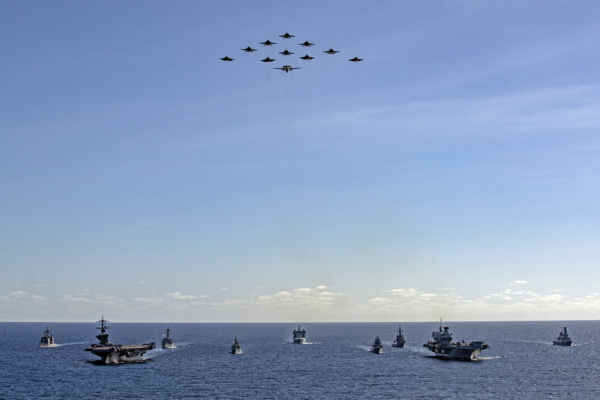
Last September, a British aircraft carrier strike group, including the frigate HMS Richmond, crossed the Taiwan Strait. The UK Ministry of Defence stated that the Royal Navy’s actions adhere to international law and norms, with the transit through the Taiwan Strait considered a routine passage exercising freedom of navigation rights.
Today, Vice Admiral George Rowell of US Indo-Pacific Command commented on the issue of warships traversing the Taiwan Strait, emphasizing that the US conducts freedom of navigation operations not only in the Taiwan Strait but also worldwide, taking into account various factors beyond potential adversaries.
Vice Admiral Rowell also expressed the US’s desire for improved military-to-military communication with China, noting current challenges in making progress in this aspect.