
The Beijing’s aberrant global industrial policy is disappointing. Unlike normal economies, the Chinese Communist Party does not intend to naturally pass on low-end industries to other countries, but aims to simultaneously hold onto upstream, downstream, and various manufacturing sectors, making it difficult for other countries to take over. The deformed economic policy of the Chinese Communist Party is causing global harm.
The Economist recently pointed out Japan’s economist Akamatsu who proposed the “Flying Geese Paradigm” in the 1930s, explaining the “import→domestic production→export” cycle of Japanese textile industry, which was later extended as a dynamic model for the economic development of the Asian region. The core metaphor is the migration of a flock of geese: the leading goose blazes the trail, faces the headwinds, while the geese behind follow sequentially, upgrading industries step by step.
The most classic example of the “flying geese model” is the rise of the Four Asian Tigers, representing South Korea, Taiwan, Hong Kong, and Singapore. With Japan’s economic prosperity and wage increases, labor-intensive industries shifted from Japan to emerging players like South Korea and Taiwan.
Many have long hoped that China could also bring similar growth dynamics to other poorer countries. However, this wish seems increasingly unlikely to materialize.
In a new paper, Shoumitro Chatterjee from Johns Hopkins University and Arvind Subramanian from the Peterson Institute for International Economics point out that despite China’s rising wage levels and the maturation of its manufacturing industry, it still holds “historically high shares” in low-end manufacturing.
Developed countries like Germany are now worried about China venturing into high-end industries, and even relatively poorer countries are questioning when Beijing will be willing to give up the low-end market and create space for them.
Finished products are commonly classified into four categories: low-tech, medium-tech, high-tech products, and products based on natural resources (such as refined petroleum).
A study by the China Finance 40 Forum (CF40) found that from 2010 to 2024, China’s share in global exports of the four categories of finished products has been increasing, indicating that China’s manufacturing sector is competing with all countries.
In some cases, China’s share of manufacturing should be even larger than its export data suggests because China is also a key exporter of raw materials for labor-intensive product manufacturing, which may be sewn or assembled into final products elsewhere.
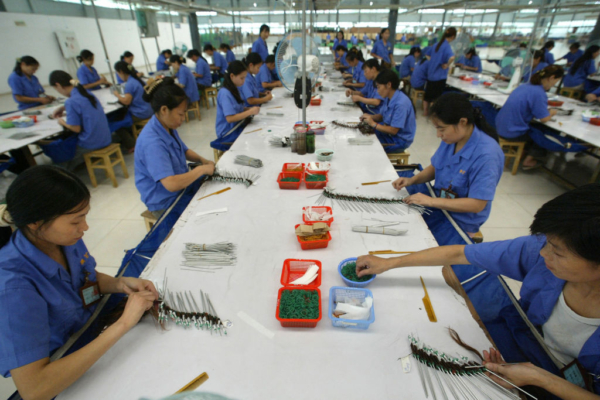
In 30 low- and middle-income countries with relevant data, China provides 64% of the total exports of clothing, textiles, leather, and similar products. This proportion is much higher than the percentage of the labor force in China’s equivalent income group.
So, what has caused this peculiar phenomenon? Development economist Lant Pritchett pointed out in 2010 that under the rule of the Chinese Communist Party, China’s economy is not a flock of geese but a “population pterosaur,” too massive in size.
Another factor is the extreme imbalance in China’s economic development, with extremes of wealth and poverty coexisting. The wealthiest four cities in China, with a total population of 84 million, have a per capita GDP higher than Japan. Meanwhile, the income levels of the four poorest provinces, with a population of 140 million, are comparable to Vietnam. They state that China’s economic situation is equivalent to 0.7 Japan, nearly 6 Malaysia, 5 Mexico, 4 Thailand, and 1.4 Vietnam. It is no wonder that China is competing with all countries.
Rhodium Group, a US research firm, recently released a report finding that the Chinese Communist Party is advancing a “comprehensive industrial policy” that covers almost all industries and regions, emphasizing both goods and services, as well as cutting-edge and traditional sectors.
The policy framework encompasses cutting-edge technologies, mature industries, and basic supply chain nodes. In a 2023 updated policy guidance, Beijing included mature industries such as household appliances and textiles.
In 2016, China occupied over half of the global export volume in 163 industries (according to international standards). However, from 2021 to 2024, this number almost doubled, increasing from 192 to 315 categories.
The report points out that this round of economic expansion is taking place under a more constrained macroeconomic environment in China, with Beijing enhancing control over fiscal spending, bank loans, capital markets, and the national investment fund. At the same time, China’s economy is facing challenges of slowing growth, weak domestic demand, rising fiscal pressures, and declining capital allocation efficiency.
Although authorities verbally acknowledge the need to address industrial imbalances, their policy responses have been inadequate. In addition, the policy efforts to stimulate consumption are limited, and the underlying issue of weak demand remains largely unresolved.
Columnist Greg Ip from The Wall Street Journal wrote that beyond the halo of advanced manufacturing, the Chinese economy is stagnant, weighed down by debt, deflation, and an aging population.
Many critics expect and even hope that under the heavy pressure of its own contradictions, the Chinese Communist Party’s industrial policy will eventually collapse. However, the exact timing of this event remains unpredictable.